The Lost Davenport Felt Table and the Suit That Stayed Unplayed
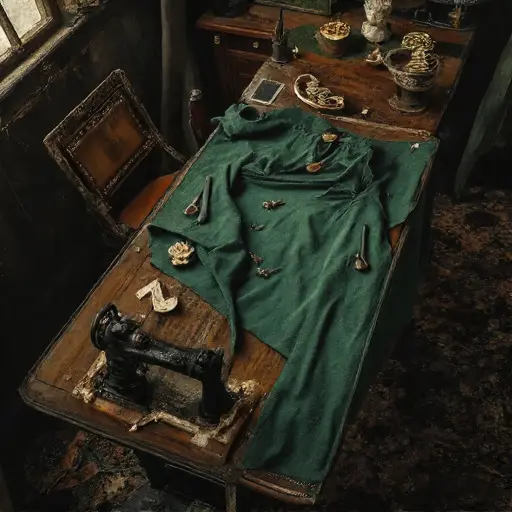
The Cutting Room seems to breathe in slow suspension. The felt table’s surface bears faint chalk outlines for a suit jacket, the left front panel neatly mapped while the right remains untouched. A pair of shears stands partly open, their blades glinting in half-shade.
A measuring tape coils near the hem marks as if dropped mid-calculation. Even the tailor’s pressing ham on the sideboard sits slightly off its usual axis. Nothing is disorderly, yet everything is stilled, as though the room’s habitual rhythm paused before the final shape could emerge.
Craft in the Hands of Edgar Lionel Davenport, English Tailor
Clues from the furnished interiors evoke Edgar Lionel Davenport, born 1871 in Manchester, trained in modest draperies where precision was a quiet creed. In the Pattern Alcove, folded muslin drafts labeled in English script rest atop wooden slopers. His shears—heavy Sheffield steel—reflect years of dutiful service. Along a narrow shelf lie bundles of tailor’s canvas, each tagged with careful measurements, speaking of a man who worked with a disciplined calm, attentive to the subtle geometry of garments.
Edgar’s typical day likely began with drafting patterns, afternoons devoted to basting and fitting, evenings to pressing seams into crisp lines. In the Side Parlour, two completed waistcoats hang beneath a dusting cloth, their welt pockets crisply squared. A pincushion embroidered with his initials sits next to a cup of cooled tea—evidence of a craftsman steady, courteous, and methodical, shaping personality into fabric through quiet choices.
Subtle Unravelings in a Skilled Routine
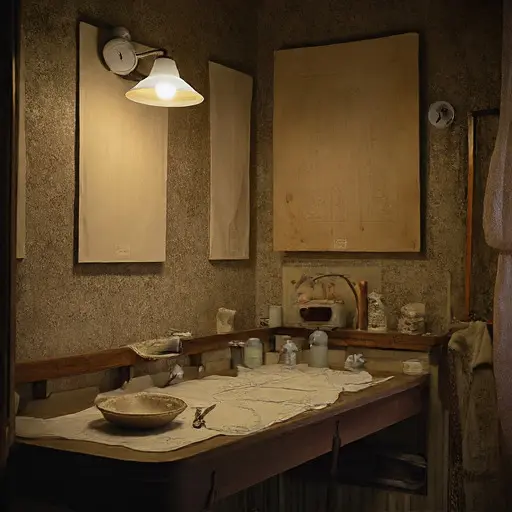
Faint disturbances settle through adjacent rooms. In the Upper Washstand Chamber, a cracked soap dish holds chalk-smudged water, as though Edgar rinsed his hands with undue haste. A letter from Leeds, its seal broken, lies untouched—perhaps carrying a cancelled commission or overdue payment. On the Guest Cot, a travel coat wraps only a tailor’s awl and a torn swatch book, insufficient for travel yet oddly curated.
Inside the Pressing Closet, a tailor’s ham bears a scorch mark from misjudged heat. The treadle machine shows a broken thread trailing loosely into its shuttle. Perhaps fatigue crept into his fingers; perhaps financial pressures narrowed his choices; perhaps grief, slow and unresolved, frayed the focus that once held his craft in perfect tension. Nothing confirms the cause, yet each misalignment murmurs of a quiet undoing.
A Collar Turned Against Expectation
Returning to the Cutting Room, the half-assembled collar at the felt table becomes the fragile center of the mystery. Its undercollar has been stitched at a slight slant, basting threads crossing in places where Edgar’s hand should have been impeccably sure. The chalk outline beneath wavers, the guiding line drawn twice, as though corrected mid-gesture. A tailor’s thimble lies overturned near a basted seam, its interior catching the lamplight.
A pattern weight rests off its usual position, skewing the muslin draft underneath. The needle stuck in the collar’s edge has bent very slightly, the sort of bend born from an uncertain push or a faltering grip. On the treadle machine, a strip of tweed remains caught beneath the presser foot, abandoned before the first strengthening stitch.
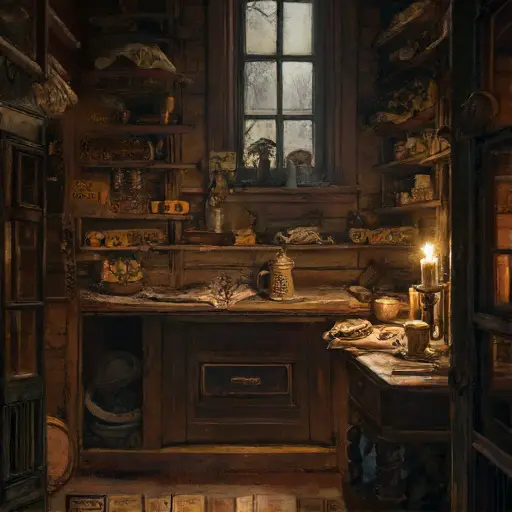
Behind the felt table, half-under a bolt of tweed, rests Edgar’s last attempt: a jacket front with its dart mis-shaped, the seam puckered where his needle once moved with certainty. The chalk guideline ends abruptly, trailing into blank cloth as though his intent dissolved between one breath and the next.
The house offers no clarity, and it remains abandoned still.