The Veiled Kübler Engraving Vise and the Line That Strayed
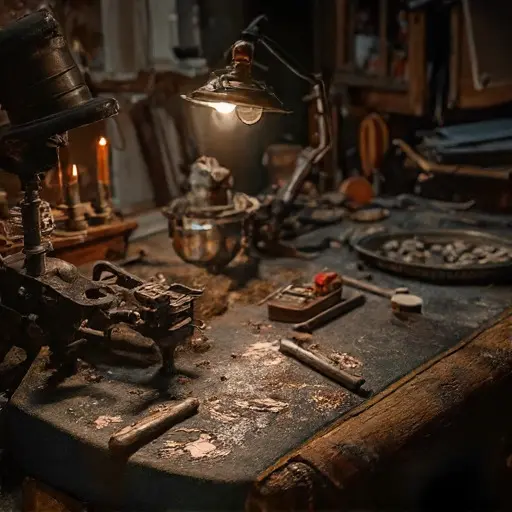
The Engraver’s Room stills into a tender quiet, each tool arranged with the precision of a habit sustained for years. The walnut bench smells faintly of oil and metal dust. A copper plate waits in the vise, its unfinished scrollwork stopping at an uncertain angle.
A square of linen stiffened with filings lies folded nearby. In this hush, the idea of an edge feels strangely vivid—not only the plate’s boundary, but the brink where purpose once steadied the craftsman’s hand before something subtle intruded and unsettled the rhythm.
The Steady Craft of Jonas Friedrich Kübler, Alpine Engraver
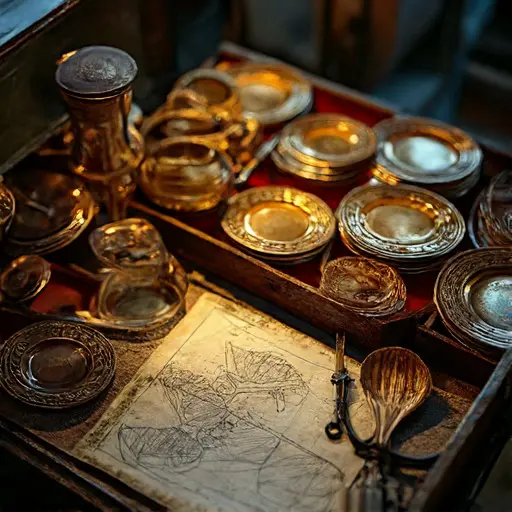
Fragmented signs across the furnished rooms sketch the life of Jonas Friedrich Kübler, born 1870 near Lake Lucerne, trained in modest Alpine workshops known for knife etchings and decorative metal plates. In the Pattern Drawer Bay, plates etched with Swiss floral borders sit in narrow stacks, each design rendered with delicate confidence. His burins show years of practice—their handles polished, their tips sharpened to bright, assertive points.
Jonas’s mornings likely began with warming a lamp to soften pitch beneath metal blanks. Midday, he would carve rosettes and geometric borders for local tradesmen; nights, he refined commissions sent from Zurich merchants. In the Side Parlour, a pair of finished silver plaques hangs above a mantel: one bearing an Alpine crest, the other a tender branch of fir cones. Dust halos each surface but does not mute their careful symmetry; the room seems shaped by a mind that revered small accuracies.
Subtle Slippages in a Once-Sure Practice
Disquiet murmurs through several adjoining rooms. In the Upper Washstand Chamber, a bowl of rinse water holds a cloudy swirl of metal dust—left longer than usual, drying in a gritty ring. A letter from Bern, its seal broken but message unread, lies on the washstand; its edges bear the faint marks of anxious handling. On the Guest Cot, a travel wrapper encloses only a single dull burin and a cracked magnifier, insufficient for any true departure.
In the Tool Closet, one sharpening stone lists at a tired angle; filings scatter asymmetrically across the shelf. A bundle of pitch sticks has partially melted onto its cloth, as if forgotten near heat. The evidence hints at a growing frailty—perhaps dimming eyesight or financial strain—made manifest not in chaos, but in tiny inconsistencies where Jonas once excelled.
A Subheading Drawn to the Edge of Doubt
Returning to the Engraver’s Room, the unfinished plate held in the vise becomes the most telling relic. The scroll line closest to the edge falters, thickening by a hair’s breadth and wavering just before a turn he had executed perfectly countless times. A burin rests across a leather roll, its blade bearing a fresh nick where the metal resisted or his hand slipped. A lamp wick hangs longer on one side, dripping soot onto the crucible’s rim.
The bench stool sits slightly skewed, angled away from the vise. A strip of tracing paper pinned to the wall shows tentative redrawn lines, shakier than the bold curves beneath. Even the pitch tray beneath the bench reveals uneven cooling, suggesting a tool had been set down suddenly, altering the heat.
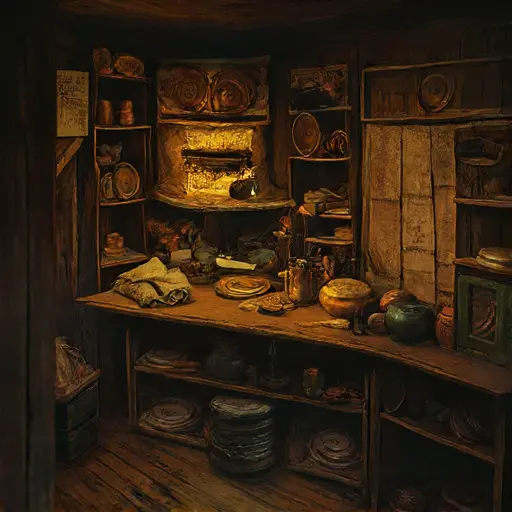
Behind the engraving vise, tucked near a crate of unused blanks, lies Jonas’s final attempt: a silver plate whose lower border drifts off-pattern by a breath. The guiding line ends abruptly, the cut thinning until it disappears mid-curve. No explanation follows—only the small, wavering mark of a craftsman whose precision faltered in silence.
The house gives no answer, and it remains abandoned still.