The Forgotten Havel Annealing Shelf and the Shape That Softened
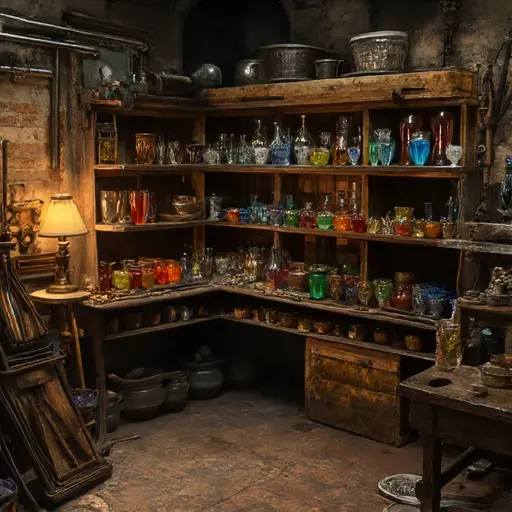
The Glassblowing Room glows faintly in wavering lamplight; furnace heat has long faded, yet the scent of scorched sand lingers. A half-shaped vase rests on the annealing shelf, its rim uneven—a single tremor frozen into transparency. On the workbench, shears lie unmatched, one arm slightly off its usual angle.
A cooled gather shows a faint glimmer of iridescence where the molten body thinned too soon. Nothing is tipped or broken, yet each object seems suspended between intention and faltering resolve.
Glimmer in the Work of Václav Ondřej Havel, Glassblower
Clues stitched through the furnished spaces reveal Václav Ondřej Havel, born 1873 in Jablonec, shaped by Bohemian workshops famed for carved and tinted glass. In the Crucible Corner, clay pots hold remnants of cobalt and manganese, each labeled in Czech script. Blowpipes lean in neat rows along an iron trough, their grips wrapped in scorched cloth. His temperament emerges in the careful parade of samples on the windowsill—cut-glass medallions etched with starbursts, each edge polished with reverence.
His days likely began at the furnace, gathering molten glass with a steady breath, coaxing shape through patient rotation. Afternoons brought him to carving wheels where he incised delicate patterns; evenings, to the annealing shelf, where cooling pieces fixed his judgment into their slowly stiffening form. In the Side Parlour, a cluster of finished Bohemian vases gleams beneath a dust-softened cloth, their smooth contours testifying to years of disciplined rhythm.
Signs of Uncertainty Stirring in the Heat’s Aftermath
Soft disruptions surface elsewhere. In the Upper Washstand Chamber, a bowl of cooling water shows a cloudy ring—evidence of quenched tools forgotten too long. A letter from Prague, its seal broken and ink blurred, rests beside a cracked mirror. On the Guest Cot, a travel coat encloses nothing but a protective glove and a broken paddling block, neither sufficient for real departure nor casual storage.
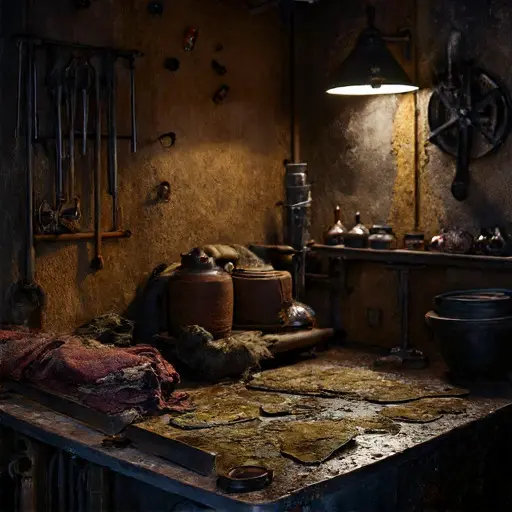
Within the Tool Cabinet, one carving wheel leans at an angle, its axle newly scratched. A bundle of canes has toppled sideways, their hues misaligned. Perhaps uneven commissions, or a creeping weakness in sight, or a refusal from a prominent patron pressed upon his steady routines. The disturbances murmur softly, but never resolve.
The Softened Vessel on the Annealing Shelf
Returning to the Glassblowing Room, the sagging vessel on the annealing shelf commands attention. Its rim droops a few millimeters more on one side, a deviation subtle yet unmistakable for a master of symmetry. A strip of wetted newspaper—used for shaping freshly gathered glass—stiffens on the bench, its edge charred unevenly. A blowpipe nearby bears a fresh scorch across its wrapping, as though handled with sudden misjudgment.
Scattered cullet along the floor creates a delicate constellation of glass shards; each fragment glints faintly. The carving wheel’s foot pedal lies partially depressed, caught in a position neither fully released nor engaged. Even the furnace shovel has been set down with its handle touching the wall at an odd angle, contradicting the careful placement typical of his practice.

Tucked behind the annealing shelf, near a crate of unused canes, lies his final attempt: a small bowl whose base flattens abruptly, the rotation once required to perfect its shape abandoned mid-turn. The interior curve dims into a cloudy patch, as though his breath faltered before the glass could settle. No annotation follows—only a form left questioning itself.
The house keeps its silence, and it remains abandoned still.