The Haunting Duval Infusion Cabinet and the Scent That Drifted
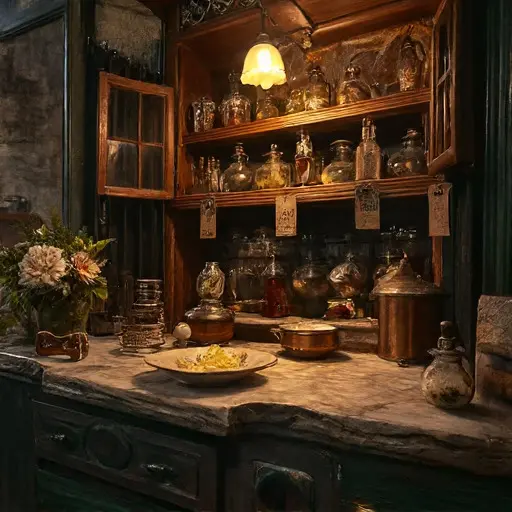
The Perfumer’s Atelier folds itself around a warm, resinous hush. At the center, the infusion cabinet stands half-open, its hinges stopping just short of a confident click. On the marble worktable nearby, a copper funnel leans toward a jar whose liquid meniscus wavers in a fragile tilt.
A muslin filter stiffened with dried tincture lies abandoned beside shears. Nothing spills or shatters, yet every object carries a faint drift of expectation—something paused between intention and regret, the air thick with a sweetness that has nowhere left to settle.
The Composed Practice of Émile Laurent Duval, Perfumer of Provence
Subtle arrangements reveal Émile Laurent Duval, born 1876 in Avignon, apprenticed among modest Provençal scent-makers. In the Maceration Niche, glass jars etched with French botanical names—lavande, fleur d’oranger, vétiver—stand in careful columns. Cotton wicks used for testing volatility coil beside porcelain spatulas. His temperament surfaces in these steady alignments: a man who trusted patient extraction over haste, letting flowers yield their truth drop by drop.
His days likely began with crushing petals at dawn, steeping them into warm alcohol, then refining tinctures in long, measured cycles. In the Side Parlour, small flacons of earlier creations rest on a lace runner: violet water, a mild rose accord, a cedar blend touched with faint citrus brightness. These bottles glow softly beneath dust, suggesting a quiet pride and restrained ambition shaped by the rhythms of perfume craft.
Where Unsteadiness Crept Between Notes
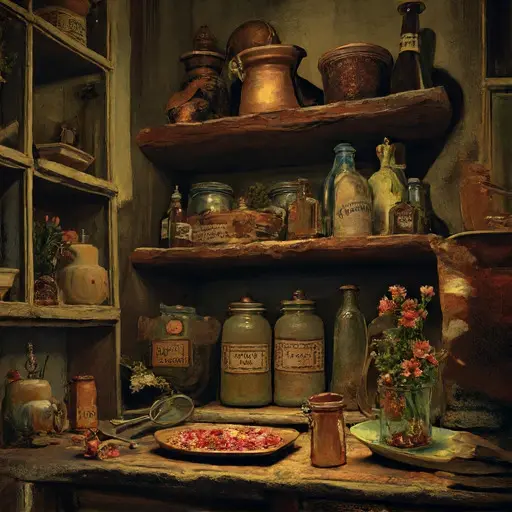
Hints of strain ripple gently through the rooms beyond. In the Upper Washstand Vestibule, a cracked bottle of alcohol spills a thin arc along the basin, its vapors sharp. A letter from Grasse, softened by moisture, lies unread on the washstand—its torn crest from a supplier known for exacting demands. On the Guest Cot, a travel cloak encloses only two droppers and an empty flacon, not enough for true departure yet too purposeful for casual misplacement.
In the Storage Press, a bundle of dried jasmine appears unevenly cured; the petals have browned along one edge, a detail Émile would never have ignored. Even the small copper still used for enfleurage shows a streak of dark residue down its side, as if heated without proper stirring. Nothing suggests chaos, yet everything hints at a craftsman whose measured grace had begun to waver—perhaps from mounting debt, a faltering hand, or news he could not bring himself to read.
A Whisper Around the Essence Left Adrift
Returning to the Perfumer’s Atelier, attention gathers around the single vial of essence resting apart from its crate in the infusion cabinet. The label bears Émile’s delicate script, but the final flourish trails off, the ink thinning as though interrupted by a tremor or sudden reconsideration. The cabinet’s interior shelves show faint dust shadows where other vials once stood, recently moved or removed. A glass pipette lies at an odd angle across a folded cloth, its tip stained by a drop of tincture left to dry.
On the marble worktable, a parchment record of his latest experiment shows carefully logged proportions—bergamot, rose absolute, a trace of benzoin—until the last line, where the quantities waver and blur. The warmth of the room feels strangely uneven, as if a candle had been extinguished too abruptly, leaving a soft imbalance drifting through the notes.
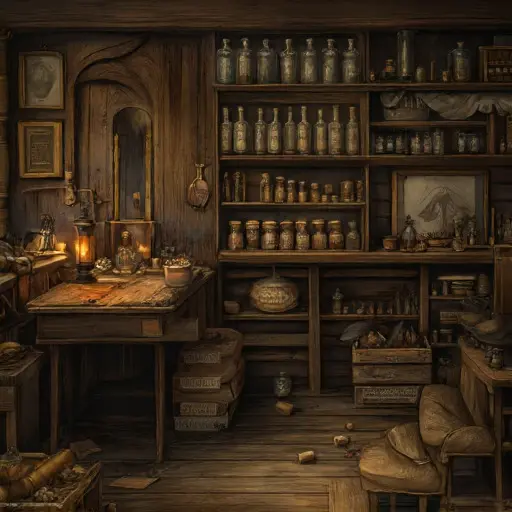
Behind the infusion cabinet, tucked beside a crate of drying herbs, lies Émile’s final attempt: a formula sheet where one accord stops midline, the handwriting collapsing into a wavering mark. The intended balance of scents remains unfinished, the last note hanging silent. No explanation follows—only the quiet drift of an artisan whose certainty dissolved between one breath and the next.
The house offers no further clarity, and it remains abandoned still.