The Silent Moretti Varnishing Table and the Note Unkept
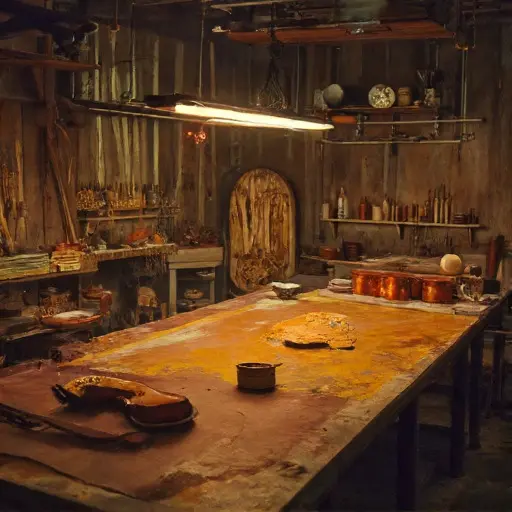
The Luthier’s Room holds a softened hush that seems shaped by familiarity and something newly unsettled. Along the varnishing table, curled shavings cluster near a half-scraped violin back, its wood pale and waiting. A cloth used for buffing hangs limp over a chair, stiffened by resin.
In this stillness, the faint idea of resonance hovers—not as sound, but as the quiet suggestion of a craft interrupted. A battered bridge template lies skewed, out of alignment with the measured order the room otherwise preserves.
The Working Life of Carlo Benedetto Moretti, Luthier of Modena
Signs across the furnished interior trace the habits of Carlo Benedetto Moretti, born 1872 in Modena, raised among modest workshops where violin making was humble, devotional work. In the Plate-Carving Niche, gouges lie sorted by sweep, their handles smoothed by steady hands. A stack of Italian labels—bearing his name in looping cursive—rests beside a spool of gut strings. His temperament appears in the clean arch of carved tops, the precision of f-hole outlines pinned beneath tracing paper.
Carlo likely greeted mornings by planing spruce until it whispered under the blade, then shaped ribs against heated bending irons. Afternoons brought him to the varnishing table, where he blended glazes from resin blocks and oils sourced from Genoa merchants. In the Side Parlour, two finished violins hang above a small mandolin; their curves shine warmly beneath a dust-softened lamp. Everything suggests a man devoted to craft, steady in the ritual of shaping sound from quiet wood.
Disturbances Moving Through His Craft
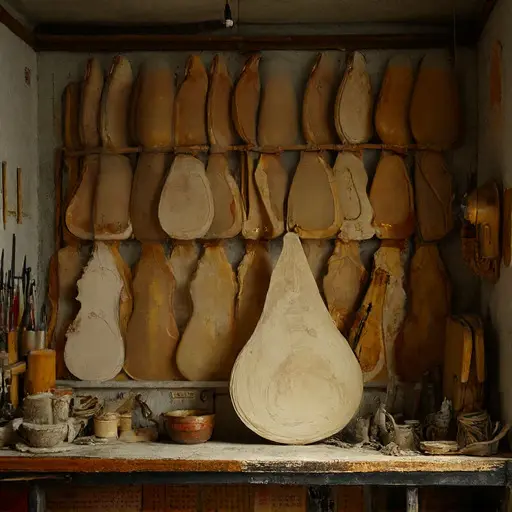
Hints of decline whisper from the surrounding rooms. In the Upper Washstand Chamber, a cracked bowl holds cloudy water used for wetting bending cloths; the cloth itself is stiff, as if left too long without tending. A letter from Cremona, edges softened by humidity, bears the crest of a patron known for exacting standards—its contents unreadable, but its folded weight troubling. On the Guest Cot, a travel coat contains nothing but a dulled plane blade and an empty resin pouch, hardly the makings of travel yet far too deliberate for mere storage.
In the Tool Closet, one rib mold shows a warped outline, perhaps from misjudged heat or an unsteady hand. A bundle of gut strings has loosened, their coils uneven. Nothing here proclaims disaster, yet the evidence hints at a creeping frailty—perhaps tremors in the fingers that once cut clean arcs, or debt closing around a commission gone awry.
A Subtle Drift in the Line of Work
Returning to the Luthier’s Room, the varnishing table becomes the quiet center of unease. A drying rack holds three narrow bottles of glaze, one uncorked, its rim ringed with hardened resin. A small brush lies bristle-down, a breach of his fastidious habit. On the table’s edge, the half-scraped back bears a region where the arching wavers, dipping more sharply than his usual geometric grace.
A soundpost blank rests near a miniature clamp, both placed askew. The template for f-holes displays a faint smear of charcoal at its lower point, as though shifted mid-trace. Even the padded cradle for holding violin bodies lists slightly to one side, as if nudged by an uncertain movement.
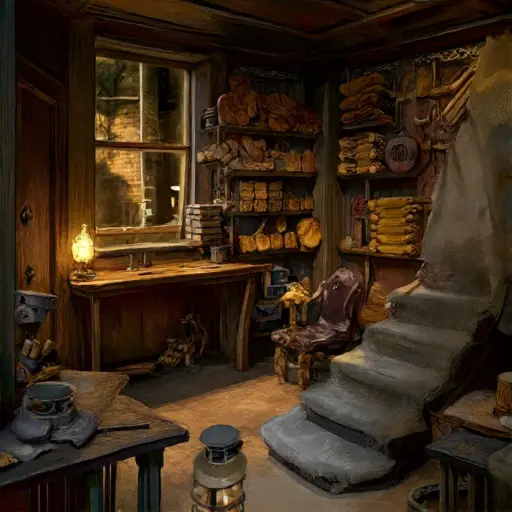
Behind the varnishing table, tucked near a crate of tonewood, rests his final attempt: a violin plate whose arching falters along the bass side, the contour slackened as though shaped by a moment of wavering intent. A single chalk mark ends abruptly, trailing off before the guiding curve could be completed. No explanation follows—only a quiet surface where certainty thinned.
The house holds its silence, and it remains abandoned still.