The Hidden Vasiliev Sorting Rack and the Specimen Gone Astray
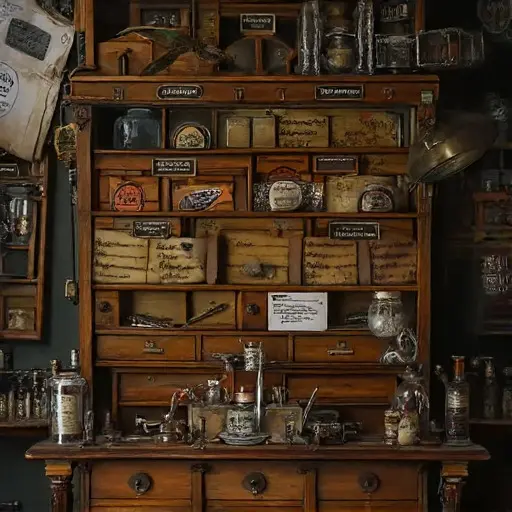
The Naturalist’s Room holds a distilled stillness, the air carrying faint notes of ethanol and dried grass. Specimens line the sorting rack with almost ceremonial precision, yet a few labels slant off-center. A thin film of dust outlines where a box was recently shifted.
An ink pen rests uncapped beside a blot stained in two tones, as though caught mid-revision. Nothing here suggests haste; instead, the pause feels suspended, drawn taut between concentration and a wandering uncertainty that entered softly.
The Methodical Observations of Mikhail Petrovich Vasiliev, Naturalist
Traces across these furnished spaces reveal Mikhail Petrovich Vasiliev, born 1871 near Kazan, raised in modest surroundings where fieldwork was a humble vocation. In the Reference Nook, Russian-language botanical guides lie stacked, their dog-eared pages marked with delicate marginalia. A cedar cabinet holds folded netting, jar seals, and narrow envelopes for winged specimens. Each item’s neat placement echoes a gentle, deliberate nature—one accustomed to hours of quiet categorization.
Mikhail’s routine likely began with early sorting, followed by delicate pinning of insects caught during previous excursions. Evenings were spent labeling specimens with steady Cyrillic script. In the Side Parlour, a framed sketch shows a moth rendered with loving detail, its pattern noted in pencil. The room breathes calm diligence, the lifelong patience of a collector who found solace in symmetry and small truths.

Tensions Creeping Into Stillness
Subtle disquiet pervades the adjoining rooms. In the Upper Washstand Chamber, a jar of preserving alcohol stands half-evaporated, its stopper lying on its side. A letter from a Moscow institution, its seal cracked, rests unread on the washstand’s edge—perhaps a critique or rejection that unsettled him. On the Guest Cot, a travel satchel contains only folded netting and a tin of specimen pins, lacking clothes or practical necessities.
A specimen board in the Side Cupboard holds two mismatched beetles pinned at inconsistent angles—a small, rare flaw in his craft. The alcohol stains near the room’s threshold form irregular arcs, suggesting a container tipped at a moment of distraction. These hints weave toward a quiet slip in certainty, an erosion of confidence too delicate to name.
A Wing Out of Place in an Ordered World
Returning to the Naturalist’s Room, attention draws to the lone displaced wing fragment on the sorting rack. Its pale surface glows faintly in lamplight, the tear along its edge recent, its placement not matching any tray. Nearby, a labeling pen lies angled across blank tags—an unfamiliar untidiness. The magnifier’s brass frame tilts slightly, leaving a ring of oil on the desk where it once stood firm.
Pinned specimens on the nearest board drift from perfect rows; one moth leans subtly to the right, its pin not fully set. A jar of beetles sits open, the stopper balanced precariously against the rim. It is all very slight, yet profoundly at odds with Mikhail’s precision.
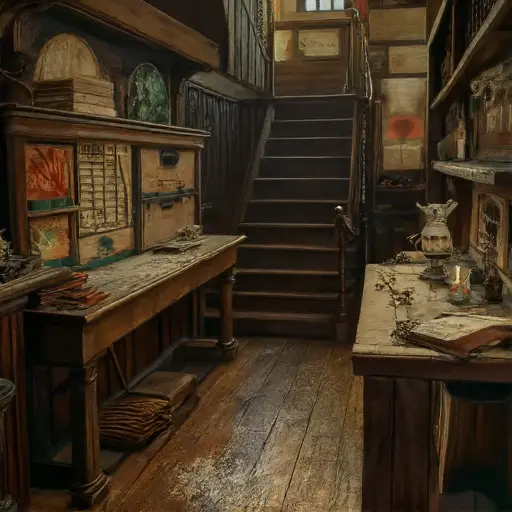
Behind the sorting rack, tucked near a crate of envelopes, lies his final attempt: a small board bearing two half-labeled species, their arrangement wavering out of symmetry. The script on the labels thins, then stops entirely mid-letter. No explanation follows—only the quiet drift of a collector whose order fractured in a gentle, unspoken moment.
The house offers no answer, and it remains abandoned still.