The Eerie Navarro Loom Frame and the Thread That Faltered
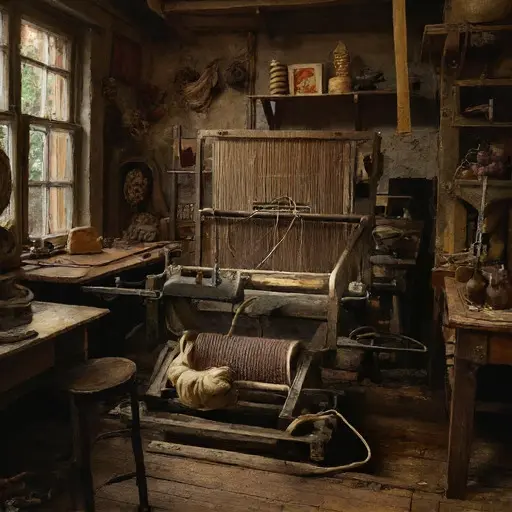
The Textile Room sits in measured stillness, its hush tinged with lanolin. The loom frame dominates the space, frozen between one weft pass and the next. A comb leans crookedly beside a half-beaten section of weave.
A thin notch in the beater’s edge suggests a startled touch or a sudden misstep. On the floor, a few stray fibers lie curled as though brushed from a garment in haste. The air holds the faint warmth of dried dye, thick with the gravity of stopped routine.
The Quiet Precision of Lucía Esperanza Navarro, Weaver
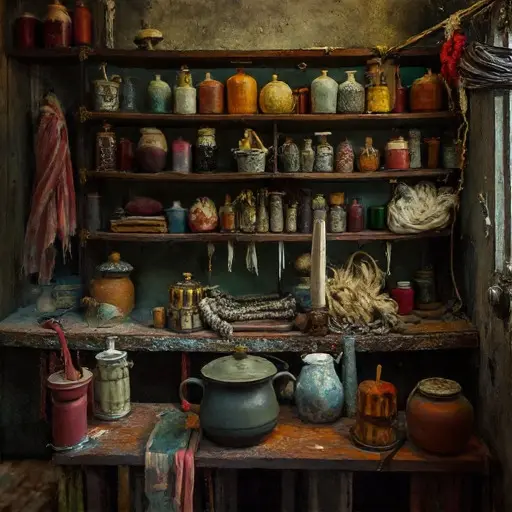
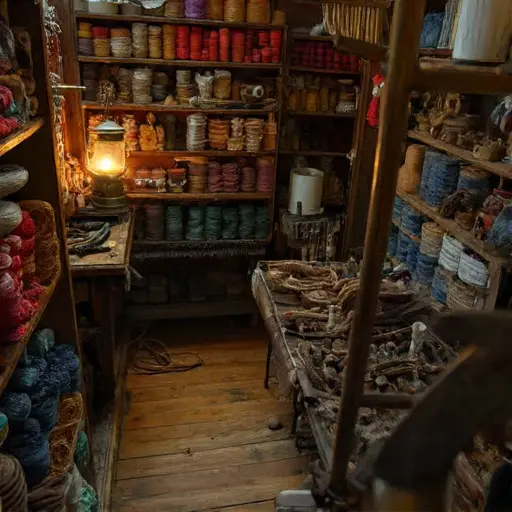
Traces across the interior reveal Lucía Esperanza Navarro, born 1875 in Zaragoza, shaped by Spanish cottage weaving traditions. In the Dye Nook, ceramic jars labeled in Castilian—cochinilla, nogal, azafrán—stand in tidy rows. Bundles of carded wool rest atop folded cloths. Lucía’s temperament appears in the even tension of warp threads, the careful alignment of heddles, the neat stacking of sample swatches used to measure pattern drift.
Her workdays likely began with tending dyes at dawn, then weaving under steady lamplight until late afternoon. In the Side Parlour, framed samplers display motifs of Iberian stars and almond blossoms. A small family photograph sits beside them: blurred, but enough to imply quiet devotion to her craft and her kin. The emotional gravity of these objects hints at a life drawn through color and pattern, anchored by daily discipline.
Disruptions Whispering Through Her Routine
Signs of strain appear in narrower corners. In the Upper Washstand Chamber, a cracked pitcher shows traces of mineral-rich water—a hazard to wool she once guarded against. A letter from Madrid lies half-open on the sill, its ink smeared as though handled with damp fingertips. On the Guest Cot, a travel wrap encases only shears and an empty spindle; not enough for real departure, too much for simple storage.
In the Back Closet, a bolt of cloth exhibits slight pattern distortion—color bands misaligned by a few threads. Lucía would never have left such an error uncorrected. A broken reed segment rests atop the shelf, freshly snapped. Whether exhaustion, grief, or sudden doubt weaved itself into her hands, the evidence lacks a decisive narrative.
A Thread Wandered from Its Path
Returning to the Textile Room, the errant thread suspended from the heddle becomes the focal tremor. Its severed end curls upward, as though plucked by a hesitant gesture. The shuttle on the bench bears a spot of stray dye, suggesting she worked while pigments were still drying—a lapse in timing she would not typically allow. Even the beater’s groove shows a faint smear of indigo where her grip faltered.
A spool of cream yarn rests on its side, the loose end coiling over the treadle in an untidy arc. Beneath the loom, a slip of paper marked with a partial pattern draft shows a wavering grid, lines less certain than the motifs framed in the parlor.
Between the loom’s crossbeams, partly hidden behind the warp beam, lies her final attempt: a panel where two pattern bands drift apart by a single misplaced pass. The mistake is small yet unmistakable, as if her concentration wavered in an instant she could not reclaim. No note accompanies it—only that one wandering thread marking a point where certainty slipped.
The house keeps its silence, and it remains abandoned still.