The Lost Sørensen Dipping Rail and the Wax Unresolved
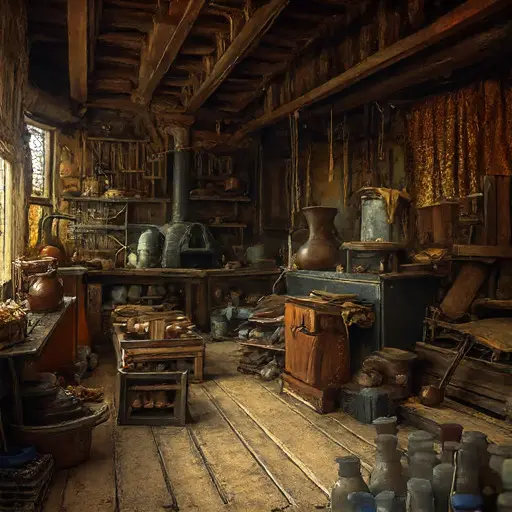
The Wax Room still carries a mellow sweetness—beeswax, tallow, and the ghost of warm steam. On the dipping rail, half-weighted wicks dangle as if waiting for one final immersion. A ladle rests on its rim, congealed wax clinging to its bowl, forming a stiff curl.
Across the floor, faint footprints interrupt the sawdust scatter, pausing near a small brass hinge dropped beside a crate. The room’s balance feels tipped, but softly, as though a quiet reconsideration pressed itself into the wooden walls and never lifted.
The Slow Craft of Jens Emil Sørensen, Chandler
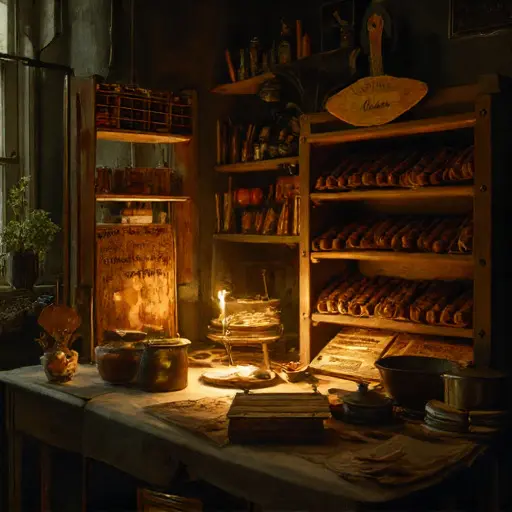
The studio recalls Jens Emil Sørensen, born 1872 in Odense, shaped by Danish households where candles were both utility and modest art. In the Mold Cabinet, bars of beeswax marked with Danish initials stack neatly; clay molds from Copenhagen stand in even rows. His tools—trussing needles for wick threading, wooden paddles for stirring—bear smooth edges from years of deliberate strokes. Everything speaks of a measured temperament, unhurried and meticulous.
He likely began at dawn, melting wax in copper kettles, letting each batch settle before dipping. Evenings spent trimming cooled candles, smoothing seams with a gentle twist. In the Side Pantry, bundles of flax cords lie coiled beneath small bottles of Danish-scented oils—fir, birch, distant coastlines whispered in glass. These rooms hold the unassuming precision of a man for whom routine was a steadying hand.
Disturbances Shaping Toward Decline
Small frictions appear beyond the wax room. In the Upper Washroom, a spilled tin of scented oil stains the basin, its spill rimmed in uneven arcs. A folded notice from a Copenhagen merchant—its ink blurred—lies beneath a cracked soap dish, perhaps relaying overdue fees or a rejected shipment. On the Guest Cot, a travel coat holds only wick samples and a dull trimming knife: hardly the belongings of someone planning a proper departure.
In the Back Storage Press, a bundle of tapered candles shows a subtle warp, their form bent as though cooled too quickly or tended with trembling attention. A soot smudge lifts along the stove’s flue, hinting he missed a draft adjustment he once performed with instinctive ease. Nothing declares crisis, yet unease threads through each corner, frail but persistent.
A Subheading Marked by the Hinge
Returning to the Wax Room, the brass hinge near the crate feels like the room’s smallest but most telling dissonance. Sørensen fitted hinges to his wooden frames when adjusting wick lengths; finding one here, away from its pair, speaks of interruption. The half-weighted wicks sag unevenly, one stretched too far from its companion. A wax ladle tilts off-center on the stove’s edge, its handle bearing a fresh scorch along one side.
Steam once condensed on the rafters, forming droplets that marked the cycle’s rhythm; now the beams are dry, the hearth cold. Near the dipping rail, a ring of hardened wax on the floor shows where a kettle had been moved abruptly, leaving a crescent of half-fused drips. The room holds its breath, as though the next dip awaited certainty that never formed.
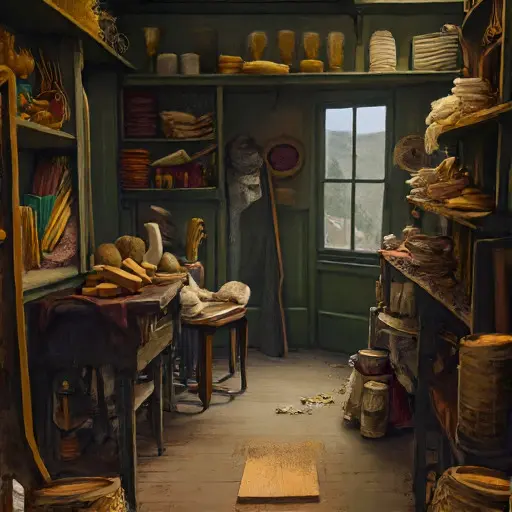
Beneath the dipping rail’s lowest slat, tucked behind a crate of molds, lies his last attempt: a pair of half-finished tapers fused at their base, the seam wavering where two dips met imperfectly. The wicks twist unevenly, betraying a moment where Sørensen’s once-certain motion faltered. No inscription clarifies the cause—only a room shaped by habit, held still by a single break in rhythm.
The house shares no explanation, and it remains abandoned still.