The Hidden Åkesson Specimen Table and Its Vanished Task
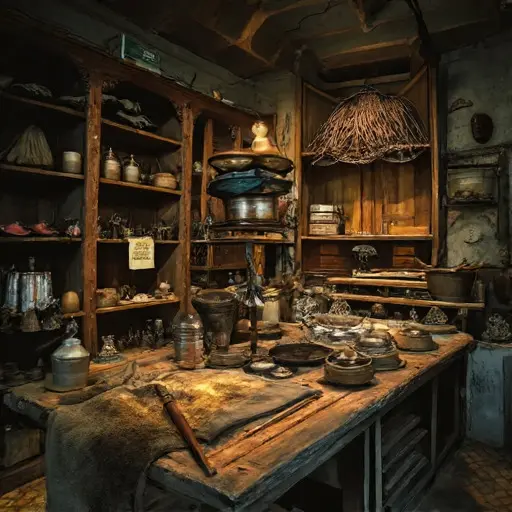
The Taxidermy Room simmers in a quiet tension, as though the air remembers a final routine that never resumed. At the center, the specimen table holds a half-cleaned hide, its contours rigid where the borax dried too soon. Nearby, an awl rests upright against a tin of pins, angled as if nudged by a wavering hand.
A faint chemical tang lingers in the rafters. The wooden floorboards curve slightly toward the table, guiding the eye to a single missing frame that once supported a small creature before its purpose faltered. This stillness carries the unspoken weight of choices left unfinished.
The Working Years of Sven Alvar Åkesson, Taxidermist
Clues scattered through the furnished rooms reveal Sven Alvar Åkesson, born 1873 in Uppsala, trained under a modest naturalist who prized fidelity to living forms. In the Back Preparation Nook, Swedish-labeled tins of borax and drying powders cluster beside folded muslin squares. A brass compass, used for measuring skull spans, rests beside a pine box holding glass eyes sorted by hue. His steady temperament emerges in the precisely coiled wires on the windowsill and the slow, careful brushstrokes frozen in partially groomed feathers.
He worked from dawn, preparing skins on the specimen table, stitching fine seams by noon, and setting mounts into lifelike postures by evening. In the Dining Parlor, several finished pieces—an owl, a stoat, a small capercaillie—perch atop sideboards, their plumage softened by dust. Each one hints at his quiet ambition: not grandeur, but accuracy, as though truth in form could right the subtle disappointments life had given him.

A Pelt That Pulled Him Off Balance
Signs of strain settle quietly across the house. In the Upper Closet, a crumpled invoice lists overdue costs for imported glass eyes and rare dyes. A letter—its Swedish script waterlogged—sits pressed between two herbarium boards, suggesting unwelcome news from a distant sibling. On the Guest Cot, a travel coat lies folded, but no trunk stands ready; only a pouch of pins and a small flask of borax share the blanket. A cracked jar of preservative solution stains the washstand, the spill recent enough to carry a sharp tang.
Back at the specimen table, the incomplete hide’s uneven stretch implies uncertainty. The pattern along its flank deviates subtly—as though whatever he attempted to preserve troubled him more than he admitted. Tools that once held strict positions now drift slightly from their assigned places.
Reading the Pelt for His Final Hesitation
In the Taxidermy Room, all unease knots around that unsettled hide. The stitches near its edge begin neatly but lose rhythm, spacing wider as though his concentration thinned. A wire armature, half-bent, lies across the specimen table, one end wrapped clumsily in twine. Even the borax tin’s lid sits askew, revealing a thin crust along its rim—an oversight foreign to his disciplined hands.
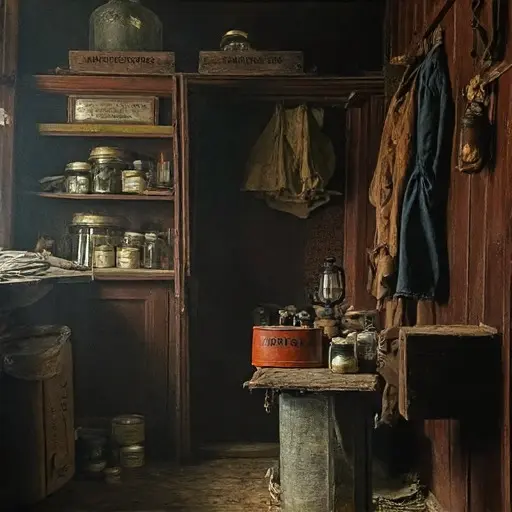
Tucked beneath the specimen table lies his final attempt: a partially mounted creature whose flank reveals a wavering seam, the tension slack and uneven. The glass eyes set aside for it differ slightly in hue, as though he doubted his own choice. No note clarifies the hesitation; only the strained stillness of a craftsman who carved accuracy from quiet hours until one day the line between truth and imitation blurred too sharply to finish.
The house yields no answer, and it remains abandoned still.