The Haunting Grünwald Soundboard and the Tune Unraveled
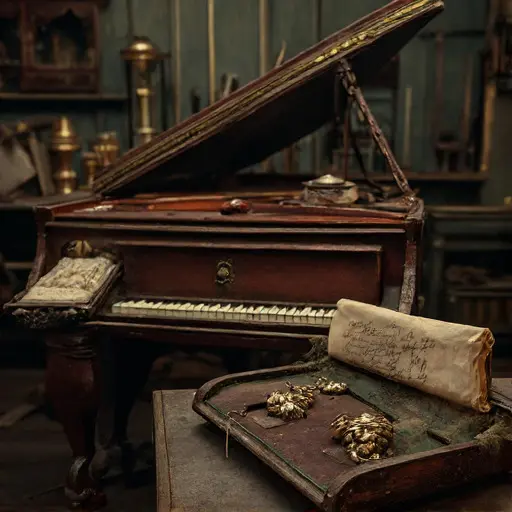
A faint draught crosses the Music Workshop, stirring motes that drift above the exposed piano. The soundboard holds a thin shimmer of dust, mapping precisely where hands once traced its grain. A single note lies dead beneath its hammer, the felt oddly compressed.
On the tuning bench, a muted fork leans against a cloth, beside a slip of paper marked with the word resonance, underlined twice. Nothing is disturbed violently, yet everything implies an assessment paused at the edge of decision.
The Vanishing Routine of Ludwig Franz Grünwald, Piano Tuner
Preserved objects whisper of Ludwig Franz Grünwald, born 1870 in Vienna, trained under a modest guild of instrument technicians. In the Side Parlour, Viennese sheet music and a chipped zither evoke his roots. Tools carved with German initials—LF.G.—sit arranged by length, each wrapped in linen to preserve their edges. Mutes, wedges, and felt strips rest in disciplined order, suggesting mornings spent balancing strings, afternoons correcting hammers, evenings easing minute tonal shifts.
He favored quiet method: tapping pins in slow spirals, listening to beating frequencies settle into calm. His temperament seems steady, introspective. In the Study Niche, a row of tuning forks spans the narrow shelf in ascending pitch; each shows wear at the handle, as though turned often between thoughtful checks. Nothing flamboyant, nothing rushed—just the discipline of a man measuring sound against silence.

Strains Catching at the Edges of His Craft
Hints of trouble slip through adjoining rooms. In the Upper Dressing Chamber, a travel coat rests on a chair, its pocket weighted by two unopened letters stamped from Leipzig—perhaps notices concerning overdue payments or failed orders for replacement hammers. A cracked hinge on a portable tuning box lies unrepaired, its velvet lining crushed. The Guest Vestibule holds a small crate lined with straw intended for a replacement action mechanism, but the housing remains empty. A soft scorch on a cloth near an oil lamp suggests a moment of distraction, its irregular burn uncharacteristic of his measured ways.
These elements echo strain rather than catastrophe: perhaps a disputed repair, a misjudged pitch adjustment, or hearing fatigue creeping into a man who relied on the subtlest vibrations. The interiors offer parted clues, each hinting toward something he worried he could no longer hear cleanly.
The Resonance He Could Not Trust
Back in the Music Workshop, the slip of paper marked resonance draws the room’s quiet into focus. The deadened note beneath the hammer seems newly afflicted—its string shows a faint kink near the bridge, something he would never overlook. A wedge lies where it would not naturally fall, hinting that he revised the same tone repeatedly. Slight dust rings mark spots where tuning forks had once been laid in deliberate sequence, now absent from their positions.
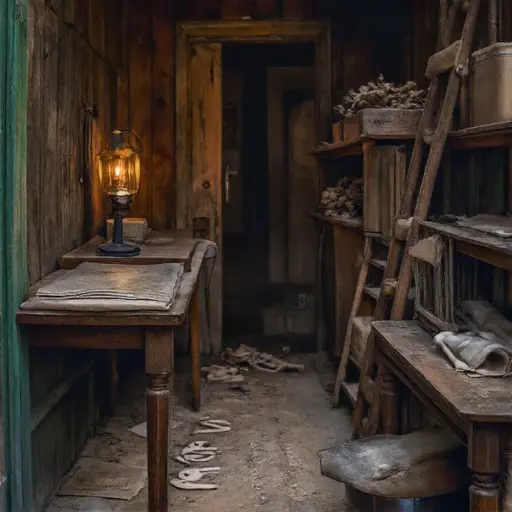
Beneath the piano’s frame lies his final attempt: a small wooden hammer head, half-voiced, its felt teased unevenly—unlike his usual perfection. A penciled marking on the shank trails off where a measurement should complete. No note clarifies whether doubt in his hearing or fear of a flawed repair silenced his hand. Only the trembling hush of the room remains, heavy with the chord he never finished tuning.
The house offers no resolution, and it remains abandoned still.