The Eerie Nakamura Kiln Shelf and the Vessel That Shifted

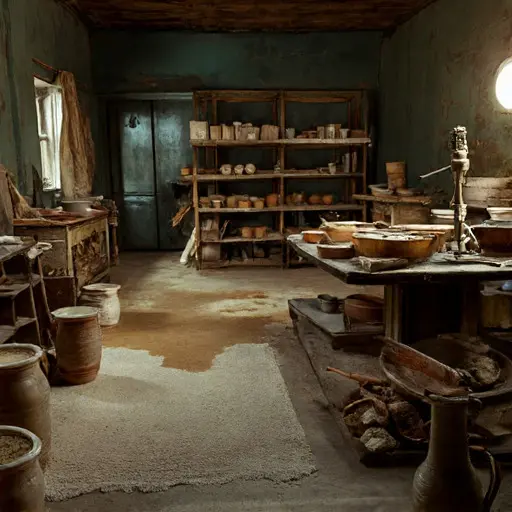
In the Ceramics Loft, dust settles lightly on cooling bricks. A half-shaped bowl, its curve elegant but incomplete, rests at the edge of the kiln shelf—too close, as if nudged or reconsidered. A bamboo trimming stick angles against the wheel’s basin, its tip stained in pale slip.
Nothing here shows panic; instead, the stillness bears a slow inward pull, as if the room were listening for the return of a motion that never resumed. The faint scent of wood ash lingers, clinging to a displaced jar where a once-reliable glaze dried unevenly, marking the moment precision faltered.
The Handwork of Keiji Haru Nakamura, Potter
The arranged tools remember Keiji Haru Nakamura, born 1872 in Kyoto and trained in modest kilns that valued patience above flourish. His migration left hints: Japanese bamboo ribs trimmed cleanly, celadon tests taped to a cupboard door, and a pair of wooden paddles carved with familiar East Asian patterns. In the Glaze Mixing Room, bowls of raw pigments—ash white, iron red, tea brown—rest in careful sequence, betraying his hunger to adapt old traditions to Victorian tastes.
He likely centered clay at dawn, guiding each lump through calm repetition. Evenings found him trimming bases by lamplight, turning vessels with meditative steadiness. A pallet of wrapped brushes in the Sitting Corner attests to his gentle temper: every bristle washed, every handle dried before storage. Nothing speaks loudly of him—only a quiet thoroughness running like grain through the house.
When Heat and Circumstance Quietly Pressed In
Subtle distress emerges through furnished alcoves. In the Upper Scullery, a cracked bisque cup lies near a water basin, its fracture new and sharp-edged. A bill from a London supplier, creased and re-creased, lists rising costs for imported clay. In the Guest Chamber, a travel robe hangs beside a half-packed trunk padded with straw for finished wares—though no vessel sits inside. A faint soot stain climbing the scullery wall might speak of a misjudged firing, or perhaps an oven draft he could not correct. Each sign whispers of creeping uncertainty, not disaster.
Reading the Glaze for His Final Intention
Returning to the Ceramics Loft, unease gathers around the jar of mis-set glaze, its lid askew as though interrupted mid-measure. A thin crust forms on its surface, the color muddied from overmixing. The bowl on the kiln shelf shows a faint warp along one rim—the kind caused by rushed drying or an unsteady hand. Ash dust forms a delicate arc beneath the bisque oven’s mouth, marking where something was placed, then quietly removed. A wooden rib, beloved from its worn edge, lies further from the wheel than habit would allow.
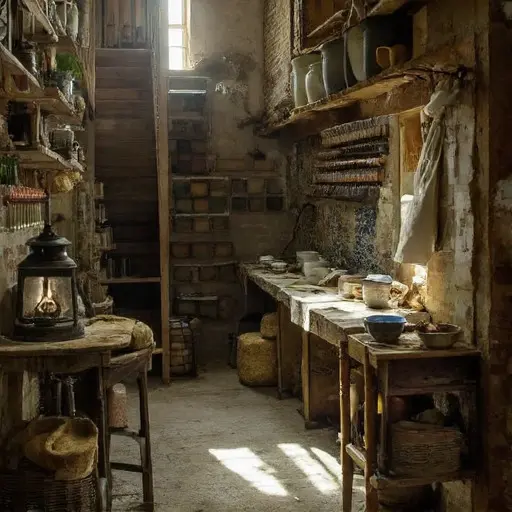
Tucked beneath the kiln shelf lies his final attempt: a shallow celadon dish whose surface blushes unexpectedly—part green, part unintended grey. The brushmark at its center wavers, as if his hand hesitated during the last pull. No note clarifies the cause of that tremble—only the quiet drift of pigments settling where intention once guided them.
The house holds its stillness, and it remains abandoned still.