The Haunting Calderón Binding Table and Its Unfinished Reply

The Bindery Room exhales a low, papery hush, where an untrimmed folio flutters against a straightedge left halfway across the binding table. The scent of hide glue lingers, sweet and metallic, while a faintly curled crease along one sheet hints at an interruption no one witnessed. Scattered tools stand ready for the next gesture, yet nothing here has moved in years; the stillness is too deliberate, as though someone stepped out intending to finish a single, decisive fold.
How Julián Rafael Calderón, Bookbinder, Filled These Rooms
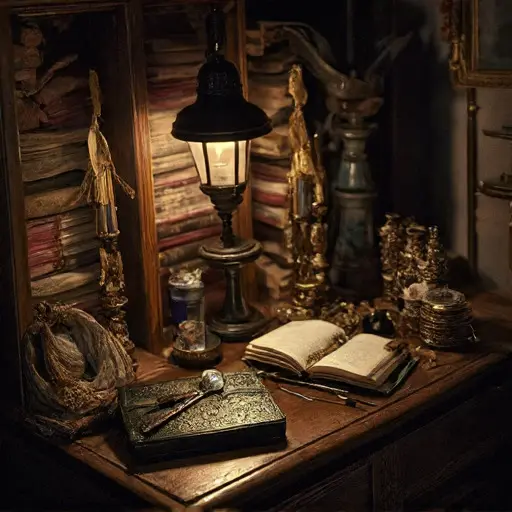
The interiors recall Julián Rafael Calderón, born 1872 in Zaragoza, trained in a modest guild that prized careful stitching and disciplined temper. His Spanish wooden press sits in the Study Alcove, its handles smoothed by persistent work. Swatches of marbled endpapers—veins of ochre, turquoise, and vermilion—rest on a citron-painted console, whispering of clients who asked for beauty without extravagance. A slim devotional text in Castilian lies opened to a prayer he annotated lightly, suggesting quiet faith woven into his routines.
He stitched signatures at dawn, pressed boards in the warm midday hours, and burnished gilt letters by lamplight until they shone like thin suns along the spines. In the Music Room, a shelf holds hymnals he once repaired, their linen joints reinforced with discreet care. Judging by the squared edges of his tools and the patient order of his work surfaces, he was steady in temperament, fond of routine, and respectful of silence.
When Strain Settled into His Craft
The Upper Hall Cabinet yields the first sign of tension: a half-bound volume clamped too tightly, its spine warped as if he misjudged pressure. A letter from an unfamiliar printer lies folded beneath it, flecked with paste, its address smudged beyond recognition. Nearby, a backing board shows a splintered edge where force was applied—uncharacteristic for a man proud of precision. Perhaps a commission went wrong, or accusations about a misprinted edition threatened his position. The rooms hold no accusation aloud, only uneasy evidence.
In the Guest Chamber, a valise remains opened on a low trunk. Inside, wrapped in wool, rests a bundle of fine goatskin and a set of rare stamping tools—items he would never travel without unless planning a departure. Yet the tools are arranged too carefully, as though he hesitated to close the valise. A thimble-sized pot of gold size lies tipped on its side, dried in a thin crescent across its rim.
A Crease That Redirected His Last Intent
Back in the Bindery Room, everything circles the meaning of the crease on that waiting folio. The fold is tentative, pulled at a hesitant angle. Below it, the binding table bears faint traces of paste brushed away by hand—more hurried than his usual calm gestures. A bone folder rests across the gutter, its handle stained by a streak of pigment rarely used in his commissions. Something forced a correction he could not accept or account for.
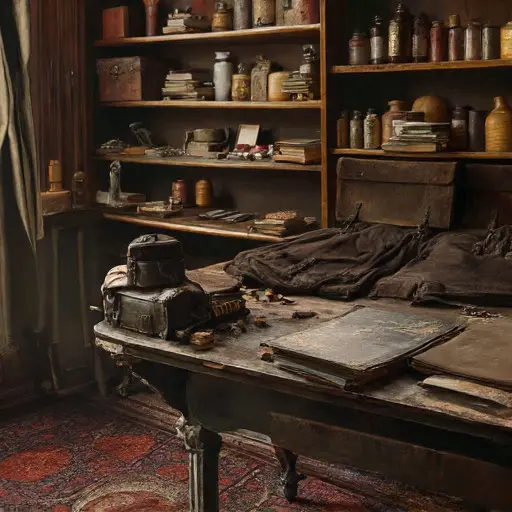
At the far edge of the binding table, beneath a blotter sheet, lies his final attempt: a title leaf lightly penciled with letters he never inked. The strokes waver, as if his hand faltered at the moment purpose should have sharpened. No farewell accompanies it, no correction explains why he paused. Only the faint ghost of a decision hovers in the quiet grain of the wood.
The house keeps its distance, and it remains abandoned still.