The Silent Valdieri Alcove and Its Unmarked Departure
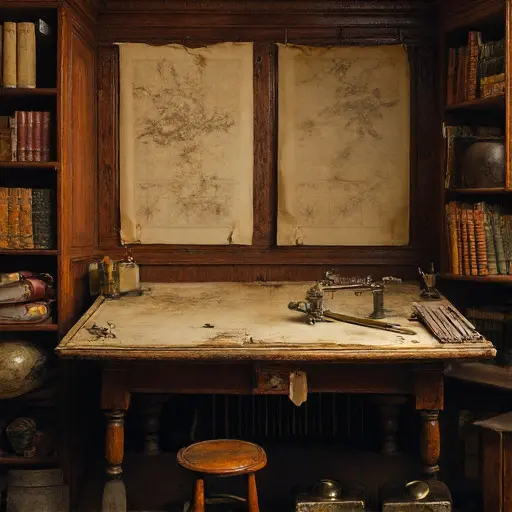
A brittle hush settles over the Map Room, where a tilted lamp reveals dust drifting across an open chart stand. On the central table, a half-finished draft curves beneath a warped ruler. Even here, the displaced compass glints faintly as if startled from its usual post.
The house seems to hold its breath; each object remains where it once obeyed familiar patterns, yet every stillness implies someone left mid-task, neither fleeing nor intending to be gone for long.
Footsteps of Salvatore Emilio Valdieri, Cartographer
Traces across the rooms speak of Salvatore Emilio Valdieri, born 1870 in Turin, trained within a modest technical school that prized accuracy over elegance. His profession inhabits every furnished corner: precision dividers left on a velvet mat in the Study, binding threads for atlases coiled neatly atop a small chest, and a carved alpine barometer—likely brought from home—mounted over the drafting table. A curved magnifier, smudged from repeated use, suggests his steady routine of evening revisions long after household lamps dimmed.
His working rhythm was gentle and thorough. In the Library, a narrow side desk bears faint indentations from weighted folios he consulted nightly. Cartographic stencils lie aligned with quiet discipline, revealing a temperament both patient and solitary. A tin of imported inks, labeled in Italian, hints at careful indulgence in tools he trusted. Through placement and wear, these interiors recall a man at the height of his precision, crafting worlds on paper he seldom saw in person.
A Constriction He Could Not Name
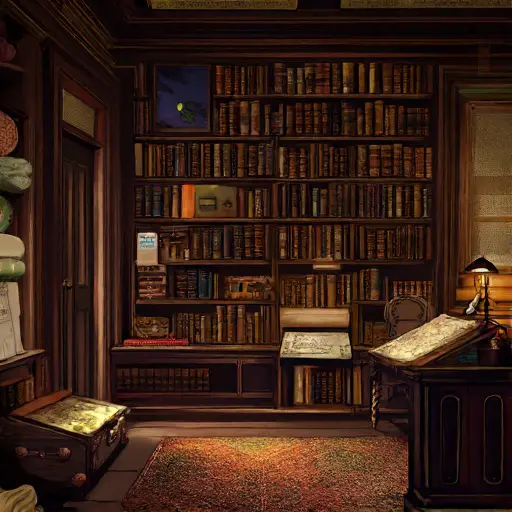
Signs of strain gather with unsettling subtlety. In the Hallway Niche, a locked folio case was forced open, its clasp bent and one hinge loosened. Inside lie overlapping sheets: competing border outlines, alternative passes through mountain ranges, and several segments struck through with heavy strokes. A mismatched scale ruler, clearly snapped and repaired poorly, rests beside these revisions. Perhaps a commission challenged him; perhaps a client doubted his accuracy. The interiors mutter about pressure neither articulated nor resolved.
Across the Guest Room, furniture remains properly arranged, but a travel trunk stands open on a stand, lined with woolen clothing that still bears the scent of linseed oil from his tools. A pair of well-worn gloves lies atop a folded coat, the fingertips stained by pigment. There is no sign he completed the packing.
A Subtle Drift Around the Compass
In the Map Room, tension concentrates around the area where the displaced instrument should sit. The brass plate on the table bears faint circular markings that once indicated a preferred orientation. Now the metal is cold, lightly tarnished, and strangely distant from the drafting edge. A single weight used to flatten vellum pages lies overturned, revealing a scratch on its underside. It suggests an object dragged hurriedly across the table as if in sudden reconsideration.
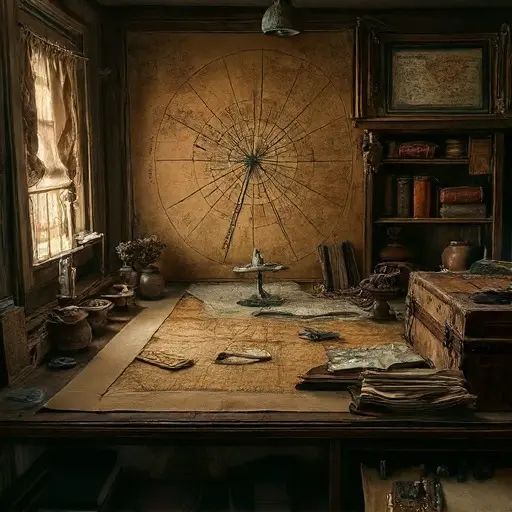
A last detail lodges in the quiet: a folded sheet tucked beneath the tilted lamp, its margins rubbed thin where a hand pressed repeatedly. The markings show an altered route reframed twice, then abandoned entirely. No farewell, no confession—only the faint impression of a man rethinking his craft at the moment it defined him most.
Whatever happened, the house never provides its verdict. It remains abandoned still.