The Forgotten Sato Binding Room Where the Thread Slackened Without Warning
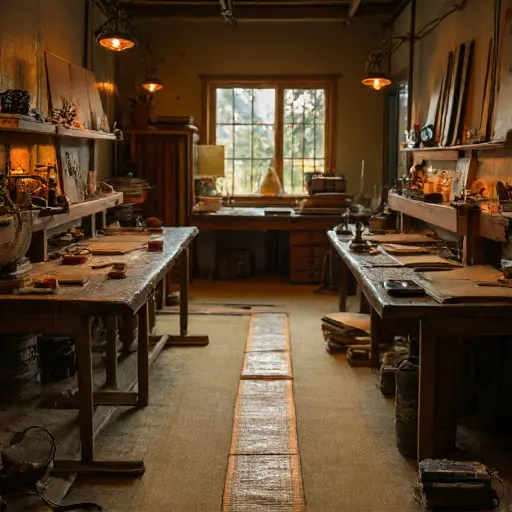
A muted paper-dust stillness fills the binding room, as though each surface holds a memory of work interrupted. On the central table rests a half-bound volume: its upper signatures stitched tightly in measured intervals, its lower ones loosening into slack, uneven spacing. A corner press sits misaligned.
A trimming plane rests atop a pile of cover boards that once would have been squared to exact angles. Nothing suggests abrupt damage—only the slow unwinding of routine once performed with deliberate hands.
A Binder’s Work Defined by Grain, Weight, and Thread
This binding room belonged to Sato Haruki, artisan bookbinder trained within a lineage of East Asian binding traditions. The evidence of his practice lies entirely in the objects: shifu-thread spools imported from Osaka traders, brass corner pieces etched with modest wave motifs, and sewing frames sized for traditional stab-stitch arrangements. His worktable edges display long, smooth wear, marking years of leaning close to stitching lines.
The tools imply a binder of disciplined habits: awls nested by diameter; paper weights arranged in perfect increments; trimming blades kept sharpened on a stone whose surface has been worn slightly concave. Along a wall shelf, finished boards show immaculate cloth wrappings, edges folded with crisp precision—older works that held their form before later pieces began to drift.
Disturbances in the Sequence
Subtle evidence marks the shift from mastery to decline. A cloth spine panel lies warped, its mull layer pulled unevenly. A stack of signatures, once aligned flush, now splay outward at their fore-edges. Paste jars that should settle into smooth consistency instead show separated layers, one heavier than the other, as if mixed without full attention.
A slip of paper pinned beneath a corner press bears fragments in brush-written Japanese: “order disputed… mismeasured boards.” Another note, scarcely legible, mentions “return requested,” though the specifics disappear beneath a smear of dried paste. Along the far wall, two cloth-bound cases sit mismatched—morbidly asymmetrical for a binder known, from surviving work alone, for near-geometric regularity.

The TURNING POINT Written into Loosened Spines
At the central table lies the most telling artifact: a commissioned volume bound in patterned indigo cloth. Its upper case corners are immaculate—sharp, unmarred—yet its lower case drifts out of square by several millimeters. A spine liner, cut for reinforcement, remains unglued beside the text block, lightly buckled by humidity. The trimming plane’s track across the fore-edge is uneven, as though drawn across shifting weight.
Beneath a stack of unused boards rests a narrow strip of vellum bearing faint strokes: “measure contested… adjustment refused.” Ink fades mid-phrase, not from wear but from initial irregularity of pressure. Nearby, two signatures show mismatched sewing stations, an error unusual for this style of binding. Whether caused by haste, uncertainty, or external dispute cannot be read clearly from the fragments. Still, the evidence reveals a binder pushed from his steadiness by unresolved pressures.
Inside a drawer, linen tapes once sorted by width now lie jumbled, some water-warped, others unraveling at their ends.
A Slot Concealed Behind the Trimming Cabinet
A wooden cabinet used for storing cover boards and cloth offcuts has one panel eased slightly outward. Behind it sits a shallow, unfinished book block wrapped in mulberry paper. Its first signatures are stitched neatly; the latter signatures show only penciled marks, stations never pierced. On the outer wrapper, faint graphite records: “for… when steadiness returns,” though the name or intent is lost in abrasion.
Beside the block lies a sealed packet of new washi—its deckled edges crisp, reserved for a binding he did not begin.
A Final Misaligned Volume
In the shallow drawer beneath the nipping press rests a test binding: its early signatures tight and uniform, its final section sagging in a slight crescent, spine thread slackening toward the tail. On the pastedown, penciled lightly enough to fade under the surface fibers, reads: “Even structure gives way when resolve slackens from its thread.”
The binding room settles into its paper-fragrant quiet, half-bound volumes resting in suspension.
And the house, holding its abandoned bookbinder’s chamber, remains abandoned.