The Eerie Lindblom Conservatory Room Where the Notes Lost Their Bearing
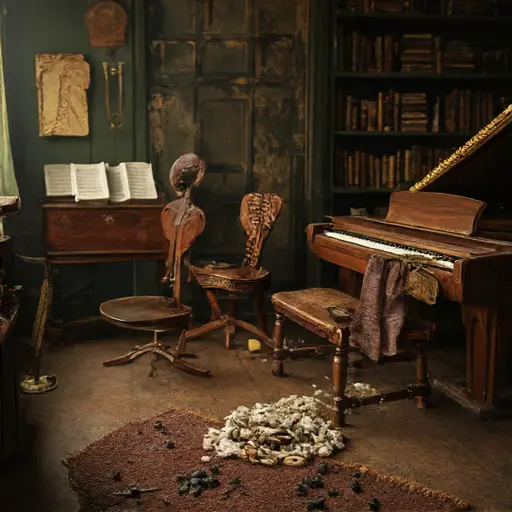
A mild hush settles in the conservatory room, tinged with rosin and varnish. On the central stand lies a score with strong, articulate notations tapering into hesitant half-bars. A violin bow rests crooked against a stool; its horsehair frays at the midpoint.
A metronome sits frozen at an errant tempo. Nothing here ruptures the silence—only the impression of a precision that once held steady but faltered, measure by measure.
A Musician Guided by Pitch, Breath, and Bearing
This conservatory room was home to Elin Sofia Lindblom, violinist and ensemble instructor, born 1879 in Uppsala. Raised in a modest merchant’s household, she studied under a traveling virtuoso who taught her to feel resonance through the bow arm, shape emotion through tempo, and find bearing in quiet intervals between phrases. A faded blue ribbon from her brother, Nils Lindblom, ties a small packet of practice scales on the far shelf.
Elin kept to a disciplined rhythm: dawn etudes to warm the wrists, midday ensemble drills, dusk refining vibrato under lanternlight. Her tools remain lovingly set—resinous rosin cake, polished tuning pegs, bow screws aligned with mindful care. Patrons once trusted her performances for their poise, clarity, and steady heart.
When Phrases Drifted from Their Center
In vigorous seasons, the room hummed with patient exercises. Scores unfolded in tidy staves, bow strokes struck the air in measured arcs, and ensemble students praised her intuitive timing.
But small fractures arrived. A phrase slows unexpectedly. A high note wavers off intonation. A written tempo marking contradicts the bow’s motion. Her commission ledger records a civic concert’s program written, crossed out, rewritten, then smudged by rosin. A terse Swedish note reads: “De säger att jag förstörde finalen”—they say I ruined the finale.
Whispers spread among the conservatory corridors: at a public rehearsal, the ensemble she directed lost unison—violins entering late, lower parts miscounting bars. Some blamed her for misguiding the section cues. Others murmured she refused a board member’s request to alter the program order for prestige, stoking quiet resentment.
The TURNING POINT Scored in Hesitation and Strained Silence
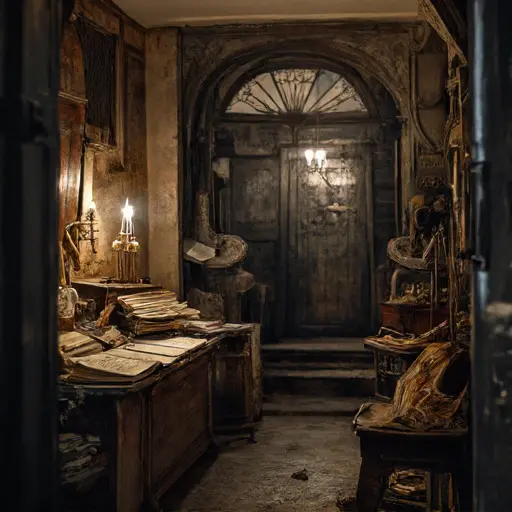
One dusk left faint yet insistent signs. On the piano’s lid rests a marked conductor’s score—its overture annotated with confident cues, its final movement crossed by erratic arrows and circled mistakes. A tuning fork lies dented along its stem. A bow screw has fractured, its grooves worn thin.
Pinned beneath a cluster of loose folios is a torn scrap: “De kräver ersättning för skammen.” They demand reimbursement for the shame. Another fragment, blurred where rosin dust clung, reads: “Jag följde takten… de förnekar den.” I followed the tempo… they deny it. Her handwriting slopes downward, intervals widening like an uncertain beat. Even the staves on the stand—once perfectly aligned—appear spread and uneven, as though pushed by unseen drafts.
On the nearby bench, a half-rewritten cadenza lies unfinished, its climactic run dissolving into hesitant slurs.
A Quiet Hollow Behind the Sheet-Music Shelves
Behind stacked hymnals and étude collections, a loose panel shifts gently inward. Inside rests a small composition Elin meant for Nils: the opening bars rendered in meticulous notation, the rest only sketched in ghostly ledger lines. A folded note in her trembling script reads: “För Nils—när min känsla för riktning återvänder.” For Nils—when my sense of bearing returns. The final word fades into pale graphite marks.
Beside it lies an unplayed mute, polished and untouched, awaiting the steadiness she could not reclaim.
The Last Broken Interval
Inside a shallow drawer beneath the podium lies a test phrase: the first bar written in even, confident strokes; the second bar drifting into uneven measures. Beneath it Elin wrote: “Even harmony falters when resolve loses its bearing.”
The conservatory room sighs into varnish-scented quiet, unfinished phrases lingering in muted air.
And the house, holding its abandoned musician’s chamber, remains abandoned.