The Strange Moretti Mosaic Studio Where the Tesserae Broke Their Sequence
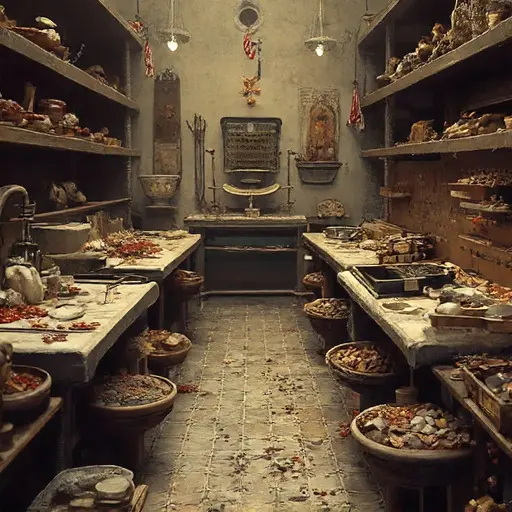
A hush of mortar dust and mineral scent permeates the room. On the central workboard rests an unfinished mosaic panel—its upper corner arranged in fluent geometry, its lower border drifting into uncertain spacing. A bronze nipper lies open, as if dropped between cuts.
A smear of drying mortar edges toward the rim of the basin. No single event announces itself; the quiet is shaped by small hesitations where discipline once ruled every fragment.
A Maker Guided by Color, Edge, and Sequence
This mosaic studio belonged to Giulio Renato Moretti, mosaicist and stone cutter, born 1870 in Ravenna. Raised among modest marble workers, he apprenticed under a traveling master who taught him how light behaves across angled tesserae, how mortar sets in temperamental climates, and how a pattern’s integrity rests on the smallest shard’s placement. A faded ribbon from his sister, Lucia Moretti, ties a stack of stencils near the windowless wall.
Giulio built his days on quiet exactitude: dawn shaping stone, midday fitting tesserae into measured arcs, dusk smoothing mortar seams beneath a steady lantern. His tools still sit in ordered ranks—nippers sharpened, tesserae sorted by hue, stencils weighted with river stones. Patrons once admired his mosaics for their precise flow and restrained brilliance.
When Patterns Fell from Their Order
In earlier seasons the studio thrived with a subdued rhythm. Cut tesserae clicked softly into bowls. Designs lifted from Roman motifs blossomed across tabletops. Mortar cured in even tones, free of pocks or rush marks.
Then, disruptions crept in. A curved border leans off its intended track. Spacing between fragments stiffens unevenly. A color shift grows abrupt where it once blended gently. His commission ledger bears a wealthy patron’s order written, crossed out, rewritten, then smeared by mortar dust. A curt Italian note states: “Dicono che ho insultato la loro casa”—they say I insulted their home.
Rumor moved among artisans: a grand mosaic Giulio installed for a noble family revealed subtle misalignment—the central motif drifting just enough to be noticeable. They accused him of deliberate slight. Others whispered he refused their demand to alter an ancient pattern to aggrandize the family crest, breeding quiet resentment.
The TURNING POINT Set in Stone and Hesitation
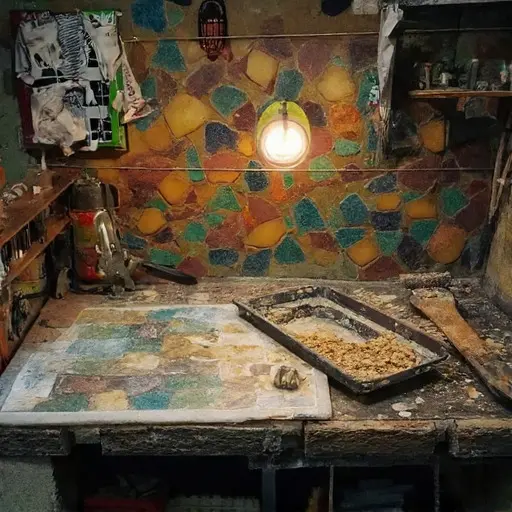
One dim evening left its subdued mark. A ceremonial wall panel lies across the main table—its upper patterns aligned with majestic precision, its lower bands dissolving into irregular joints. A trowel’s blade shows a fresh bend. A bowl of tesserae rests overturned, pigments mingling against their intended design.
Pinned beneath an incomplete stencil is a torn scrap: “Chiedono risarcimento per la vergogna.” They demand compensation for disgrace. Another fragment, blurred by mortar streaks, reads: “Ho seguito la forma… loro la negano.” I followed the form… they deny it. His handwriting wavers downward, spacing uneven, letters sagging like mis-set tiles. Even the tesserae bowls—once immaculate—now tilt, some stones spilled as though brushed in frustration.
A half-carved corner motif nearby remains rough, its symmetry abandoned mid-curve.
A Hidden Pocket Behind the Marble Rack
Behind stacks of marble offcuts and color bowls, a leaning board gives way. Inside rests a small mosaic Giulio began for Lucia: a simple sun motif, its rays formed from bright tesserae placed with exquisite care—yet half the circle remains outlined only in charcoal. A folded note in his trembling script reads: “Per Lucia—quando torna la mia sequenza.” For Lucia—when my sequence returns. The final word fades into a pale, trailing line.
Beside it lies a fresh slab of limestone, untouched, awaiting designs he no longer trusted himself to begin.
The Last Fragmented Pattern
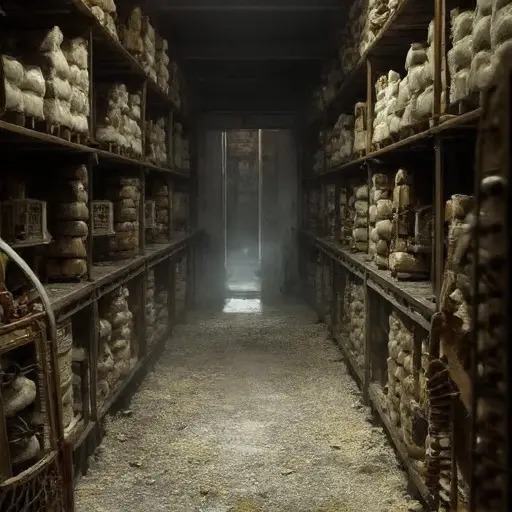
Inside a shallow drawer beneath the mounting frame lies a test mosaic strip: its opening tiles aligned in sure rhythm, its ending pieces drifting into scattered misfit. Beneath it Giulio wrote: “Even meaning cracks when resolve breaks its sequence.”
The mosaic studio folds back into mineral-scented stillness, unfinished designs resting in mute suspension.
And the house, holding its abandoned mosaicist’s chamber, remains abandoned.