The Haunting Kowalski Carpentry Atelier Where the Measurements Drifted from the Mark
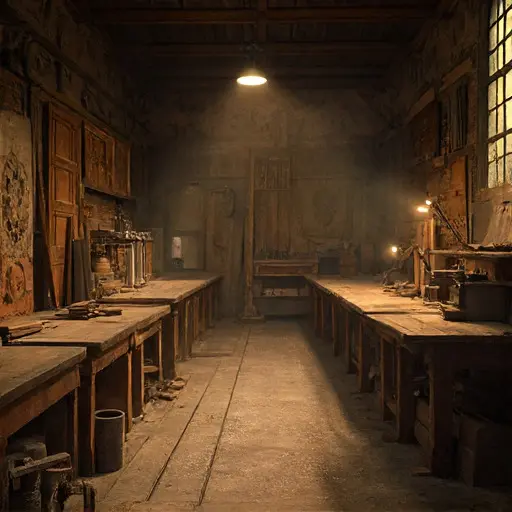
A low stillness settles over the benches, as though every unfinished joint has drawn a shallow breath. On the center bench rests a cabinet door—its upper mortise crisp and balanced, its lower mortise slightly skewed, angled as though a careful hand paused mid-cut. A try square hangs askew from its peg.
A pot of glue has skinned into amber ridges. Nothing abrupt has happened here; only the subtle hesitation of craft once shaped by certainty.
A Woodworker Moving by Line, Grain, and Mark
This carpentry atelier belonged to Jakub Stefan Kowalski, cabinetmaker and decorative joiner, born 1871 in Kraków. Raised in a modest carpenter’s household, he trained under a traveling craftsman who taught him to read grain direction, sense balance through weight, and trust the measured mark laid before the saw. A threadbare red ribbon from his sister, Helena Kowalski, ties a bundle of folded design sketches above a shelf.
Jakub lived by rhythm: dawn planing of raw boards, midday chiseling of joints, dusk sanding of finished surfaces under lamplight. His tools remain arranged with devotion—planes sharpened to clean steel, chisels wrapped in cloth, clamps aligned like quiet sentinels. Collectors once admired his cabinets for their integrity, fine symmetry, and calm restraint.
When Boards Refused Their Perfect Fit
In his stronger years, the atelier hummed with patient continuity. Boards from Tatra pine and beech rested in tidy stacks. Joints clicked into alignment with practiced ease. Carved details unfurled in disciplined arcs along panel edges.
But slight irregularities crept in. A dovetail darkens where the chisel bit too deep. A frame sags a hair off-square. A drafted outline sits faintly misaligned. On a plan sheet, the name of a noble patron appears written, struck through, rewritten, then blurred by glue. A clipped Polish note mutters: “Mówią, że przekręciłem projekt”—they say I distorted the design.
Word circulated quietly: a ceremonial cabinet Jakub delivered showed a subtle flaw in its central panel—its carved motif leaning off-center, its joints not perfectly flush. The patron insisted the piece mocked his family crest. Others whispered Jakub refused additions meant to emphasize status, stirring quiet hostility.
The TURNING POINT Carved into Wood and Weariness
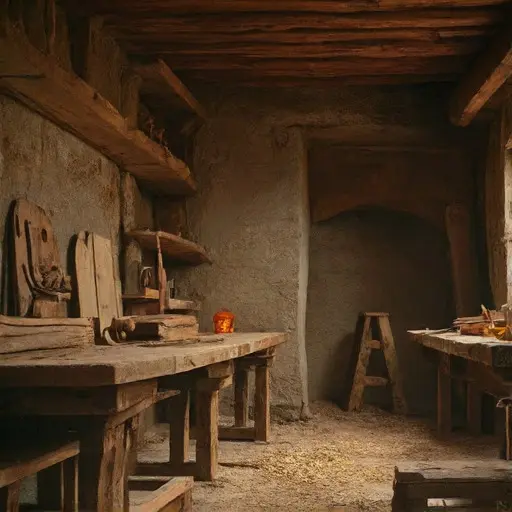
One late evening left signs scattered in muted disorder. A grand cabinet door rests half-assembled—the upper joints balanced and clean, the lower joints drifting outward, leaving a thin, accusatory gap. A saw handle bears a fresh fracture. A glue brush has stiffened mid-stroke.
Pinned beneath an off-cut panel is a torn scrap: “Żądają odszkodowania za zniewagę.” They demand compensation for insult. Another fragment, stained by glue, reads: “Zachowałem linię… odrzucają ją.” I kept the line… they reject it. His handwriting slants downward, spacing widening as if pulled by fatigue. Even the clamps—usually ordered by length—stand uneven, some forced tight, others loosened too early.
Across the bench, a carved crest lies unfinished, its central flourish frozen in a wavering curve.
A Small Recess Behind the Tool Cabinet
Behind the tall cabinet of chisels and rasps, a narrow board gives way. Inside rests a wooden music box Jakub began for Helena: its lid carved in serene precision, its inner compartment outlined only in pencil. A folded note in his trembling script reads: “Dla Heleny—kiedy moja ręka wróci do pewności.” For Helena—when my hand returns to certainty. The last word fades into faint graphite.
Beside it lies a fresh pine block, flawless and waiting for the first decisive cut he never delivered.
The Last Misaligned Joint
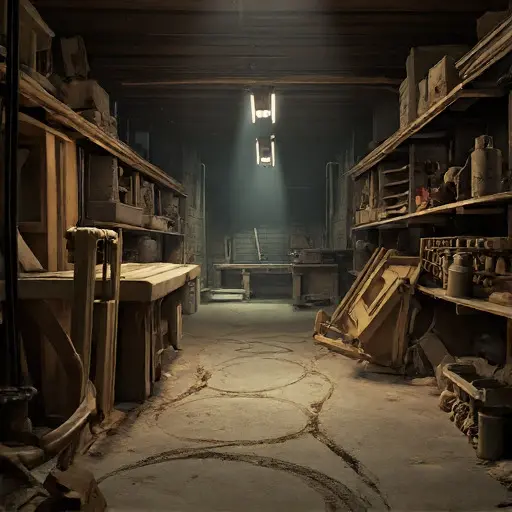
In a shallow drawer beneath the assembly table lies a test frame: its first corner locked in elegant precision, its final corner widened into a hesitant gap. Beneath it Jakub wrote: “Even structure shifts when resolve misses its mark.”
The carpentry atelier exhales into resin-scented stillness, unfinished joints resting in mute suspension.
And the house, holding its abandoned joiner’s chamber, remains abandoned.