The Lost Diop Weaving Loft Where the Threads Strayed from Their Loom
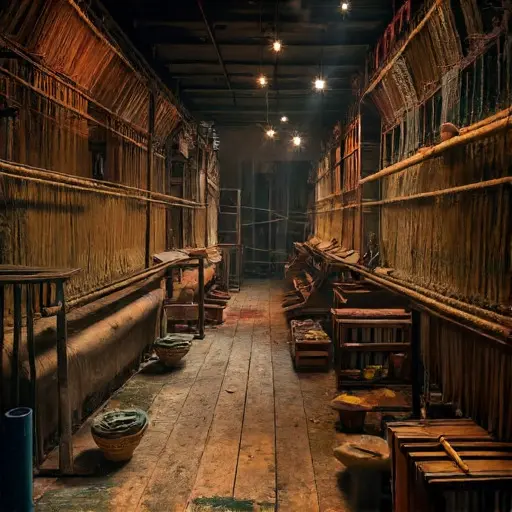
A warm hush hangs above the looms, woven with remnants of indigo dye. On the central frame, a half-finished strip of cloth shows rhythmic geometry at the top, unraveling into timid irregularity toward the lower edge. A beater leans crookedly against a heddle bar.
A tension weight hangs slack, pulling the warp out of true. Nothing here signals catastrophe—only the gradual softening of a discipline once held steady by memory and hand.
A Weaver Guided by Color, Pattern, and Thread
This weaving loft belonged to Aminata Salif Diop, strip-weaver and textile artisan, born 1877 near Saint-Louis in Senegal. Raised in a modest family of dyers, she trained under a traveling loom-worker who taught her the cadence of warp and weft, the tension changes that shape motifs, and the quiet arithmetic of balanced cloth. A faded indigo cord from her brother, Mamadou Diop, ties a bundle of pattern drafts along the rafters.
Aminata moved by a steady ritual: dawn stretching of warp lines, midday weaving through geometric cycles, dusk knotting of finished edges beneath a small lantern. Her instruments remain carefully arranged—shuttles waxed, yarn skeins sorted by hue, loom beams polished from years of touch. Patrons once admired her cloth for its symmetry, lightness, and unspoken harmony.
When Motifs Lost Their Holding Rhythm
In her strong years, the loft pulsed with patient motion. Indigo-dyed yarn from coastal traders dried along taut ropes; completed strips hung in neat columns, repeating motifs like soft percussion.
Then, small deviations slipped into the pattern. A diamond motif slants off-center. A tension weight hangs too lightly. A warp thread loosens without correction. Her commission ledger shows a merchant family’s order written, crossed out, rewritten, then smudged by dye. A brief Wolof note reads: “Neena neen def dara reccu”—they say you did something wrong.
Rumors traveled through textile stalls: a ceremonial cloth Aminata wove for a marriage gathering revealed misaligned motifs—its center panel drifting, its edges refusing to stay true. The family accused her of embarrassment, claiming the flawed cloth hinted at disharmony. Others whispered she refused their demand to alter traditional patterns for ostentation, stirring quiet anger.
The TURNING POINT Woven into Hesitation and Strain
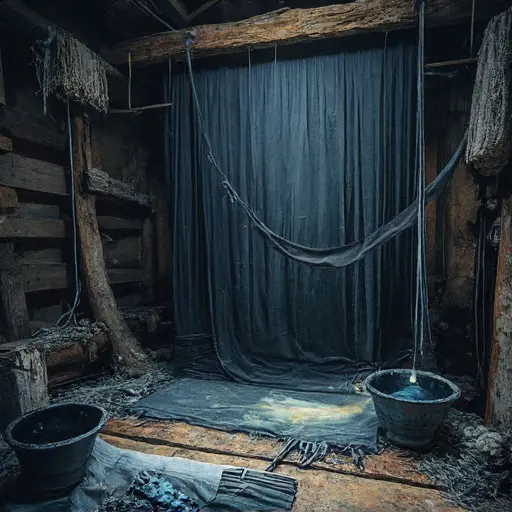
One fading evening left layered evidence. A long ceremonial strip lies across the main loom—its top pattern crisp and balanced, its lower motifs wandering into asymmetry. A heddle bar lists slightly, pulled by a loose tie. A pot of indigo water rests clouded with silt, as though cooled before the dye set properly.
Pinned beneath a curling pattern sheet is a torn scrap: “Dafa ñaanal lu bees.” They demand repayment for disgrace. Another fragment, blurred where damp dye spread, reads: “Xaar naa ci dëgg… ñoom du leen neex.” I followed the truth… they refuse it. Her handwriting dips into wavering strokes, spacing inconsistent. Even the skeins—usually arranged by shade—sit in jumbled piles, colors touching where they once stayed distinct.
On a nearby bench, a length of warp thread lies frayed at the ends, tension forgotten.
A Quiet Hollow Behind the Loom Beams
Behind the tallest loom, a panel shifts inward. Inside rests a small cloth she meant for Mamadou: the starting motif stitched with gentle precision, the continuing rows marked only in faint chalk guidelines. A folded note in her trembling hand reads: “Ngir Mamadou—bi samay xët dañu dellu.” For Mamadou—when my threads return. The final word fades into pale dust.
Beside it lies a spool of undyed cotton, pristine and soft, awaiting a weaving she no longer trusted herself to begin.
The Last Unraveled Line
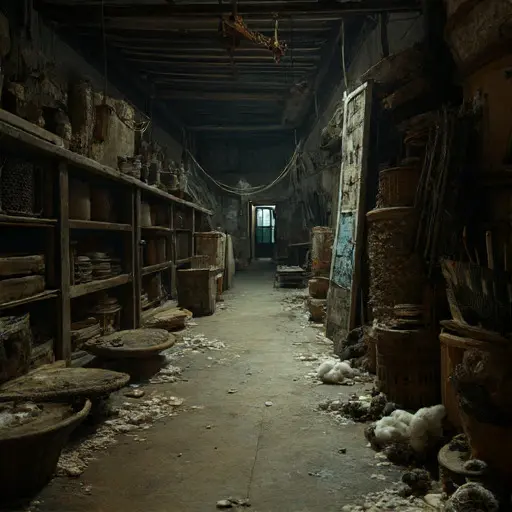
In a shallow drawer beneath the silent warp frame rests a test strip: its first rows measured and strong before drifting into uncertain spacing, warp and weft losing their pact. Beneath it Aminata wrote: “Even purpose unweaves when resolve breaks its thread.”
The weaving loft settles into dye-scented quiet, unfinished patterns lingering in mute suspension.
And the house, holding its abandoned weaver’s chamber, remains abandoned.