The Haunting Ndlovu Beadwork Chamber Where the Patterns Slipped Out of Rhythm
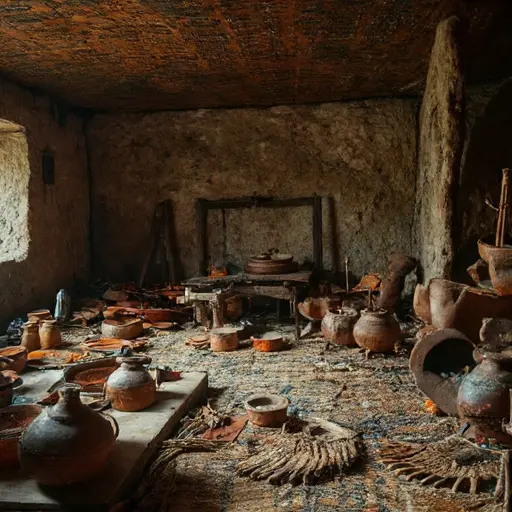
A kind of soft quiet clings to the air, carrying a hint of dust and dye. On the main worktable lies a half-finished collar—its upper half composed in sure geometric harmony, its lower half drifting into irregular clusters as though the hand that guided them faltered mid-pattern. A bone awl rests bent near a spool of sinew gone slack.
A gourd of white beads tilts, several lodged against a woven mat as if halted in flight. Nothing abrupt occurred here—only the slow unthreading of confidence.
A Maker Guided by Color, Pulse, and Fragile Rhythm
This beadwork chamber once belonged to Zanele Makhanda Ndlovu, bead artisan and adornment specialist, born 1875 near Durban. Raised in a modest family of textile dyers, she learned under a traveling craftswoman who taught her to read tension in sinew thread, to space beads by instinctive count, and to follow traditional motifs without losing her own voice. A faded indigo strip from her brother, Sibusiso Ndlovu, is tied around a bowl of cobalt beads.
Zanele’s daily cadence was deliberate: dawn threading of base rows, midday tightening of multi-strand sections, dusk pressing finished pieces beneath warm cloth. Her materials remain arranged with affectionate precision—motif sketches folded neatly, dyes stored in small clay pots, beads sorted by shade in calabash bowls. Patrons once treasured her adornments for their clarity, balance, and quiet pulse.
When Motifs Drifted from Their Logic
In her bright years, the chamber carried a soothing buzz of practice. Cobalt beads arranged themselves in measured ascents; ochre and cream wove into symmetrical flares; completed adornments dried on racks with confident precision.
But irregularities crept in. A triangular motif lists a degree off-center. A sinew thread loosens where it should hold firm. A bead cluster shows muddied spacing. Her commission ledger bears the name of a prominent wedding family written, crossed out, rewritten, then smudged by a droplet of dye. A terse isiZulu note beside it reads: “Bath’ ngiphazamise umshado wabo”—they say I disrupted their wedding.
The murmur that followed struck deep: the family claimed her ceremonial necklace unraveled during the procession—beads slipping free as though symbolically dishonoring the union. Others whispered she refused to modify the pattern to exaggerate status symbols the family insisted upon, stirring quiet tension.
The TURNING POINT Caught in Thread and Doubt
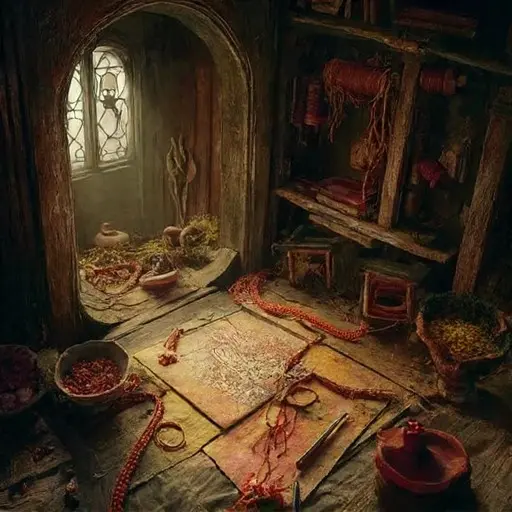
One evening left its subdued evidence. A grand wedding collar dominates the table—its top bands strung with unerring precision, its lower tiers crooked where beads slipped free or threads pulled thin. A clay pot of dye has dried into crusted cracks. A length of sinew rests frayed at the midpoint, fibers splayed like a whisper unraveling.
Pinned beneath a torn motif sketch lies a scrap reading: “Bafuna imali yokuhlazeka.” They demand repayment for disgrace. Another fragment, blurred by bead dust, reads: “Ngilandela iphethini… bayiphika.” I followed the pattern… they deny it. Her handwriting thins between strokes, as though the line between duty and doubt tightened unbearably. Even her bowls of beads—normally sorted in calm gradients—sit disturbed, colors mixing in subtle disarray.
Across the floor, a trail of cream beads arcs like the remains of a once-assured gesture.
A Hidden Hollow Behind the Dye Rack
Behind the stacked clay pots of pigment and drying cloths, a reed panel shifts aside. Inside rests a necklace Zanele meant for Sibusiso: upper strands threaded with patient elegance, lower strands sketched only by a lightly penciled path on a strip of hide. A folded note in her trembling script reads: “KuSibusiso—uma isingqi sami sibuyela.” For Sibusiso—when my rhythm returns. The final word breaks into faint graphite.
Beside it lies a calabash bowl of untouched beads, colors luminous under untouched light, awaiting arrangement she could not begin.
The Last Unsteady Pattern
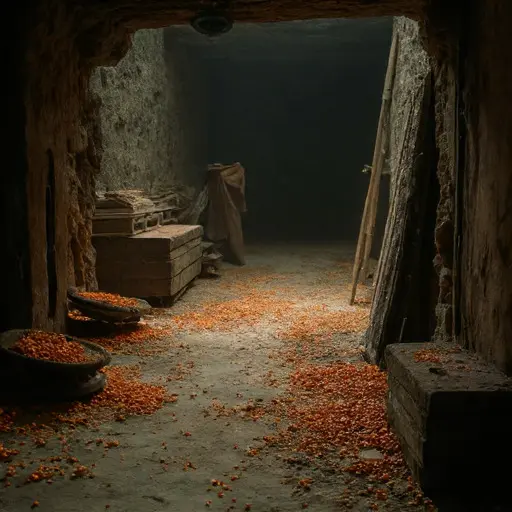
Inside a shallow drawer beneath the beading frame rests a test strand: its opening sequence aligned in calm symmetry, its latter portion scattering into uneven spacing. Beneath it Zanele wrote: “Even meaning falters when resolve slips from its rhythm.”
The beadwork chamber exhales into dye-scented quiet, patterns lingering in half-shaped memory.
And the house, holding its abandoned artisan’s chamber, remains abandoned.