The Eerie Kowalski Lithography Workshop Where the Plates Fell Out of Register
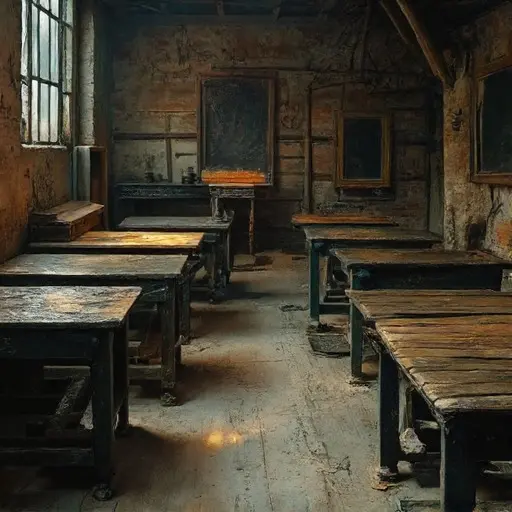
A low, ink-scented hush holds the room. On the central stone, a half-drawn illustration shows confident shading on one side and blurred lines on the other, as though the artist’s hand tightened then wavered at a crucial contour. A roller sits heavy with half-dried pigment.
A proof print lies smudged along one margin, its alignment slipping shy of the mark. Nothing violent—only the soft evidence of a practiced craft loosening at its seams.
A Printer Defined by Pressure, Patience, and Fragile Register
This lithography workshop belonged to Józef Marek Kowalski, lithographic artist and printer, born 1872 in Kraków. Raised among modest bookbinders, he apprenticed under a journeyman printmaker who taught him the delicate graining of limestone, the angle of pressure that carries ink without pooling, and the slow coaxing of sharp detail from subtle grease. A red thread from his sister, Magda Kowalska, knots around a tin of charcoal dust.
Józef’s days followed a careful rhythm: dawn graining of plates, midday drawing in waxy crayon, dusk rolling ink across etched fields under patient lanternlight. His instruments remain in studied ranks—scrapers laid sideways, rollers lined by width, pigments tamped into quiet bowls. Patrons once sought his prints for their clarity and disciplined shading.
When the Lines Wandered from Their Hold
During his strongest years, the workshop thrummed with purposeful calm. Limestone plates bore elaborate cityscapes; pigments from Vienna suppliers dried in smooth layers; proofs stacked in drying racks revealed crisp boundaries and steady proportions.
Then distortions slipped in. A skyline leans past its true angle. A shadow mottles where it should grade smooth. A plate’s edge chips from careless pressure. His commission ledger lists a museum order written, crossed out, rewritten, then stained by thick ink. A clipped Polish note scrawled beside it reads: “Mówią, że przekręciłem historię”—they say I distorted history.
Word circled among printers: a commissioned historical scene printed askew, its central figure appearing off-balance, as if mimicking insult. Others whispered he refused the patron’s demand to enlarge certain heroic details, igniting quiet suspicion.
The TURNING POINT Pressed Into Stone and Strain
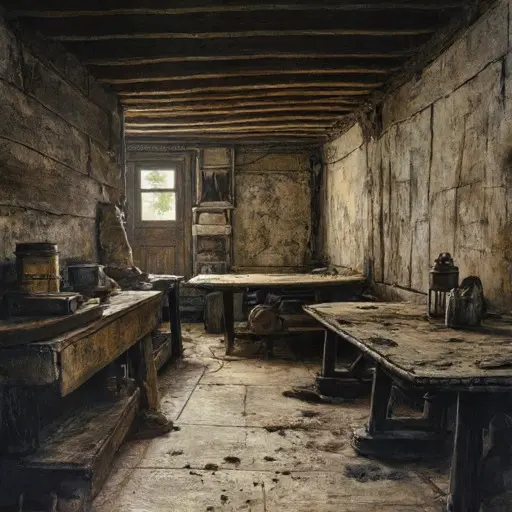
One evening left delicate traces. A major commission rests on a grained block—its left quadrant shaded with decisive hatching, its right side faltering into weak, unresolved shapes. A heavy roller lies dented near the handle. A bowl of pigment has separated, oil dragging away from its colored sediment.
Pinned beneath a smudged proof is a torn scrap: “Żądają odszkodowania za wstyd.” They demand compensation for shame. Another fragment, blurred where ink pooled, reads: “Rysowałem zgodnie z prawdą… odrzucają ją.” I drew according to truth… they reject it. His handwriting drifts downward as if each stroke sank under weight. Even the tools on the benches—usually aligned precisely—sit skewed and unsettled.
Near the wall, a discarded sheet of limestone shows accidental gouges where his hand must have slipped.
A Hollow Behind the Stack of Printing Stones
Behind the tower of unused stones, one block shifts slightly from the wall. Behind it rests a private lithograph Józef meant for Magda: a quiet woodland scene drafted in graceful silhouettes, its lower half barely sketched. A folded note in his faltering script reads: “Dla Magdy—gdy mój kontur wróci.” For Magda—when my contour returns. The last word trails into faint graphite.
Beside it lies a pristine stone slab, grained smooth and ready, awaiting the drawing he could no longer trust himself to begin.
The Last Misaligned Impression
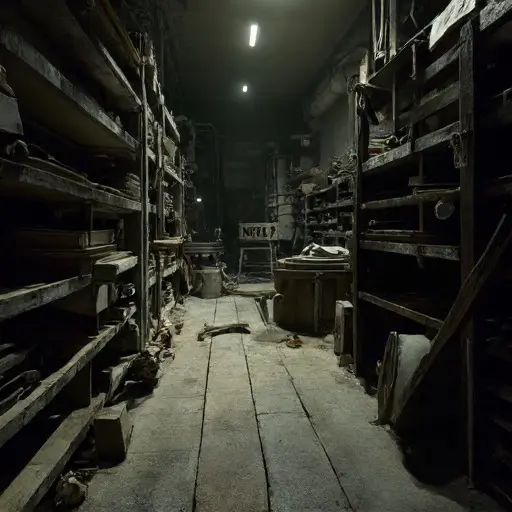
Inside a shallow drawer beneath the idle press lies a test print: its left half aligned with elegant precision and its right half drifting off the mark by a narrow, damning tilt. Beneath it Józef wrote: “Even truth skews when resolve breaks its register.”
The lithography workshop eases into ink-scented quiet, half-formed images resting in suspended intention.
And the house, holding its abandoned printmaker’s chamber, remains abandoned.