Hidden Gruber Glass-Compositor’s Cellar Where the Panels Lost Their Sheen
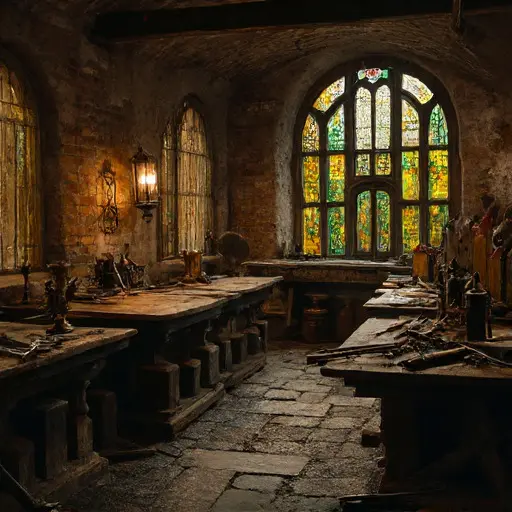
A hush presses low beneath the arched ceiling. On the central table, a half-assembled panel shows crisp geometry on one flank and unsure alignments on the other: lead lines wavering, amber sections set fractionally askew. A glazing knife lies tarnished beside a pot of stiffened putty.
A thin ruby triangle, intended for a corner flourish, sits chipped at the tip. Nothing loud remains—only the soft evidence of work that lost its confidence at the cusp of decision.
A Life Shaped by Careful Cuts and Fading Sheen
This glass-compositor’s cellar belonged to Anton Matthias Gruber, stained-glass artisan and leadwork compositor, born 1874 in Salzburg. Raised in a modest family of church caretakers, he trained under a traveling master who taught him to score panes with steady breath, guide breaks along patient curves, and solder came joints until the seams gleamed like quiet rivers. A faded ribbon from his sister, Helene Gruber, knots itself around a box of silver-oxide pigments.
Anton lived by subdued routine: dawn cutting of colored sheets, midday fitting of fragments into intricate geometry, dusk soldering under a dim lantern. His tools remain aligned with humble precision—cames sorted by thickness, irons polished smooth, brushes dusted in enamel hues. Patrons once praised his windows for their stable radiance and measured restraint.
When the Patterns Began to Slip Toward Discord
In his strongest years, the cellar carried a muted glow from panels drying along the racks. Blue and green panes from Bohemian traders arrived with reliable clarity. Completed windows waited for installation, their motifs balanced and luminous in the lamplight.
But hairline troubles emerged. A seam dips where it should rise. Enamel paint blurs into unintended haze. A score line bends out of its gentle arc. His commission ledger bears a parish’s request written, crossed out, rewritten, then smudged by putty. A clipped German note near the margin reads: “Sie sagen, ich habe ihr Heiligtum entstellt”—they say I disfigured their sanctuary.
Word passed quietly among artisans: the parish claimed Anton’s finished panel fractured during mounting—its central figure marred by a sudden crack that crept along the leadwork. Others whispered he resisted altering the depiction to flatter the donor’s wishes, a stance the committee considered insolence.
The TURNING POINT Etched into Glass, Lead, and Doubt
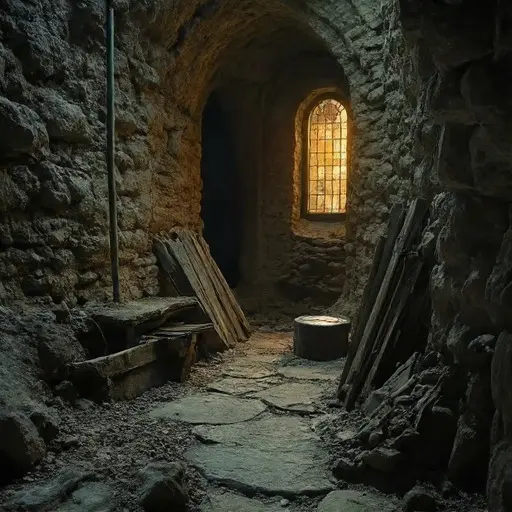
One late evening left its imprint. A commissioned panel dominates the table—its upper medallion graceful and flawless, its lower register muddled where ruby panes faltered out of alignment. A lead knife lies snapped at the handle. A pot of putty has dried into a cracked island along the rim.
Pinned beneath a wrinkled pattern sheet is a torn scrap: “Sie verlangen Ersatz für die Schande.” They demand compensation for disgrace. Another fragment, blurred by flux stains, reads: “Ich folgte der Form… sie leugnen sie.” I followed the form… they deny it. His handwriting shrinks, losing firmness between strokes. Even the pane stacks—usually sorted by hue—lean uncertainly, a few slid out of pattern.
Across the table, a small cobalt triangle sits scuffed, its intended curve flattened by a trembling score.
A Concealed Hollowness Behind the Rack of Panels
Behind the tall rack where finished windows once dried, a loose board shifts back. Inside rests a panel Anton began for Helene: its border fitted with harmonious blues, its center only sketched on parchment taped behind clear glass. A folded note in his wavering script reads: “Für Helene—wenn mein Licht zurückkehrt.” For Helene—when my light returns. The last word fades into thin graphite.
Beside the unfinished panel lies a flawless amber sheet, untouched, waiting for the cut he could not bring himself to make.
The Last Frayed Luminance
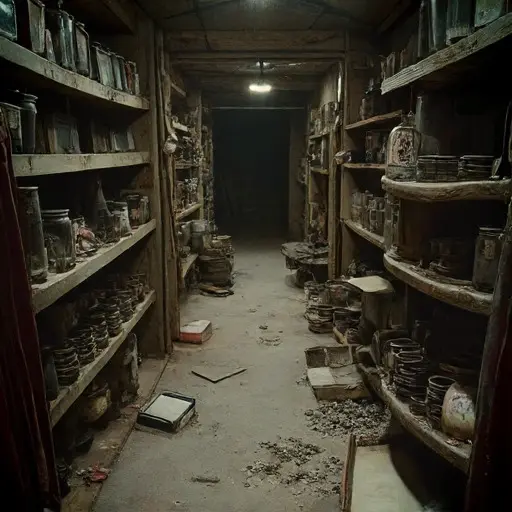
Inside a shallow drawer beneath the fitting frame lies a test sample: one curve soldered with elegant steadiness before the line buckles into a wavering edge, scattering weak reflections. Beneath it Anton wrote: “Even radiance dims when resolve loses its sheen.”
The glass-compositor’s cellar folds back into colored quiet, fragments resting in half-shaped stories.
And the house, holding its abandoned artisan’s chamber, remains abandoned.