The Silent Dubois Marquetry Attic Where the Veneers Shifted Out of Line
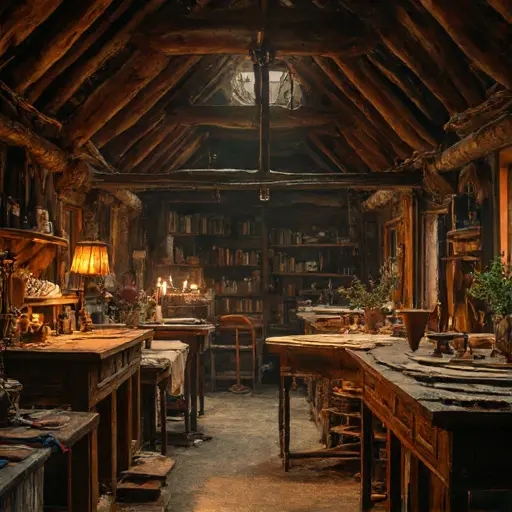
A muted stillness lingers here, warmer than dust yet hollow around the edges. On the central bench lies an unfinished inlay panel—its left side aligned with clean geometry, its right side showing mismatched seams where the craftsman hesitated. A fret saw slants across the pattern, one tooth missing from its blade.
Glue drips on a rag have hardened in uneven streaks, like intentions interrupted mid-gesture. No break, only the quiet retreat of certainty.
A Craftsman Guided by Grain, Harmony, and Fine Shift
This marquetry attic once belonged to Étienne Marcel Dubois, inlay artisan and furniture embellisher, born 1869 in Lyon. Raised in a modest household of cabinet joiners, he trained under a wandering ébéniste who taught him how to read grain direction, bond veneers with patient heat, and cut scroll patterns that breathed subtle movement. A faded ribbon from his sister, Colette Dubois, is pinned to a box of holly offcuts.
Étienne’s days moved in measured cadences: dawn trimming of veneers under morning lamplight, midday pressing of cut motifs, dusk fitting tiny inlay fragments into a larger tableau. His tools remain arranged with quiet ritual—saws hung by length, veneers stacked by tone, templates weighted with smooth stones. Patrons once admired the delicacy of his floral panels and the steadiness of his ornamental borders.
When Ordered Patterns Began to Slip
In the attic’s thriving years, cut veneers fit like calm puzzles. The glue pot warmed evenly, breathing faint steam. Finished panels dried under felt blankets, edges singing of craftsmanship and patient alignment.
But irregularities crept in. A petal motif misaligns by a whisper. A strip of ebony curls along its edge. A holly sliver darkens where glue spread too far. His commission list shows a noble household’s order written, crossed out, rewritten, then smeared by a drop of glue. A short French note beside it reads: “Ils disent que j’ai gâché leur crédence”—they say I ruined their sideboard.
Rumor wound through quiet workshops: the patron claimed Étienne’s panel warped after mounting—its pattern shifting off-line, making the household’s cabinet appear asymmetrical. Others whispered he refused to mirror the patron’s overly elaborate redesign, insisting the original balance was truer to the materials.
The TURNING POINT Pressed into Woodgrain and Doubt
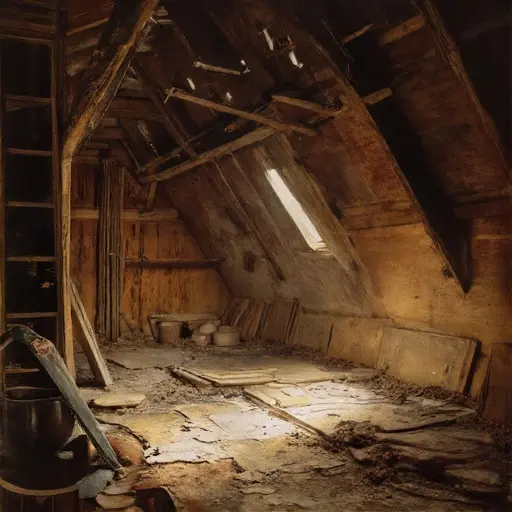
One evening left its marks. A commissioned panel for the dissatisfied patron sits tilted beneath a weight—upper motifs crisp and singing, lower motifs buckled where glue pooled or pressure wavered. A veneer strip meant for a border lies snapped along the grain. A glue brush rests splayed, its bristles set in hardened glue.
Pinned under a warped template is a torn scrap: “They demand compensation for disgrace.” Another piece, smudged by adhesive, reads: “I honored the pattern… they deny it.” His handwriting slants downward as if the quill slid without conviction. Even the veneer stacks—normally sorted by species—shift unevenly, several leaning as though disturbed in haste.
Across the bench, a pearwood leaf lies half-shaped, its lines faltering at the curve where his steadiness should have held.
A Narrow Nook Behind the Veneer Cabinet
Behind the tall cabinet of sorted veneers, a panel slides back. Inside rests a small inlay Étienne intended for Colette: a simple tulip motif whose upper petals glow in delicate harmony, while the lower petals remain outlined only in pencil. A folded note in his trembling script reads: “Pour Colette—quand mon regard redevient sûr.” For Colette—when my eye steadies again. The last word dissolves into faint strokes.
Beside it lies a pristine packet of holly veneer, uncut, waiting for the first confident slice he never made.
The Last Misaligned Edge
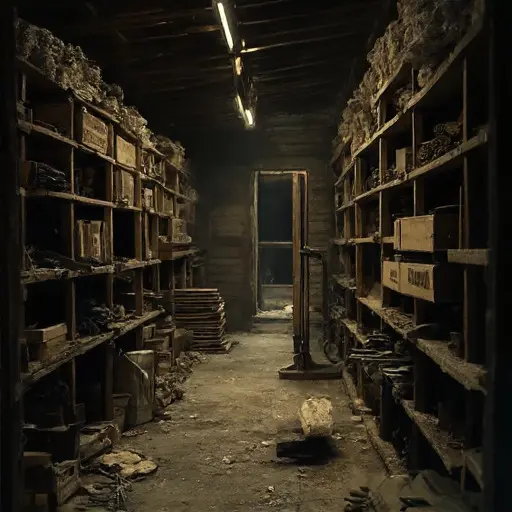
Inside a shallow drawer beneath the pressing stand rests a test motif: its first petals fitted with flawless precision, the final petal drifting just off its intended arc. Beneath it Étienne wrote: “Even pattern falters when resolve shifts.”
The marquetry attic eases into wood-scented quiet, its outlines locked in unfinished symmetry.
And the house, holding its abandoned inlayer’s chamber, remains abandoned.