The Eerie Takashima Ceramics Kiln-Room Where the Glazes Strayed from Their Bond
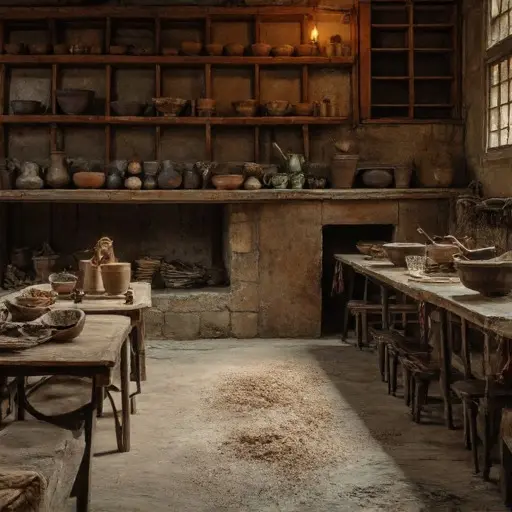
The kiln-room carries a quiet that feels recently stirred. A tea bowl on the central table reveals glaze on one half smooth as moonlit water, the other half broken into matte streaks where the mixture separated. A trimming tool lies halfway off the table, faint clay smears drying along its handle.
A bisque cup shows a warped lip, as though lifted too quickly from the wheel. Nothing broken outright—only a craft that faltered while precision hung in the balance.
A Potter Steeped in Rhythm, Heat, and Restraint
This ceramics kiln-room once belonged to Haruto Masayuki Takashima, potter and glaze-firings specialist, born 1873 in a district near Kyoto. Raised among modest kiln-workers, he studied under a traveling potter who taught him the listening of clay, the timing of water removal, and the meditative mixing of glazes. A small embroidered strip left by his sister, Emi Takashima, is tied to a brush jar that still carries whispers of mineral scent.
Haruto shaped his days through quiet cycles: dawn wedging of clay, midday trimming of leather-hard bowls, dusk mixing of glaze slurries before firing. His tools remain in careful order—ribs stored flat, sponges dried neatly, brushes bundled with twine. Patrons once admired the subtle glow and balanced surfaces of his finished vessels.
When Steadfast Practice Drifted toward Uncertainty
At his peak, the kiln-room thrummed with warm discipline. Clay from Shigaraki rested in tidy wrapped bundles. Bisque ware lined the shelves in unbroken rows. Glazed bowls emerged from the kiln luminous with steady color and fine crackling.
But small flaws crept in. A bowl’s foot ring roughens unexpectedly. A glaze dries into mottled blotches. A vessel slumps a fraction off-center. His commission ledger bears a tea master’s name written, crossed out, rewritten, then blurred by a streak of slip. A brisk Japanese note beside it reads: “He says my bowl betrayed ceremony.”
Rumor drifted quiet but firm: the tea master accused Haruto of presenting a ceremonial bowl whose glaze fractured unevenly during the ritual pour—interpreting the flaw as disrespect. Others whispered he refused to remake the bowl in a more ornate style, displeasing a man unused to refusal.
The TURNING POINT Fired into Clay and Doubt
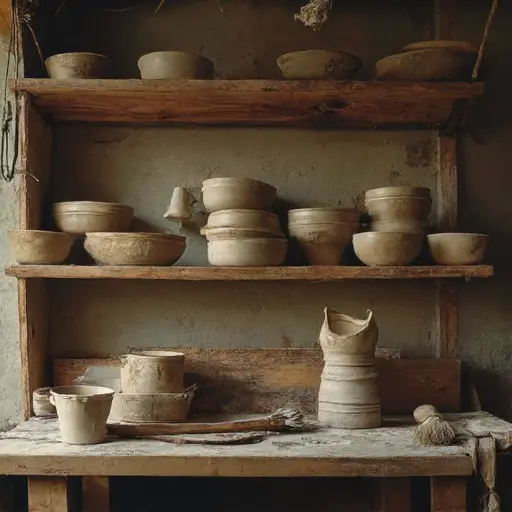
One evening left its muted evidence. A ceremonial tea bowl sits on a raised pad—its interior glossy and serene, its exterior showing a run of glaze that pooled off-line. A kiln stoke rod leans dented against the wall. A jar of feldspathic glaze has separated into uneven gradients.
Pinned beneath a broken test tile is a torn scrap: “They demand repayment for dishonor.” Another fragment, smudged by slip, reads: “I followed the kiln’s truth… they deny it.” His handwriting weakens toward each line’s end. Even the kiln logs—strict records of firing sequence—sit scrambled, pages out of order.
Across the table, a leather-hard bowl remains untrimmed, center sagged where hesitation overtook the cut.
A Narrow Hollow Behind the Kiln Woodrack
Behind the stacked wood for the climbing kiln, a discreet panel gives way. Inside rests a half-glazed tea cup: interior awash in a cool celadon sheen, exterior lightly brushed but unsealed. A folded note in Haruto’s trembling script reads: “For Emi—when harmony returns.” The final word trails off into faint graphite.
Beside it sits a perfectly shaped, unglazed bowl, walls thin and even, awaiting a glaze he never mixed.
The Last Unfired Line
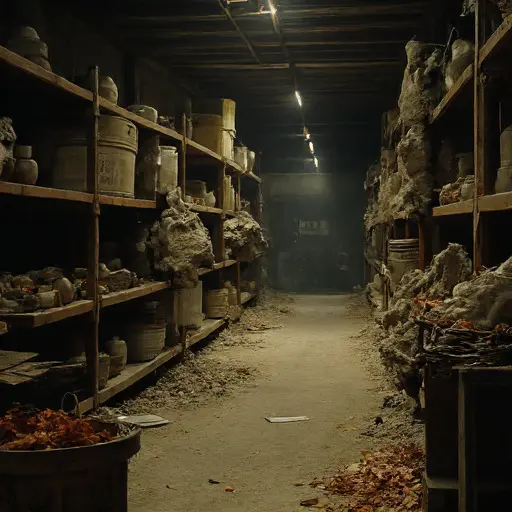
Inside a shallow drawer beneath the kiln cart rests a test tile: one edge glazed in a serene wash before the color fractures into a dull, broken pattern. Beneath it Haruto wrote: “Even fire’s bond falters when resolve thins.”
The kiln-room sinks back into mineral quiet, unfired intentions lingering in its still warmth.
And the house, holding its abandoned potter’s chamber, remains abandoned.