The Haunting Valente Confectioner’s Workroom Where the Sugars Drifted Off-Form
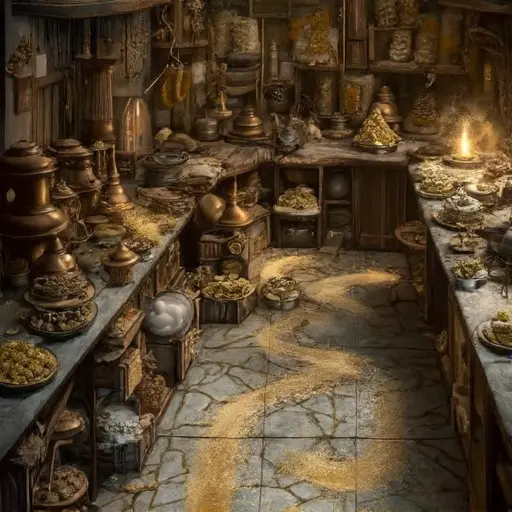
The room holds a warm, hushed tension. On the central slab sits a half-pulled sugar ribbon—one end beautifully stretched, the other collapsed as though the pull lost its moment. A cone of almond paste lies crumpled at the tip, shaped halfway toward a rosette before faltering.
A copper thermometer dangles from its chain, needle stalled between markings. Nothing sudden, only the evidence of a practiced art stalling at the precise instant harmony unraveled.
A Confectioner Who Crafted Sweetness by Discipline
This confectioner’s workroom belonged to Raffaele Domenico Valente, sugar-puller and pastry artisan, born 1874 in Verona. Raised among modest grocers, he apprenticed under a traveling sweetmaker who taught him the poise of molten sugar, the timing between soft-ball and hard-crack stages, and the care with which citrus peel must be candied. A green ribbon from his sister, Lucia Valente, is tied around a jar of candied bergamot.
Raffaele shaped his days by heat and patience: dawn boiling of syrups, midday cutting of brittle sheets, dusk folding delicate marzipan shapes under an amber lamp. His tools remain set in measured lines—molds stacked by pattern, knives kept in polished order, cloths folded along their sugar-hardened edges. Patrons once praised his confections for their gleam, balance, and floral subtleties.
When the Sugars Began to Slip from Precision
In earlier years, the workroom thrummed with sweetness. Honeycomb brittle cooled in neat sheets. Boiling syrups chimed softly as bubbles rose in even cadence. Finished sweets lay arranged in decorative tins, each shape crisp and unbroken.
Yet flaws began to surface. A caramel pull droops at its midpoint. A candied peel dries unevenly, edges over-sugared. A brittle mold shows a hairline warp. His commission ledger notes a countess’s order written, crossed out, rewritten, then smeared with a streak of syrup. A brief Italian note near it reads: “She says I spoiled her celebration.”
Rumor drifted through bakery circles: the countess accused Raffaele of providing sweets that softened during her gathering—losing their shape, staining linen, causing scandal. Others whispered he refused to darken the sugar to her preferred hue, prompting resentment.
The TURNING POINT Cast in Syrup and Strain
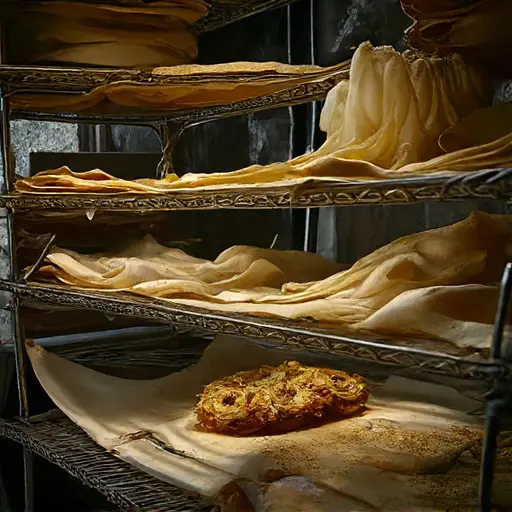
One evening left quiet signs of collapse. A grand commission—tiers of sugared citrus and spun sugar—sits unfinished, top decorations firm, lower sections sagging as if shaped in doubt. A copper ladle lies bent at its lip. A kettle of sugar syrup has cooled prematurely, surface dull and grainy.
Pinned beneath a folded parchment is a torn slip: “They demand restitution for shame.” Another fragment, blurred by syrup drips, reads: “I tempered faithfully… they dispute all.” His handwriting grows faint toward the last strokes. Even the molds—usually kept in tidy sequence—sit misaligned, one propped at an awkward angle.
Across the workstation, a marzipan figurine lies half-sculpted, its form collapsing into itself.
A Narrow Cubby Behind the Mold Cabinet
Behind the tall cabinet of molds and tins, a loose panel slides inward. Inside rests a small confection he began for Lucia: a candied rose petal perfectly crystallized at the edges, but the accompanying sugar filigree remains a soft sketch, never pulled into shape. A folded note in his wavering script reads: “For Lucia—when sweetness steadies.” The final word trails into pale graphite.
Beside the unfinished piece sits a jar of unheated syrup, its surface calm, waiting for a transformation he could not attempt.
The Last Slumping Ribbon
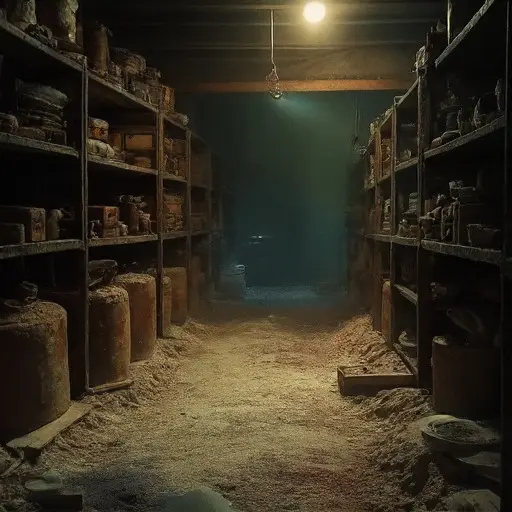
Inside a shallow drawer beneath the pulling hook rests a test ribbon: one end pulled to glassy sheen before the form collapses, folding into a dull curve. Beneath it Raffaele wrote: “Even sweetness falters when resolve drifts.”
The confectioner’s workroom settles into sugar-scented quiet, forms arrested in mid-creation.
And the house, holding its abandoned artisan’s chamber, remains abandoned.