The Strange Van Dalen Engraving Vault Where the Lines Slid Astray
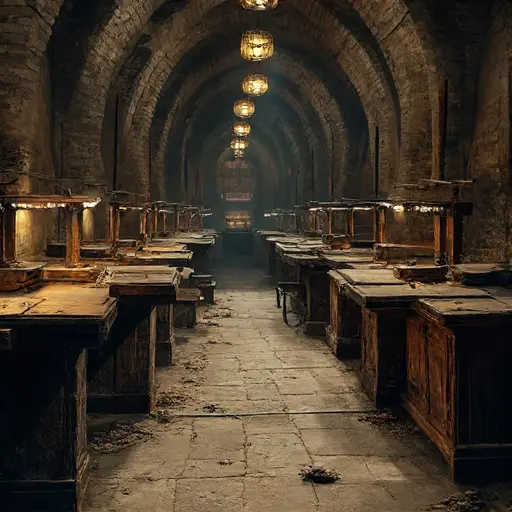
A hush clings to every tool. On the central counter, a copperplate portrait lies partly incised—its left side carved with unerring confidence, its right side wavering into hesitating marks. A burin with a chipped tip sits near a coil of cloth stiff with dried ink.
A rocker tool leans against a rag as though nudged from its place before the engraver’s certainty faltered. No rupture, merely the quiet slackening of a once-precise hand.
A Craftsman Who Etched Stillness into Metal
This engraving vault belonged to Pieter Willem van Dalen, copperplate engraver and printmaker, born 1873 in Haarlem. Raised among modest bookbinders, he trained under a traveling etcher who taught him depth, pressure control, and the delicate shaping of crosshatch shadows. His sister, Hester van Dalen, is remembered in a ribbon tied to a drawer of rocker tools.
Pieter organized his work with meticulous ritual: dawn scoring of primary outlines, midday carving of tonal fields, dusk inking and proof-pulling beneath the faint warmth of an oil lamp. His instruments remain in calm order—burins aligned by width, plates wrapped in linen, daubers cleaned into neat spirals. Patrons once praised his engravings for their clarity, restraint, and quiet power.
When Control Drifted from Its Measured Path
In better seasons, the vault steadied each motion. Copper sheets from Antwerp traders waited in stacked bundles. Press rollers gleamed beneath evening lamplight. Finished proofs dried on hanging lines, their shadows building in delicate harmonies.
But disruptions seeped in. A crosshatch deepens irregularly. A contour line dips unexpectedly. A copperplate corner bears a faint warp. His commission ledger lists a gentleman’s portrait order written, crossed out, rewritten, then smeared into unreadable strokes. A curt Dutch note beside it reads: “They say I marred his likeness.”
The rumor unraveled: the patron claimed Pieter portrayed him with insulting severity—lines too sharp, shadows too aged. Others whispered he refused to lighten the features as demanded, insisting on truthful depth over flattering illusion.
The TURNING POINT Inscribed in Metal and Strain
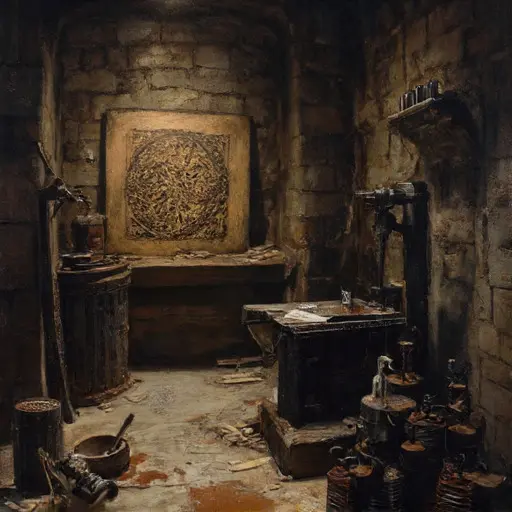
One late night left its quiet scars. A near-finished portrait plate sits on a linen pad, its mid-tones flawless, its upper features trembling into broken strokes. A burin rests snapped along its shaft. A copper sheet meant for a landscape engraving shows a crease from unknown pressure.
Pinned beneath a smudged proof is a torn scrap: “They demand restitution for insult.” Another fragment, blurred by linseed ink, reads: “I carved what I saw… they refuse it.” The handwriting trails lower with each word. Even the rocker tools—normally arranged like measured promises—skew slightly out of order.
Across the counter, a small tin of charcoal dust lies spilled, leaving diagonal streaks across the stone surface.
A Concealed Shelf Behind the Press Cabinet
Behind a tall press cabinet, a narrow door slides aside. Within rests a partially engraved copperplate: a serene waterscape its subject, lower half beautifully rendered, upper half etched only in faint guidelines. A folded note in Pieter’s wavering script reads: “For Hester—when my hand steadies anew.” The last word dissolves into pale scratches.
Beside the unfinished plate lies a pristine copper sheet, its surface mirror-bright, awaiting a first line he could not make.
The Last Frayed Line
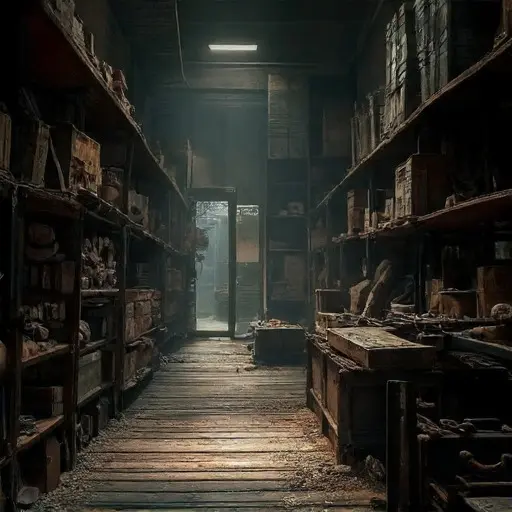
Inside a shallow drawer beneath the empty press lies a test incision: a clean, strong groove that abruptly weakens, drifting into shaky, shallow scoring. Beneath it Pieter wrote: “Even truth skews when resolve tilts.”
The engraving vault slips back into ink-scented quiet, lines lingering in unresolved metal.
And the house, holding its abandoned engraver’s chamber, remains abandoned.