The Hidden Sokolov Miniature-Painting Parlor Where the Strokes Broke Off
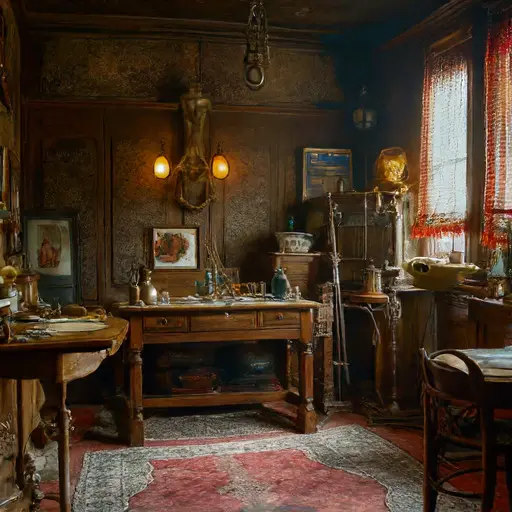
The quiet feels almost held in the air. A miniature on the main table shows a face outlined in calm precision, but the eyes remain a soft blur, as though the brush trembled before defining them. A brush with a single bent hair rests near a palette of muddled color.
A tiny oval frame stands empty beside a discarded cloth stained by strokes begun with intention yet abandoned. Nothing abrupt—only the sense of hands losing certainty where detail mattered most.
A Painter Who Labored in Whisper-Fine Detail
This miniature-painting parlor once belonged to Artem Leonid Sokolov, portrait miniaturist, born 1872 in Samarkand. Raised among modest artisans, he trained under a traveling painter who taught him the discipline of infinitesimal strokes, the preparation of lacquered panels, and the patience required to portray expression scaled to a thumbnail. His sister, Irina Sokolova, is remembered by a silk tassel tied to a pigment jar.
Artem lived by meticulous routine: dawn sanding of lacquer ovals, midday mixing of pigment paste with hushed precision, dusk painting of features under a focused lamp. His tools remain arranged with reverent order—brushes no thicker than a reed stem, pigments in carved bone trays, magnifiers polished to clarity. Patrons once valued his portraits for their stillness, tenderness, and exact likeness.
When Detail Slipped from Its Reliable Center
At his height, the parlor shimmered with careful purpose. Imported inks from Bukhara rested in sealed vials. Lacquered ovals dried along velvet pads. Completed miniatures gleamed in thin gold frames, each capturing a gaze with unwavering poise.
But imperfections crept in. A cheek shading turns muddy. A line defining a jaw flattens unexpectedly. A pigment mound dries unevenly across its shell. Artem’s commission ledger records a noble patron’s name written, crossed out, rewritten, then smeared. A quick Russian note beside it reads: “They say I insulted their likeness.”
Rumor moved in quiet circles: the family accused him of portraying their daughter with an unflattering shadow—claiming the miniature made her appear older, harsher. Others whispered he refused to adjust the portrait to meet a stylized beauty standard the patron demanded.
The TURNING POINT Written in Fragile Color
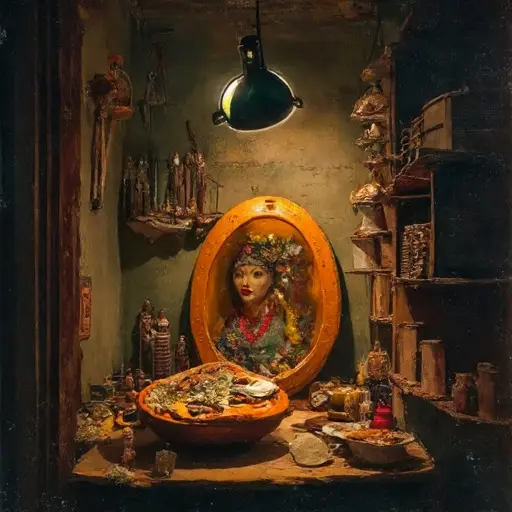
One evening left faint but telling signs. A portrait meant for the disgruntled patron sits tilted in its stand—the lower features shaped, the upper fading into erratic strokes. A magnifier lies toppled, its rim bent. A pigment shell used for mixing fine carmine has dried into clumped ridges.
Pinned beneath a vellum guide is a torn scrap: “They demand repayment for disgrace.” Another fragment, dampened by spilled pigment water, reads: “I painted with honesty… they insist on alteration.” The handwriting thins as though his hand trembled between each letter. Even the lacquer board—normally smoothed to mirror sheen—shows a faint scratch across its surface.
Across the table, a brush used for eyelash detailing sits bristle-splayed, its fine tip collapsed.
A Narrow Cavity Behind the Velvet Screen
Behind the brocade screen stands a hidden recess. Inside rests a miniature Artem began for Irina: the frame prepared, the background laid in quiet blue, the figure only softly sketched. Beneath it lies a folded note in his wavering script: “For Irina—when my hand steadies again.” The final word dissolves into faint graphite.
Beside the unfinished portrait sits a pristine lacquer oval, untouched, holding a promise he could not keep.
The Last Faltering Stroke
In a shallow drawer beneath the workstand lies a test panel: one eye painted with exquisite control, the other only outlined before the brush veered, leaving a pale smear. Beneath it Artem wrote: “Even likeness fails when resolve breaks.”
The miniature-painting parlor falls back into lacquer-scented quiet, fragile colors resting in half-realized form.
And the house, holding its abandoned painter’s chamber, remains abandoned.