The Forgotten Kral Shoemaking Attic Where the Leather Creased Out of Step
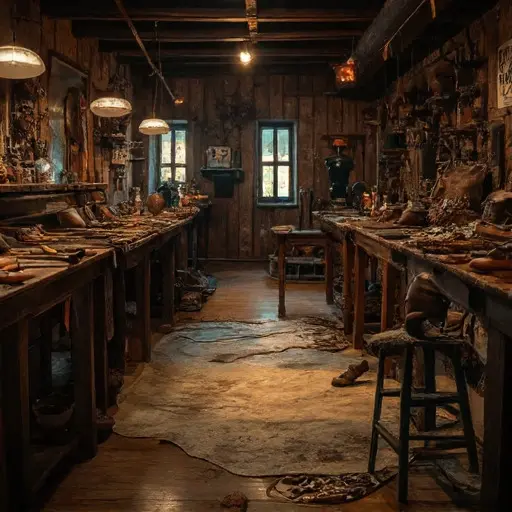
The hush seems weighted by the scent of hide and wax. On the central bench, a boot upper lies partly stitched, its seam even until a sudden wobble fractures the line. A last sits on its side, marked by stray chalk lines that drift from their intended contours.
A knife with a chipped edge glints beside a spool of thread that snapped mid-pull. No violence, not even haste—only the slow vanishing of a once-steady hand.
A Craftsman Shaped by Quiet, Exacting Labor
This shoemaking attic was the domain of Anton Václav Kral, bespoke cobbler, born 1871 near Brno. Raised among modest tradespeople, he learned from a traveling shoemaker who taught him to cut leather along its grain, to test flex with gentle pressure, and to stitch seams tight but yielding. His sister, Jitka Kral, endures here in a blue ribbon tied to the handle of a burnisher.
Anton ordered his days by careful procedure: dawn cutting of patterns, midday forming of vamps and quarters, dusk pulling final stitches under amber lamplight. His tools remain placed with humble fidelity—knives wrapped in cloth, awls arranged by thickness, thread sorted into skeins of flax and cotton. Patrons once praised the comfort and balance of his handmade boots.
As Reliable Craft Tilted Toward Disorder
In his strongest years, the attic answered each movement with calm precision. Leather shipments from Prague merchants lay folded neatly in crates. Completed shoes rested on racks, their silhouettes proud and symmetrical. Patterns pinned to the rafters bore clean, confident chalk arcs.
Then subtle faults emerged. An instep curve droops where it once lifted. A heel stiffener shows uneven lamination. A seam puckers just past the midpoint. His commission ledger carries the name of a noble household scribbled, corrected, then heavily blotted. A brief Czech note beside it reads: “They say the fault is mine alone.”
Rumors trailed through neighboring workshops: a patron accused Anton of crafting boots that collapsed during a formal procession—claiming the leather weakened prematurely. Others whispered he refused to alter the heel height to satisfy an impulsive client who demanded fashion over structure.
The TURNING POINT Pressed into Leather and Strain
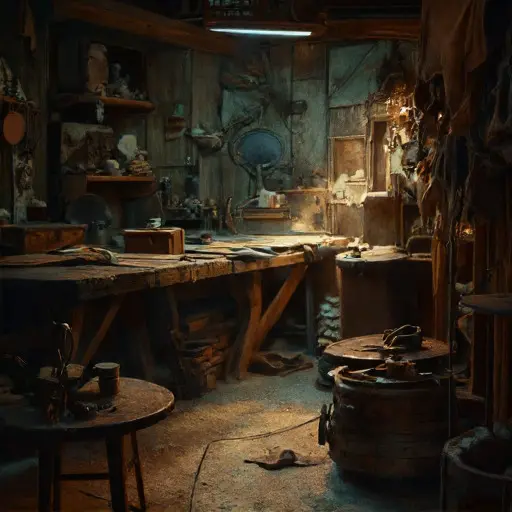
One evening left its traces. A nearly finished pair of ceremonial boots rests on the central stand—left boot shaped with assurance, right boot sagging along the upper throat. A lasting pinch lies crooked on the bench. A pot of beeswax has cooled into a dull rind, untouched before completion.
Pinned beneath a warped pattern piece is a torn scrap: “They demand compensation for disgrace.” Another fragment, smudged by wax, reads: “I followed the grain—they will not hear it.” His handwriting thins toward the margins. Even the measuring cords—once coiled with composure—lie tangled as though dropped in sudden discouragement.
Across the bench, a heelplate rests askew, its nails partly driven, as if he set his hammer aside mid-strike.
A Narrow Recess Behind the Pattern Cabinet
Behind the tall cabinet storing lasts and templates, a panel shifts back. Inside rests a half-assembled boot: the vamp molded with rare finesse, the quarter pieces pinned but unstitched. Beside it lies a folded note in Anton’s wavering script: “For Jitka—when my hands steady again.” The final word blurs into pale graphite.
Next to the unfinished boot lies a perfect piece of leather, its surface unmarred, waiting for a cut he never made.
The Last Uneven Stitch
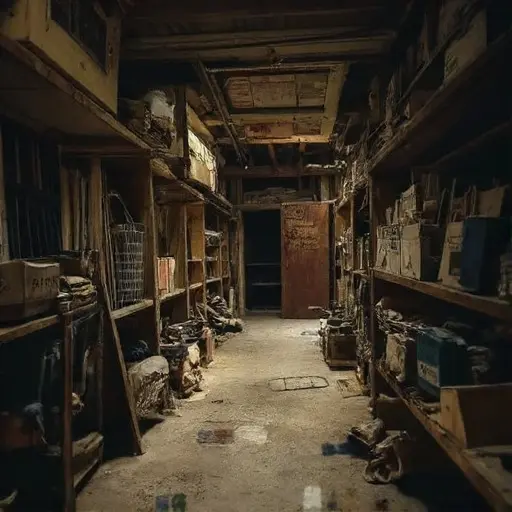
Inside a shallow drawer beneath the forming stand rests a test seam: tight and uniform across most of its length before one stitch slips wide, pulling the leather into an unintended buckle. Beneath it Anton wrote: “Even craft fails when certainty creases.”
The shoemaking attic folds back into wax-scented quiet, patterns drifting into half-shaped memory.
And the house, holding its abandoned cobbler’s chamber, remains abandoned.