The Eerie Moretti Mosaic Conservatory Where the Tesserae Lost Their Place
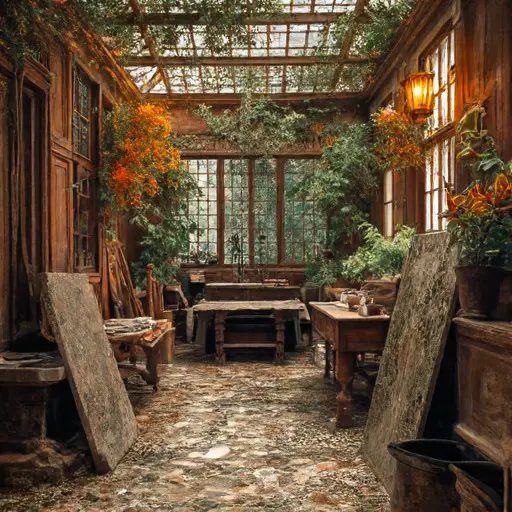
The conservatory holds a breathless stillness. A half-set mosaic on the central table reveals one side laid with mathematical grace while the opposite edge crumbles into hesitant spacing. A palette knife rests in a bowl of dried mortar, blade caught mid-swipe.
A tray of tesserae tilts forward, as if disturbed by a hand pulled abruptly away. Nothing violent—only disciplined labor arrested at the point where pattern might have clarified everything.
A Life Defined by Color, Weight, and Steady Rhythm
This mosaic conservatory belonged to Luca Domenico Moretti, mosaicist and stone cutter, born 1872 in Florence. Raised among modest stone merchants, he trained under a traveling artisan who taught him how to coax luminosity from tiny cubes, how to chase curvature through pattern, and how patience shapes even the smallest piece. A frayed green ribbon from his sister, Giulia Moretti, hangs from a tesserae scoop near the corner basin.
Luca’s workdays unfurled with ritual care: dawn cutting of stone slivers, midday mixing of lime mortar, dusk coaxing subtle gradients across shifting surfaces. His tools remain carefully arranged—chisels wrapped in cloth, mallets resting together, pattern boards stacked in gentle order. Patrons once praised his mosaics for their gentle transitions and quiet precision.
When Order Drifted Toward Unease
In his strongest years, the conservatory shimmered with calm purpose. Marble deliveries from Carrara filled the room with pale brightness. Completed panels dried against tiled columns, each design resolving into blooming geometry. Luca laid tesserae with unbroken discipline, fingers steady even in long stretches of silence.
But fractures emerged. A sweeping vine motif dips where it should rise. A color transition jars, jumping from bright ruby to dull ochre. A stone-cutting chisel bears an unexpected burr. His commission ledger lists a wealthy patron’s order written, crossed out, rewritten, and finally masked with mortar dust. A short Italian note scrawled beside it reads: “They say I distorted their emblem.”
Word drifted through artisans’ gatherings: he had been accused of misrepresenting a family crest—misplacing symbolic colors, altering delicate shapes. Others whispered he refused to revise a design to flatter a patron seeking gaudy flourishes.
The TURNING POINT Etched in Stone Dust and Strain
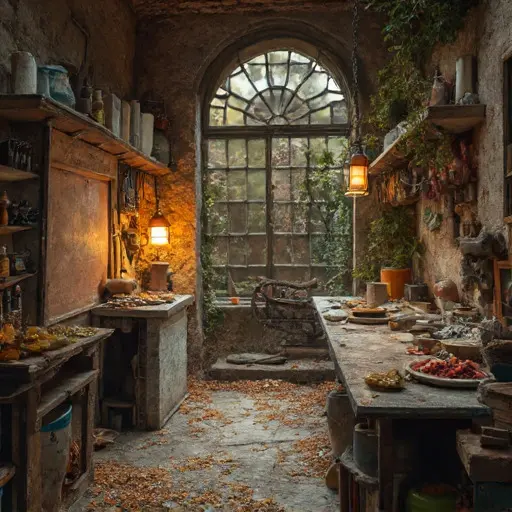
One dim evening left its imprint. A major commission rests on the main stand, central motif near perfection, outer ring hesitating between shapes. The gold-flecked tesserae meant for the crest’s crown sit untouched. A mixing bowl lies tipped, lime residue marking a pale crescent on the tiles.
Pinned beneath a curling vine-pattern board is a torn scrap: “They demand repayment for dishonor.” Another fragment, blurred by mortar dust, reads: “Their version… not mine to alter.” His handwriting thins as though his grip slackened. Even his color trays—normally sorted with quiet reverence—are shifted out of sequence, a single onyx cube resting in a tray of lapis.
Across the table, a small segment of border design has been lifted out, leaving pale gaps like words scraped from a sentence.
A Hidden Hollow Behind the Marble Cabinet
Behind a tall cabinet of sorted stone, a loose panel slides back. Inside rests a small mosaic circle: the center an elegant swirl of greens and blues, the outer ring only traced in chalk, never set. Beneath it lies a folded note in Luca’s wavering script: “For Giulia—when arrangement returns.” The final word fades into scattered graphite.
Beside this incomplete piece lies a fresh tray of uncut tesserae, their surfaces still dry with quarry dust, waiting for a direction he could not give.
The Last Uneven Line
In a shallow drawer beneath the mounting frame lies a test strip: tesserae aligned in a perfect curve until the final inch, where spacing falters and the gradient breaks. Beneath it Luca wrote: “Even pattern fails when resolve scatters.”
The mosaic conservatory dims back into mineral quiet, tiny stones resting in half-born design.
And the house, holding its abandoned mosaicist’s chamber, remains abandoned.