The Hidden MacAllister Violin-Making Loft Where the Notes Slipped Between
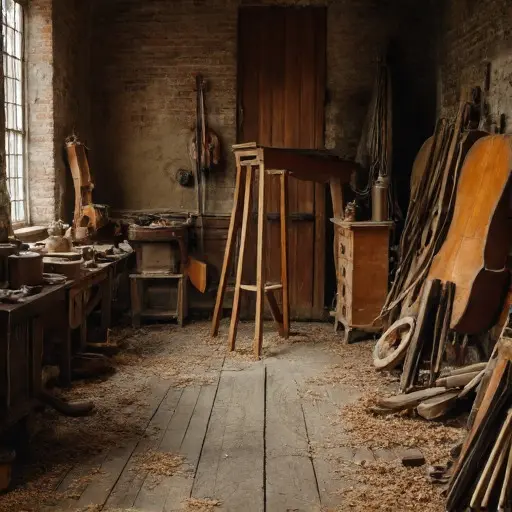
A hush gathers amid the rafters. On the central bench, a violin belly plate lies half-graduated—the bass side carved with delicate confidence while the treble side thickens abruptly. A soundpost setter rests at an odd angle beside a bridge blank shaved too thin along one foot.
A chisel leans against a clamp as though placed down in the instant a decision failed. Nothing violent, only the whisper of routine abandoned.
A Luthier’s Life Tuned by Patience and Subtle Hands
This violin-making loft bears the work of Ewan Douglas MacAllister, luthier and wood-tonal specialist, born 1875 near Inverness. Raised among modest crofters, he trained under a traveling fiddle-maker who taught him plate-tuning by ear, the slow warming of bending irons, and the fragile truth of resonance. A tartan scrap from his sister, Morven MacAllister, is pinned beneath a peg reamer on the upper shelf.
Ewan shaped his days in careful rhythms: dawn carving of plates, midday bending of ribs around heated irons, dusk varnishing under a low lamp that softened the tones of amber and red. His tools remain aligned with near-ritual precision—fingerplanes in descending sizes, scrapers honed razor-thin, hide glue kept warm in a small copper pot. Patrons once valued his violins for clarity, mellow warmth, and stable pitch.
When Steady Craft Began to Waver
In his strongest years, the loft hummed with quiet music-making. Imported tonewood billets from Mittenwald traders stacked neatly along one wall. Completed violins glowed on padded stands, their varnish luminous as late sunlight. Ribs bent in perfect arcs lay clipped to molds with even spacing.
Yet inconsistencies crept in. A back plate’s tap-tone sits duller than expected. A rib set rises unevenly along its mold. A varnish layer dries blotched, scattering reflections. His commission ledger shows a prestigious musician’s name written, crossed, rewritten, and finally struck through. A terse Gaelic note near it reads: “They say the tone lies.”
Rumors traveled: the musician accused Ewan of crafting an instrument that failed under performance—intonation unstable, projection unreliable. Others claimed he refused to alter wood thicknesses to match a fashionable continental model, angering a patron unaccustomed to dissent.
The TURNING POINT Hidden in Woodgrain and Hesitation
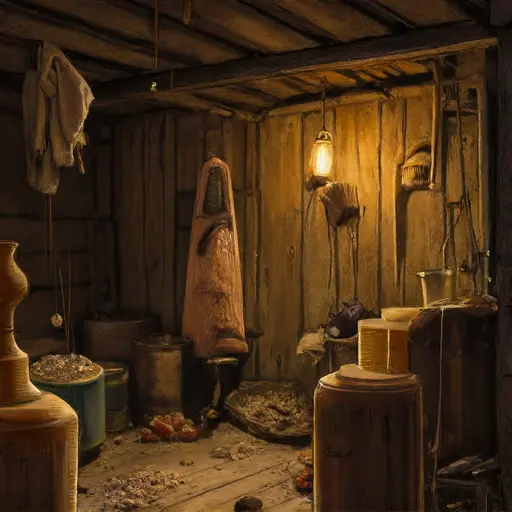
One late evening left clues scattered in gentle disarray. A nearly finished violin rests on its padded cradle, but the soundpost lies fallen inside the body, rolling faintly when moved. A bridge blank shows a snapped heart cutout. A long scraper bears a fresh nick, its edge marred by an impatient stroke.
Pinned beneath a plate caliper lies a torn scrap: “They insist the fault is mine alone.” Another fragment, blurred where varnish touched it, reads: “Compensation beyond hope.” The graphite sinks toward the final letters, losing pressure. Even the tuning forks—normally kept in exact alignment—lay askew, one bearing a faint dent as though struck against something unyielding.
Across the bench, rib offcuts scatter as if brushed aside without thought.
A Small Recess Behind the Tonewood Stack
Behind stacked spruce billets, a thin panel shifts with a soft rasp. Inside rests a violin back carved to near-perfection, its figure shimmering in quiet flame, but the final graduation remains unfinished along the upper bouts. A folded note in Ewan’s angled hand rests beneath it: “For Morven—when resonance returns.” The last word trails into pale graphite, thinning as though a breath wavered.
Next to it lies a fresh spruce billet, flawless and untouched, waiting for a new beginning he never managed to summon.
The Last Quiet Resonance
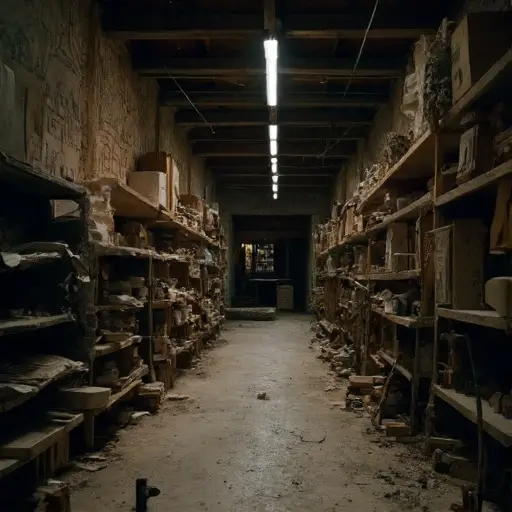
Inside a shallow drawer beneath the assembly stand lies a thin plate shaving: featherlight, clean along one edge, abruptly thick along the other. Beneath it Ewan wrote: “Pitch fails when conviction falters.”
The violin-making loft exhales resin-scented quiet, echoes stilled in half-formed wood.
And the house, holding its abandoned luthier’s chamber, remains abandoned.