The Veiled Duarte Drafting Gallery Where the Lines Bent Untrue
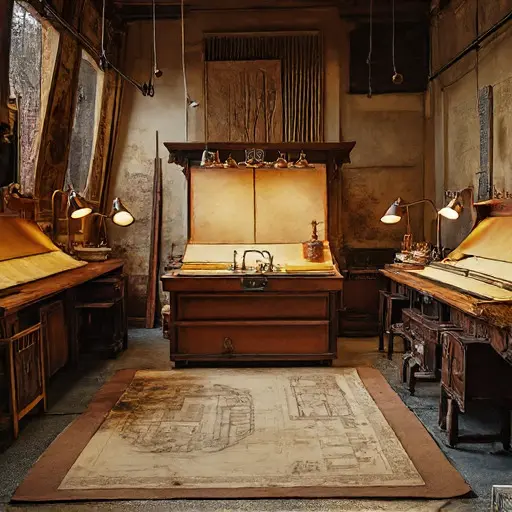
A hush pools beneath the slanted ceiling. A half-rendered elevation rests on the central table, one column drawn with meticulous care while its twin bows subtly out of symmetry. A compass lies splayed, a bead of dried ink glinting on its hinge.
A folded vellum corner has lifted as if a breath once stirred it, then never returned. Nothing broken—only the sense of a steady eye losing its sure hold on proportion.
A Draftsman Formed by Patience and Measured Sight
This drafting gallery carries the imprint of Joaquim Álvaro Duarte, architectural draftsman and ornamental designer, born 1873 near Porto. Raised among modest masons, he studied under a traveling architect who taught him disciplined geometry, steady shading, and the quiet refinement of proportion. A small ribbon from his sister, Leonor Duarte, is pressed beneath a paperweight shaped like a terracotta roof tile.
Joaquim worked in calm routine: dawn hatching of shadow lines, midday setting of column spacing, dusk tracing final elevations under lamplight. His tools remain arranged with restrained order—steel pens wrapped in linen, rulers sorted by length, stencils sliding neatly into oak drawers. Patrons once valued his unwavering scale, his elevations said to “breathe with balance.”
Where Precision Drifted into Unease
In earlier years, drawings unfurled in precise tiers. New vellum arrived from Lisbon dealers, crisp and pale. Completed plates pinned along the gallery wall displayed arches, windows, and lantern niches rendered with featherlight lines.
But small deviations now spread. A balcony curve flattens where it should rise. A façade grid displays an off-measure square. A pen nib splays at the tip, dried ink darkening its edge. Joaquim’s commission ledger bears a distinguished client’s name written, rewritten, then heavily blotted. A hurried Portuguese note reads: “They say my measure lies.”
Rumors stirred: he was accused of misrepresenting a heritage façade—geometry allegedly altered, dimensions deemed unfaithful. Others whispered he refused to adjust proportions to satisfy an official more concerned with fashion than structural truth.
The TURNING POINT Etched in Ink and Hesitation
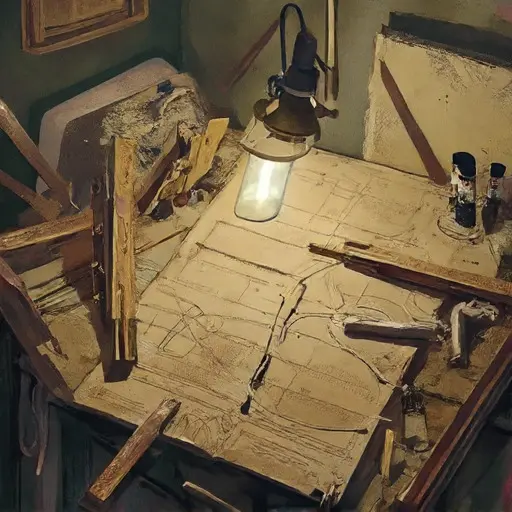
One late evening left telling fragments. A grand façade draft—nearly complete—rests beneath a cracked ruler, its central arch skewed by half a degree. A compass lies bent at the joint. A shading brush stiffens where diluted ink dried too soon.
Pinned under a folded elevation is a torn slip: “They challenge the truth of my render.” Another scrap, blurred where moisture touched it, mutters: “Restitution… impossible.” The handwriting fractures at the tail of each line. Even the perspective grid—normally precise—sits taped at an uneven angle, its vanishing points misaligned.
Across the main table, the masking tape used to secure vellum lifts at one corner, curling like an unspoken admission of uncertainty.
A Narrow Hollow Behind the Vellum Cabinet
Behind the tall cabinet of rolled drawings, a panel shifts inward. Inside rests a small elevation study: the lower tiers sharply rendered, the upper stories only faintly traced, tapering into nothing as if he could not commit the final lines. A folded note in Joaquim’s script reads: “For Leonor—when proportion returns.” The last word fades into thinning ink.
Beside it lies a pristine sheet of vellum, untouched, its surface cool and waiting for a confident outline he never set.
The Last Thin Stroke
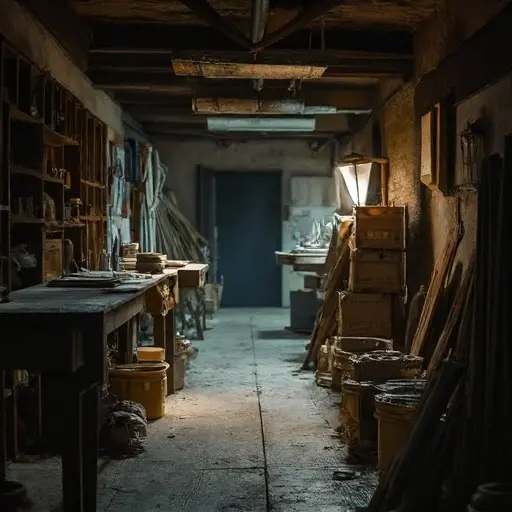
Inside a shallow drawer under the empty stand rests a small test sketch: a perfect corner molding that suddenly breaks into an uneven taper. Beneath it Joaquim wrote: “Measure falters when certainty thins.”
The drafting gallery exhales its ink-laden quiet, lines drifting in half-born symmetry.
And the house, holding its abandoned draftsman’s chamber, remains abandoned.