The Forgotten Demir Marquetry Parlour Where the Inlays Split Apart
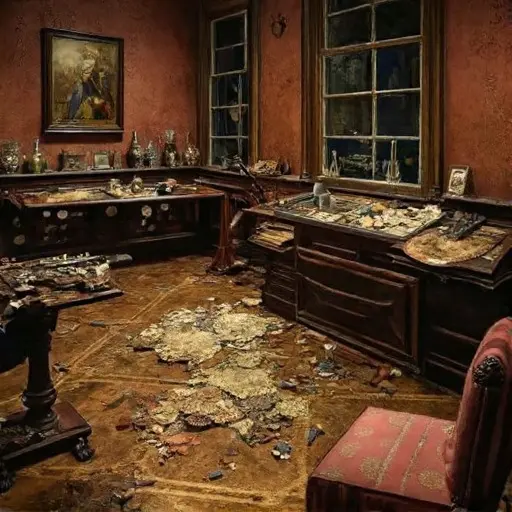
The parlour holds a hush thick as dust. A marquetry panel on the central bench shows precise tessellations on one side, while the opposite corner rises strangely from the glue bed. A knife with a snapped tip rests beside a strip of olivewood peeled back, curling like a question.
The angled ruler beneath the lamp bears a thin trail of adhesive dried mid-stroke. Nothing violent—only careful work arrested at the point of decision.
A Maker Formed by Pattern and Patient Heat
This marquetry parlour belonged to Kemal Orhan Demir, inlay artisan and furniture embellisher, born 1874 in Istanbul. Raised among modest carpenters, he trained under a traveling woodworker who prized geometry, restraint, and the subtle radiance of polished grain. His sister, Esma Demir, lingers in a beadwork tassel tied to the edge of a veneer press.
Kemal shaped his days by steady progression: dawn tracing of patterns, midday cutting of veneers, dusk heating hide glue under gentle lamplight. His tools remain aligned with serene logic—chisels wrapped in cloth, knives honed to whisper-thin edges, glue brushes stored with quiet care. Patrons once admired the crisp latticework and luminous sheen of his finished pieces.
Work Once Balanced, Then Fractions Crept In
In prosperous years, the parlour shimmered with intricate mosaics. Rosewood and pearwood arrived from coastal traders, cut into precise diamonds. Finished panels dried on stands along the wall, their motifs gliding from star to star in flawless transitions.
But distortions seep in. A star pattern drifts by a millimeter. A strip of bone inlay shows irregular spacing. A veneer saw bears a chip in its blade. His commission ledger lists a wealthy patron’s name written, crossed out, rewritten, then heavily blotted. A brief Turkish note nearby reads: “They say the pattern lies.”
Rumors murmured that Kemal misrepresented a patron’s ceremonial motif—its proportions said to violate a family’s inherited design. Others whispered he refused to copy a foreign inlay style demanded by someone with influence.
The TURNING POINT Held in Grain and Hesitation
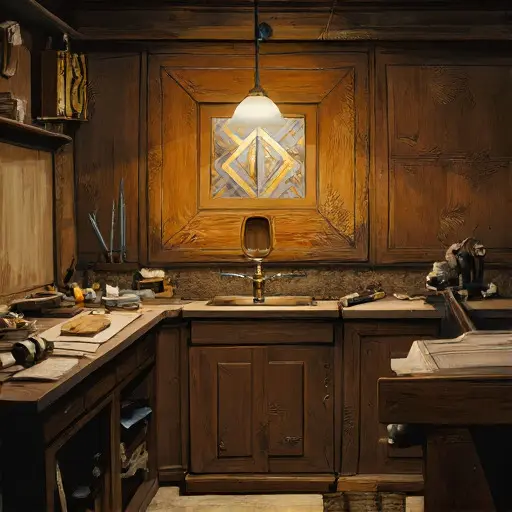
One late evening left subtle clues. A near-finished cabinet door rests on padded blocks, its inlay lifting at one corner where glue set unevenly. A chisel lies dented, as though struck against something too hard. A pattern stencil curls where moisture touched it unexpectedly.
Pinned beneath a rolled veneer sheet is a torn slip: “They accuse me of falsifying their motif.” Another fragment, smudged by resin, reads: “Recompense… beyond what I possess.” The script trembles near its final line. Even the veneer press—normally exact—sits ajar by a hair, clamps misaligned.
Across the bench, bone strips bear irregular scoring, marks of a hand that paused too often.
A Quiet Hollow Behind the Veneer Cabinet
Behind the tall veneer cabinet, a panel shifts inward. Inside rests a small marquetry plaque—its central star sharp and radiant, but its outer rings remain only roughly placed, as though he could not trust the next cut. Beneath it lies a folded note in Kemal’s delicate script: “For Esma—when the pattern steadies again.” The last word thins, fading like glue cooling before contact.
Beside the plaque sits a pristine stack of pearwood veneers, untouched, waiting for a design he never began.
The Last Uneven Edge
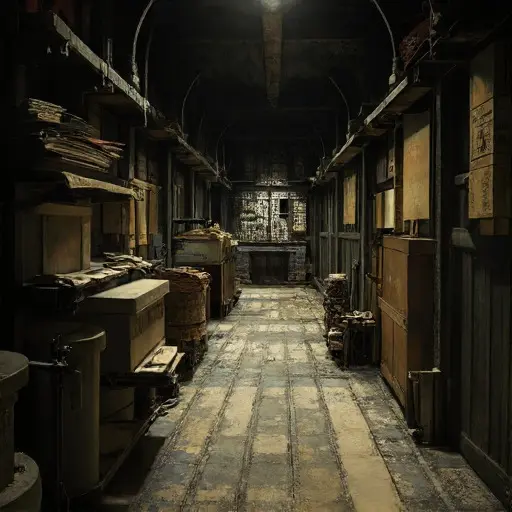
In a shallow drawer beneath the pressing stand lies a test cut: a perfect triangle transitioning abruptly into a ragged edge. Under it Kemal wrote: “Form unravels when trust thins.”
The marquetry parlour sinks back into its resin-scented stillness, patterns suspended in half-born symmetry.
And the house, holding its abandoned inlayer’s chamber, remains abandoned.