The Lost O’Rourke Chronicle Room Where the Drafts Unwound Themselves
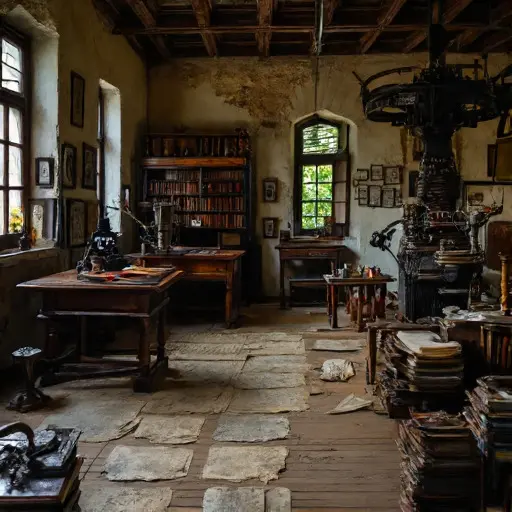
The stillness feels almost editorial—sentences paused mid-thought. A sheet pinned to the main desk bears a report interrupted mid-line, ink pulled thin where the quill must have lifted abruptly. A compositor’s stick lies misaligned on a block of type, letters jumbled into near-words.
No explosive event—just a long silence settling over a craft shaped by measured strokes and careful shaping of truth.
A Life Built on Type, Ink, and Determined Balance
This chronicle room held the steady labor of Brendan Seamus O’Rourke, rural newsman and small-press printer, born 1872 in County Clare. Raised among modest storytellers, he apprenticed under a traveling compositor who taught him clarity of column, restraint in tone, and precision in typesetting. His sister, Niamh O’Rourke, quietly endures in a torn ribbon pinned above the hand-press.
Brendan organized his days with unvaried care: dawn page layouts, midday typesetting, dusk editing proofs under a tremoring lamp. His tools remain sorted in thoughtful lines—serif blocks grouped by size, rollers wrapped in linen, pagination guides etched with faint Gaelic marks. Local readers once valued his measured dispatches, balanced in fact and tone.
Pages Once Steady, Then Distortion Crept In
In healthy years, proofs dried in neat stacks. Type drawers clicked open with sure hands. Correspondence from nearby towns brought fresh leads for rural stories. Completed broadsheets bore crisp columns and restrained punctuation.
But small failures appear. A headline skews a few degrees off its ruler. A column of text repeats a line, then omits the next. Ink smudges along a margin in a way he would never tolerate. A ledger of subscribers lists a prominent name, erased, then overwritten, then blotted into black. A brief Irish note nearby reads: “They say my account betrays truth.”
Rumors spread that a local official accused him of misreporting an incident—whether exaggeration or omission, accounts differed. Others whispered that he refused to print a flattering correction demanded by someone with leverage.
The TURNING POINT Caught in Ink and Tension
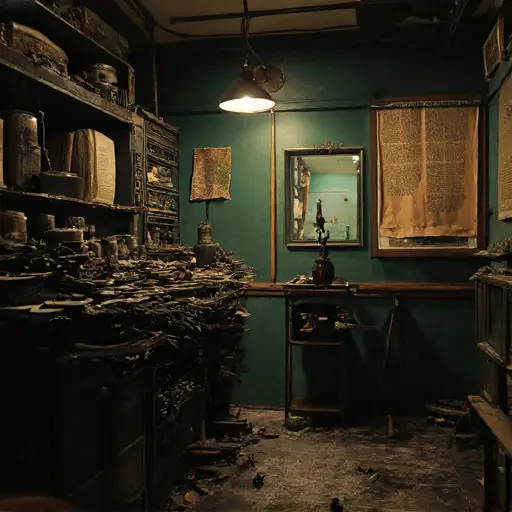
One lamplit evening left somber clues. A nearly finished broadsheet sits in the hand-press, but its central column lists figures crossed through, redrafted, then abandoned mid-correction. A quill lies snapped along the shaft. A weight meant to hold proofs flat sits off-centered, creasing the page beneath it.
Pinned under a stack of type blocks is a torn scrap: “They demand restitution for defamation.” Another fragment, thumbed thin at the edges, adds: “I printed only what was said… yet they insist.” Ink trails taper like a breath running out. Even the press platen—normally squared—leans slightly from an unfinished adjustment.
Across the desk, a headline slug bears evidence of hasty handling: a chipped serif, a reversed letter, a faint smear of fresh ink.
A Concealed Hollow Behind the Paper Shelves
Behind a stack of broadsheets, a slat lifts free to reveal a slim recess. Here lies an unprinted proof marked with Brendan’s bare outline for a story—paragraphs arranged but unwritten. At the top, faint words in quill script read: “For Niamh—when the line of truth holds steady again.” The final phrase shivers into disappearing ink.
Beside it rests a clean quire of paper, pages pristine, awaiting a report he could not bring himself to set.
The Last Interrupted Line
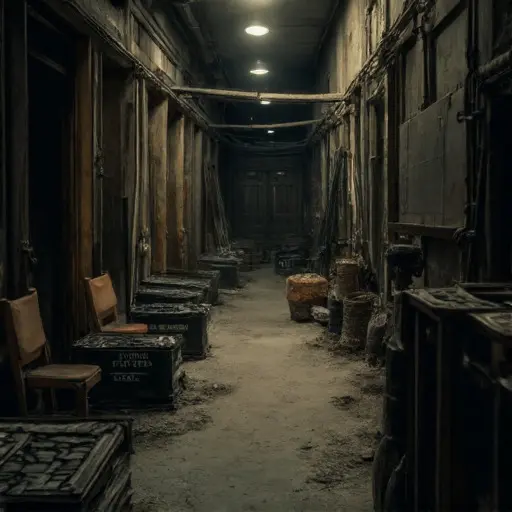
Inside a shallow drawer of type rulers rests a final test impression: a clean block of text that begins in steady columns before breaking into a staggered gap. Under it Brendan wrote: “Even sequence fails when conviction buckles.”
The chronicle room folds back into ink-scented quiet, type blocks cooled in their abandoned rows.
And the house, holding its deserted printer’s chamber, remains abandoned.