The Hidden Bianchi Lacquer Studio Where the Layers Drifted Thin
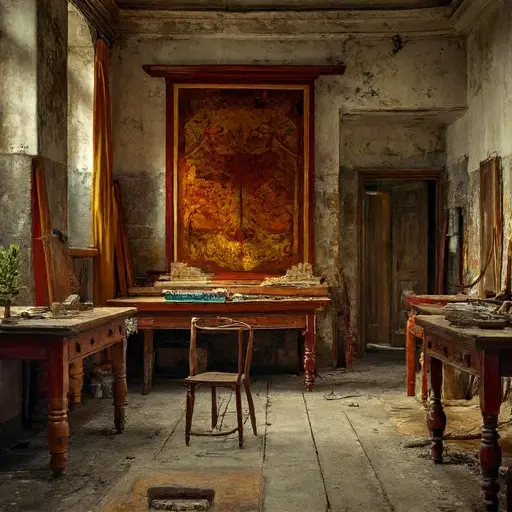
A muted glow clings to the lacquered surfaces, each reflecting the room in wavering blur. On the central table, a chest-height panel rests half-burnished, its gloss broken by a smudge where a sleeve must have brushed it. A polishing cloth lies curled near the edge, stiffening as it dries.
Nothing violent—only the sense of a delicate process halted at its most fragile point.
A Craft Shaped by Layers, Patience, and Quiet Ambition
This lacquer studio preserves the work of Alessandro Vittorio Bianchi, lacquer artist and decorative panel finisher, born 1876 near Florence. Raised among modest carpenters, he apprenticed under a traveling lacquer master who taught him the slow ritual of layering, curing, and polishing until wood glowed like still water. His brother, Marco Bianchi, lingers in a pressed olive twig tucked beneath a pigment tray.
Alessandro lived by gentle cadence: dawn sanding of cured coats, midday layering of translucent tints, dusk buffing under low lamplight. His tools remain arranged by soft order—brushes wrapped in cloth, pumice stones graded by fineness, pigments labeled in Italian script. Merchants admired his ability to achieve flawless depth in lacquered panels destined for parlors and small chapels.
A Craft Once Certain, Now Lightly Disjointed
In thriving years, the studio shimmered with layered hues. Jars of sienna, vermilion, and olive pigments arrived from coastal traders. Lacquer bowls dried in careful rotation along the shelves. Finished panels gleamed along the wall, reflecting lamplight like liquid amber.
But subtle flaws creep in. One panel’s sheen ripples where it should lie flat. Another’s tint drifts imperceptibly warm. A brush stiffens prematurely, lacquer drying before it could be cleaned. A client notebook shows a prestigious family’s name written, crossed out, rewritten, then blotted away. A small Italian note nearby reads: “They say the surface lies.”
Whispers suggested a wealthy patron accused Alessandro of delivering panels whose sheen failed in certain light—implying he used inferior lacquer or rushed the curing process. Others said he refused to mimic a fashionable foreign technique, drawing censure.
The TURNING POINT Suspended in Sheen and Strain
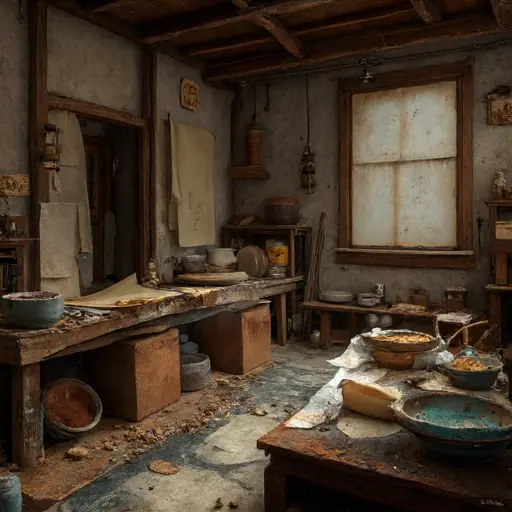
One evening left its quiet fingerprints. A ceremonial panel—nearly ready for delivery—lies dull in patches, as if Alessandro paused halfway through final burnishing. A brush’s handle is cracked, lacquer hardened around its bristles. A pigment jar stands overturned, ultramarine dust drifting across a curing tray.
Pinned beneath a polishing rag lies a torn slip: “They insist I damaged their commission.” Another scrap, smeared by resin, mutters: “Recompense beyond my means.” The handwriting trembles, letters leaning unevenly. Even the lacquer bowls show odd timing: one still glossy, one prematurely thickened, their rotation abandoned.
The main curing cabinet sits open by a fraction, exposing panels that should never meet dust or stray drafts.
A Narrow Pocket Behind the Curing Cabinet
Behind the tall cabinet, a loose board yields a shallow recess. Inside rests a small lacquer panel—its base coat flawless, its mid-layer luminous—but the final coat remains undone, the surface matte and untouched. A folded note in Alessandro’s elegant script lies beneath: “For Marco—when the light obeys again.” The final word trails off, thinning as though the pen hesitated.
Beside it rests a perfect brush—unused, bristles still silken—kept for a project he never dared resume.
The Last Incomplete Reflection
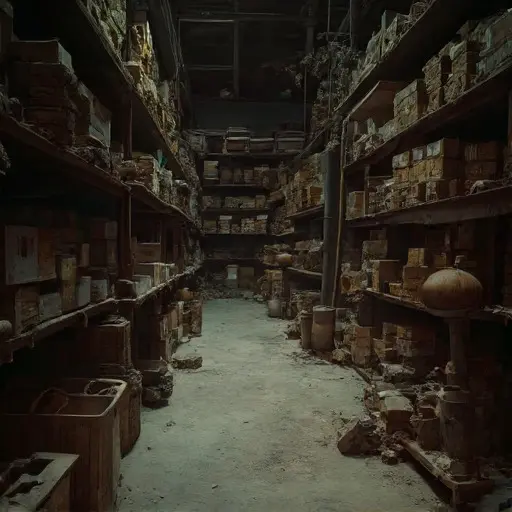
Inside a shallow drawer near the drying frame rests a test swatch: a small lacquer strip whose sheen begins with perfect depth before breaking into a dull patch. Beneath it Alessandro wrote: “Surface wavers when certainty fades.”
The lacquer studio eases back into its resin-scented stillness, layers waiting for hands that will not return.
And the house, holding its abandoned lacquerer’s chamber, remains abandoned.