The Strange Kowalczyk Metal-Engraving Foundry Where the Etch Marks Strayed
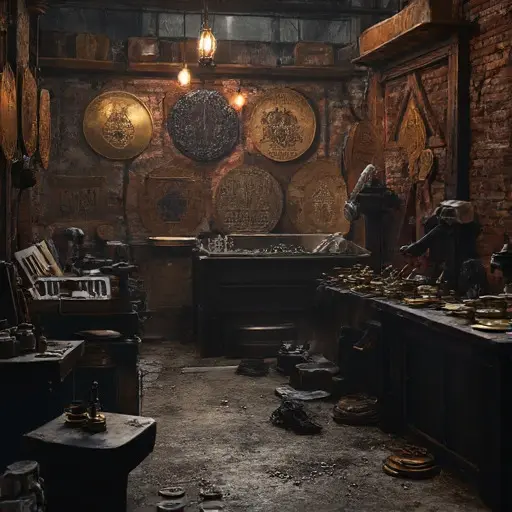
Stillness clings to iron and brass alike. A ceremonial crest etched into a half-finished plate lies skewed, its right border drifting from the guideline. A droplet of dried resist wax runs down the plate’s corner, hardened mid-flow.
The burnishing stone sits beside a scratched ruler, as though laid down at the moment confidence cracked. Every tool seems to hold the echo of halted precision.
A Craftsman Bound to Etch and Fire
This metal-engraving foundry holds the dedicated life of Mateusz Jan Kowalczyk, engraver of ceremonial plates and heraldic emblems, born 1871 near Poznań. Raised among modest blacksmiths, he apprenticed with a traveling metal artist who impressed upon him the virtue of exact pressure and unwavering patience. His sister, Zofia Kowalczyk, survives here only in a yellowed scrap of embroidered cloth pinned above a rack of gravers.
Mateusz shaped his days with disciplined ritual: dawn polishing of brass plates, midday etching under steady lamplight, dusk burnishing edges until they caught a low gleam. His tools remain orderly—burins wrapped in cloth, acid trays sealed tight, punches sorted by motif. Patrons once prized his ability to unite geometry with elegance.
Once-Clean Lines, Now Uncertain
In thriving years, the foundry sparkled with brass. Crates of etched blanks arrived from Warsaw merchants. Shelves brimmed with designs for banners, shields, and commemorative panels. Finished plates stacked neatly along the wall, their edges catching amber light.
But discord creeps in quietly. One heraldic bird appears oddly tilted on its plate. Another crest shows lettering slightly crooked. A jar of resist wax lies open, hardened along its rim. His ledger records a prominent commission name struck through, rewritten, then scraped off entirely. A quick Polish note beside it: “They say my emblem deceives.”
Rumors murmured that he was accused of misrepresenting a family’s heraldic proportions—implying he falsified the curve of a shield or misaligned a symbolic star. Others said he refused to adopt a foreign engraving style a wealthy patron demanded.
The TURNING POINT Cut Into Brass and Breath
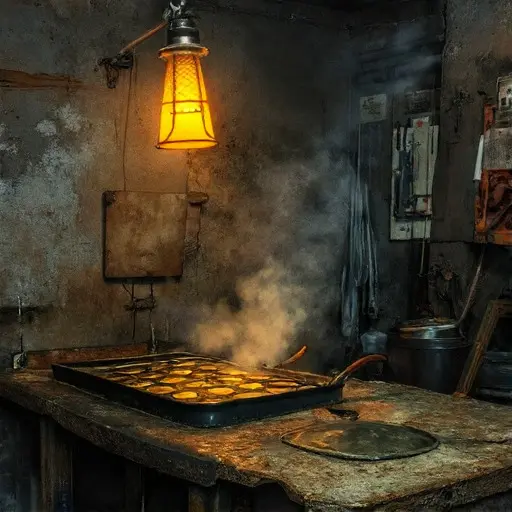
One long evening left its quiet marks. A ceremonial plate clamped in the vise displays a star motif etched too shallow on one arm, too deep on the other—an imbalance Mateusz would never tolerate. A burin lies snapped near the hilt. A cloth used to mask fine lines sits half-adhered, pulled away abruptly as though interrupted.
Pinned beneath a file: “They accuse me of falsification.” Another torn scrap adds: “Reimbursement impossible.” The script wavers, letters sinking at the tail end. Even the cooling bath shows a thin film of residue, as if a plate was withdrawn too soon, leaving its etch incomplete.
Across the bench, pattern stencils appear nudged from alignment, one corner bent, another stained with accidental solvent droplets.
A Small Recess Behind the Brass-Sheet Stack
Behind a neatly stacked column of brass sheets, a loose plank reveals a shallow hollow. Within lies a thin, unfinished emblem plate: its central shield rendered with remarkable clarity, but its outer wreath missing entire segments. Etched near the bottom corner, in faint Polish, a note curls across the brass: “For Zofia—when my hand steadies the truth once more.” The final word trails off, as if etched while breath faltered.
Beside the plate lies a pristine graver, untouched, saved for work he never began.
The Last Faint Inscription
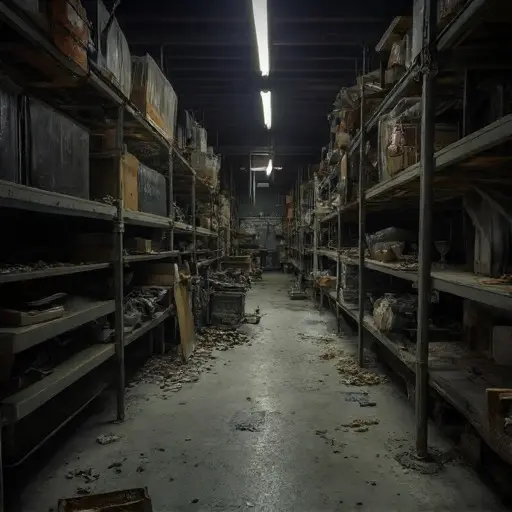
In the bottom drawer of the engraving stand rests a half-etched test strip. Its lines begin with perfect control, then stutter into shallow scratches. Beneath it Mateusz etched: “Accuracy breaks when certainty fails.”
The metal-engraving foundry settles back into its soot-soft quiet, tools dimmed by pause rather than age.
And the house, holding its abandoned engraver’s chamber, remains abandoned.