The Silent Navarro Engraver’s Folio Room Where the Lines Broke Apart
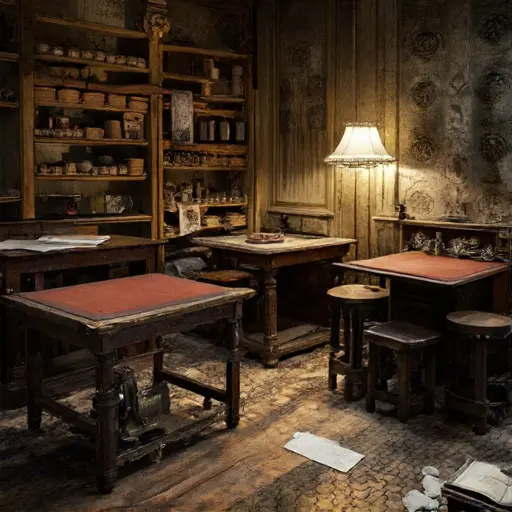
A low hush settles across every copper edge. A plate lies unfinished on the central table, its floral border crisp on one side and wandering on the other. A burin rests in a shallow groove as though set down mid-stroke.
A rag used for wiping ink trails off the table’s edge, stiffened by dried pigment. Nothing overturned, nothing loud—only patient work paused at the instant certainty dissolved.
A Life Etched in Patience and Precision
This engraver’s folio room belonged to Clara Inés Navarro, line engraver and print illustrator, born 1879 near Valencia. From a modest family of artisans, she trained under a wandering copper-plate master who taught her the discipline of pressure, angle, and breath. Her brother, Álvaro Navarro, lingers in a tiny ribbon-stitched charm tucked into a drawer of proofs.
Clara lived by steady ritual: dawn sharpening of burins, midday passes across copper, dusk pulling proofs under dim lamplight. Her tools remain aligned in neat ranks—burnishers wrapped in linen, plates polished to mirror clarity, brushes labeled with careful script. Merchants admired the balance of her botanical illustrations, their lines clean and sure.
A Flourishing Hand, Then Small Stumbles in the Pattern
In strong years, the room brimmed with copper glow. Rag papers from Barcelona traders rested in impeccable stacks. Test prints dried clipped to strings across the beams. Copper offcuts collected in jars, each reflecting lamplight in warm flashes.
But irregularities slip in. A border of an orchid plate is engraved unevenly, pressure lost midway. Another plate shows cross-hatching trembling off its intended angle. A small inkwell stands uncapped, dried around the rim. Her ledger shows a prestigious client’s order written, erased, rewritten, then blotted beyond reading. A line of hurried Spanish beside it: “They claim my lines deceive.”
Rumors wound through the craft district: a patron accused her of distorting a rare botanical specimen, insisting she misrepresented measured proportions. Others whispered she refused to alter her shading to suit a foreign collector’s preferences.
The TURNING POINT Etched in Doubt and Pressure
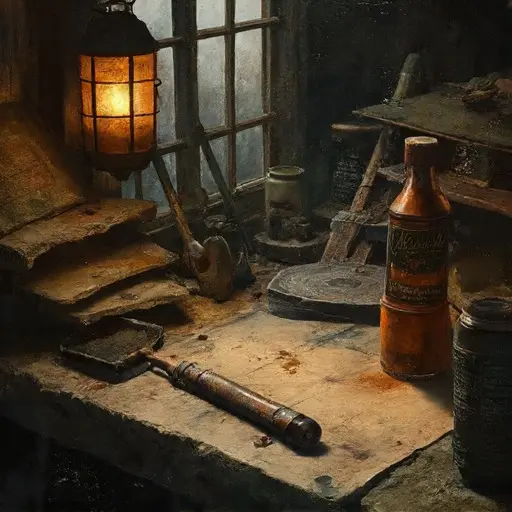
One quiet evening left unmistakable signs. A nearly completed plate rests in the press bed, but its main stem line breaks abruptly where the burin must have hesitated. A proof curled by drying sits nearby, blotched by a dark patch as though wiped without care. A burnisher bears a fresh dent, tip dulled by a misplaced strike.
Pinned under a coil of twine is a torn slip: “They insist I falsified the specimen.” Another fragment mutters, “They demand restitution I cannot pay.” The ink of her notes blurs at the edges, perhaps from a damp thumb or from lingering too long in her grasp.
Even the press crank shows new scratches—marks of an uncertain pull. A jar of powdered rosin used for aquatinting sits half-spilled, gathering grit along the rim.
A Concealed Hollow Behind the Paper Shelves
Behind the stacked folios, a loose cedar panel shifts aside. Within lies a cotton-wrapped copper plate: a small botanical study engraved with exquisite clarity until the final petal, which stops in mid-curve. A folded note tied with thread reads: “For Álvaro—when the line steadies again.” The last word thins, drifting into hesitant graphite.
Beside the plate rests a fresh blank, polished bright, untouched by tool or ink. It seems held in reserve for a commission she never began.
The Last Interrupted Stroke
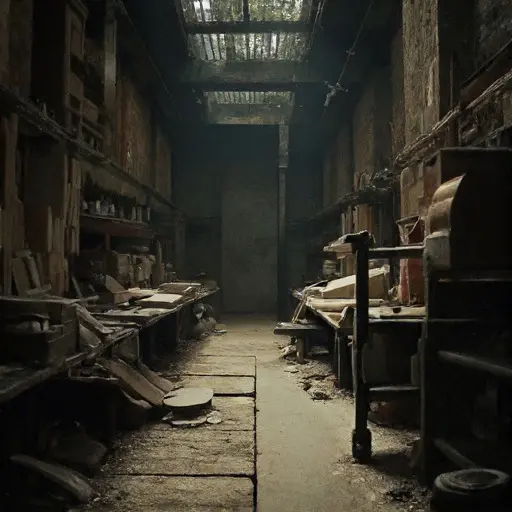
Inside a shallow drawer near the press stand lies a final fragment: a proof corner bearing one perfect line that suddenly fractures into a faint wobble. Beneath it Clara wrote: “Precision falters when faith buckles.”
The folio room sinks into its varnished silence, copper plates cooling in unfinished light.
And the house, holding its abandoned engraver’s chamber, remains abandoned.