The Strange Petrović Instrument Workshop Where the Notes Bent Sideways
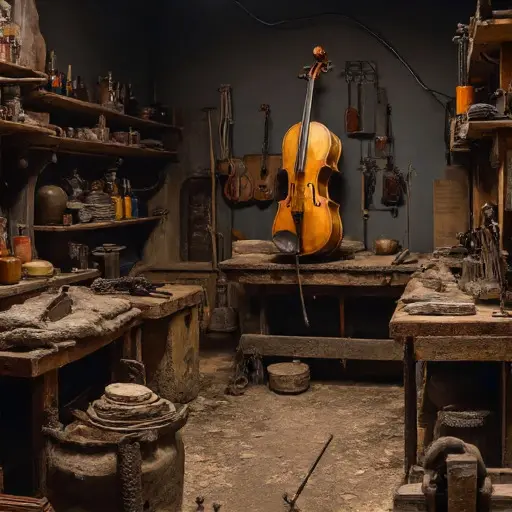
Stillness holds the room in a listening hush. A half-shaped violin plate waits on the central bench, its edges feathered by hurried tools. Soundposts lie toppled near a cracked bridge blank.
A thin rasp rests awkwardly beside a candle stub, as though nudged aside with unsteady hands. The workshop feels paused mid-measure, suspended between promise and unraveling.
A Life Tuned to Grain and Patience
This instrument workshop carries the work of Vuk Stefan Petrović, violin maker and repairer, born 1876 outside Novi Sad. From a modest family of wood merchants, he trained with a traveling luthier versed in Central European carving traditions. A small embroidered handkerchief from his sister, Ljiljana Petrović, rests folded near the varnish rack.
Vuk lived by slow rituals: dawn planing of spruce billets, midday trimming of linings, dusk varnishing beneath a single soot-kissed lamp. His tools remain arranged with disciplined calm—fingerplanes sorted by curvature, gouges aligned by sweep, glue pots cleaned with notable care. Musicians valued his warm, balanced tone, achieved through painstaking graduation of wood.
Work Once Harmonious, Then Slightly Askew
In better seasons, the workshop hummed with confident rhythm. Crates from Belgrade merchants delivered resonance-tested spruce; thin strips for purfling unfurled like dark ribbons across the bench. Completed instruments rested on a high shelf, their arches smooth and sure.
But signs of strain enter quietly. An f-hole traced on a violin top wavers, its curve oddly stiff. A purfling channel cuts too deep on one side. A varnish jar clots around the rim, neglected between coats. His ledger shows a prestigious client’s name scratched out, replaced, then blotted into obscurity. A slip written in Serbian reads: “They say the tone is false.”
Rumors drifted that a renowned violinist accused Vuk of altering the original wood thickness during a repair, claiming it dulled the instrument’s projection. Others whispered he was publicly faulted for a flawed restoration he insisted was already compromised.
The TURNING POINT Carved in Wood and Doubt
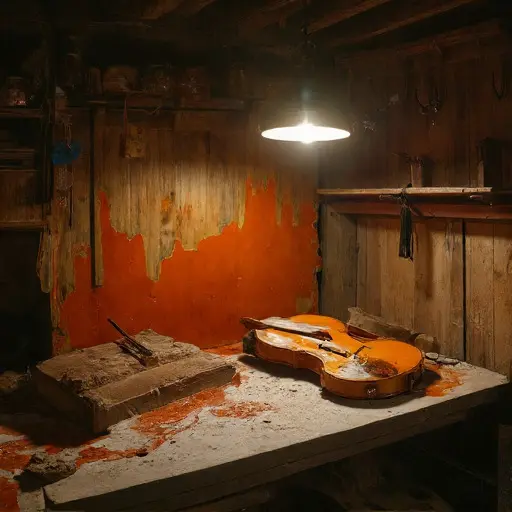
One lamplit evening left quiet evidence. A nearly finished violin hangs crookedly on a drying hook, its varnish uneven, as if applied in haste. A bridge blank sits snapped in two. The soundpost setter lies on the floor beside a spruce shard that doesn’t match any instrument in progress.
Pinned under a purfling knife is a note: “They insist I ruined their tone. Not true.” Another scrap, half-torn, mutters: “Demanding compensation… cannot meet it.” The ink trembles near each period. A gouge bears a fresh nick, as though struck against something harder than wood.
Even the clamps around the mold loosened unexpectedly, one hanging askew as if undone mid-task. And the hide glue pot, normally warm and ready, has cooled into a rigid mass.
A Shallow Recess Behind the Billet Shelf
Behind the spruce-billet shelf, a panel shifts with gentle pressure. Inside lies a linen-wrapped violin plate—smooth, elegant, and perfectly graduated until the final edge, which remains strangely thick, unfinished. Resting atop it is a folded note in delicate script: “For Ljiljana—when the measure of tone steadies again.” The last line thins into faint graphite, as though written in failing certainty.
Beside the plate sits an untouched piece of Balkan maple, shimmering with flame—reserved for a commission he did not begin.
The Last Faint Resonance
Inside a small drawer beside the bending iron lies a single tone test: a carved spruce sliver tapped and discarded. Its grain rings true at first, then dampens abruptly. Beneath it Vuk wrote: “Resonance slips when trust fractures.”
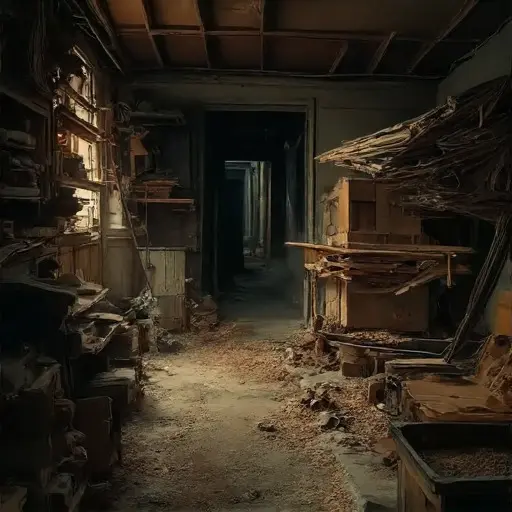
The workshop exhales its resin-dark stillness, chisels waiting in mute alignment.
And the house, holding its abandoned luthier’s loft, remains abandoned.