The Forgotten Nakamura Calligrapher’s Writing Hall Where the Strokes Drifted Free
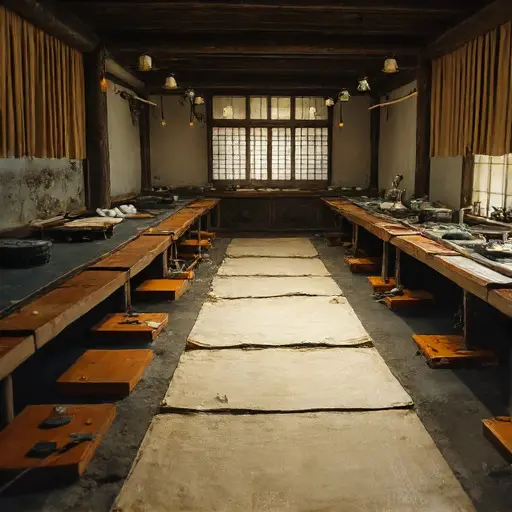
Ink hushes everything. A half-finished scroll lies across the main desk, mid-character, brush lifted but never returned. The slate’s water film tightens as it dries, forming rings where someone paused too long.
Nothing in the hall suggests violence—only a thinning of practiced movement, a hesitation that seeped into the fibers of the paper itself.
A Life Poured Through Ink and Discipline
This calligrapher’s writing hall preserves the legacy of Haruto Shinji Nakamura, master calligrapher and instructor, born 1877 in a quiet district near Kyoto. Raised among modest scholars, he trained under a traveling teacher who taught him the patience of line, breath, and clearing the mind before ink touched paper. His sister, Aiko Nakamura, appears in a small embroidered pouch pinned discreetly beneath a brush rack.
Haruto lived by soft ritual: dawn grinding of ink until it settled into velvet black, midday brush practice on waste sheets, dusk composing formal works under a lantern’s tempered glow. His tools remain arrayed with austere devotion—brushes sorted by stiffness, water bowls filled with a measured calm, weights positioned as though expecting the next sheet.
Once-Steady Practice, Slowly Frayed
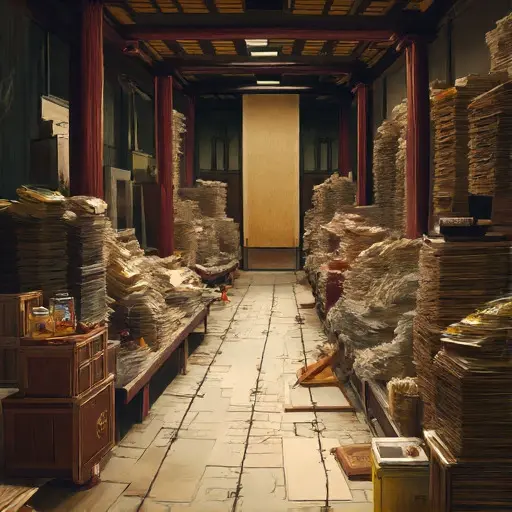
In seasons of esteem, the hall thrummed with quiet purpose. Bundles of washi from Osaka traders lined the shelves. Inkstones imported from Nara glimmered with their subtle mineral sheen. Commission scrolls hung to dry along the far wall, each stroke crisp and assured.
But irregularities surface. A series of practice sheets show strokes tapering oddly, their pressure wavering. One brush loses form at its tip, splaying as though pressed too hard. A weight stone lies cracked in two. A client’s commission slip is folded, rewritten, folded again—ink bleeding where his hand lingered. Beside it, a short Japanese note reads: “They say the stroke misrepresents the verse.”
Rumors traced through the artistic circles: a patron accused him of distorting a sacred poem’s characters—an error Haruto denied. Others murmured that he refused to alter his style to match foreign tastes, angering an influential buyer.
The TURNING POINT Sealed in Ink and Weariness
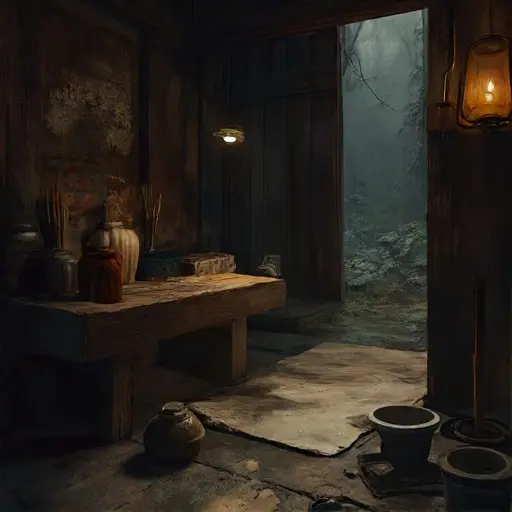
One late evening left quiet evidence. A formal scroll intended for an important patron rests pinned to the mat, but the central character leans a fraction off axis—an unthinkable lapse. The brush that formed it lies on its side, bristles dry and crooked. A second scroll curls at the edges, half the verse missing.
Pinned beneath a paperweight is a scrap reading: “They claim I defaced the poem. It is their misunderstanding.” Another torn note whispers: “Pressure to revise… unacceptable.” The ink smudges at the lines, as though his hand trembled or paused too long above the page.
A small bowl of water clouded with pigment stands neglected. The rack’s finest brush is stained unevenly, as if dipped without steady breath. Even the air around the mats feels heavy with what he could not bring himself to finish.
A Hidden Hollow Behind the Scroll Cabinet
Behind the tall scroll cabinet, a cedar panel slides aside. Within rests a gently wrapped fragment of a personal work—three characters rendered with exceptional clarity. Yet the final one stops mid-stroke, fading to nothing. A folded note tied with red string reads: “For Aiko—when the hand steadies again.” The final word thins into broken ink fibers, as though the brush wavered.
Beside the fragment lies a fresh sheet of washi, unmarked. No guides, no faint pencil lines—only intention preserved in waiting.
The Last Soft Impression
In a shallow drawer near the unused scroll rod lies a final test stroke: a single line drawn with confident pressure that unexpectedly loses form halfway through. Beneath it Haruto wrote: “Clarity falters when trust is strained.”
The writing hall exhales its ink-dark silence, scrolls unmoved in their long vigil.
And the house, holding its abandoned calligrapher’s chamber, remains abandoned.