The Veiled Farkas Stained-Glass Loft Where Colors Misled
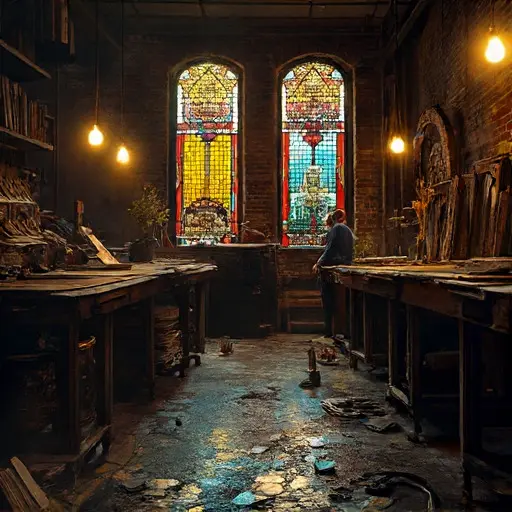
Cool mineral scents linger—tin solder, chalk dust, the faint iron tang of tools left cooling. A panel depicting a rising sun rests awkwardly on a stool, central rays misaligned by a finger’s breadth. A sheet of opal glass curls against a crate, edges chipped from an uneasy cut.
Every surface suggests halted confidence, as though the room’s purpose fled before the work dared finish.
A Craftsman Living by Light and Patience
This stained-glass loft bears the meticulous life of Miklós Benedek Farkas, glazier and window artisan, born 1876 near Sopron. Raised among modest woodworkers, he apprenticed under a traveling glass master skilled in ecclesiastical windows. His sister, Eszter Farkas, lingers in a pressed sprig of edelweiss tucked beneath an iron frame.
Miklós’ days moved to a quiet rhythm: dawn cutting of base shapes, noon soldering along traced arcs, dusk arranging glass pieces to test their light beneath a low lamp. His tools remain lined with measured devotion—cutters wrapped in linen, spools of lead came sorted by width, patterns stacked in folios inked with Central European flourishes. Merchants once admired his ability to balance hue, weight, and illumination.
Shining Craft, Then Slivers of Unease
In earlier seasons, the loft held a flourishing calm. Crates from Budapest merchants delivered ruby and smoke-colored sheets. A wooden rack displayed patterns for chapel windows, their arcs tight with geometry. Solder coils sat neatly wound, bright with possibility.
But slight distortions unsettled the order. One panel’s joints bulge with excess solder. Another shows mismatched hues—an amethyst where a deep blue was expected. A pattern paper is smudged, lines redrawn shakily. His ledger records a prestigious commission first noted with pride, then crossed out, rewritten, then blotted into obscurity. A slip in Hungarian reads, “They claim the color lies.”
Rumors carried through craftsmen’s circles: a patron accused him of falsifying a promised shade—substituting cheaper glass for expensive imported tones. Others said he refused to adjust a design to match fashionable foreign tastes. Nothing resolves; only inconsistencies glow faintly across the loft.
The TURNING POINT Etched in Heat and Doubt
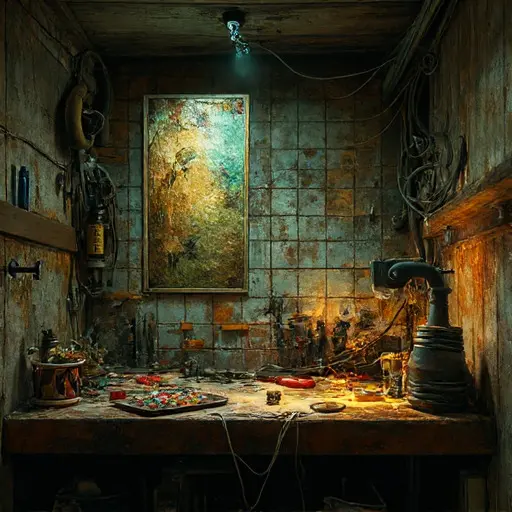
One lamplit evening fractured his steadiness. A grand arched panel—nearly complete—rests on the main table, central motif bending inexplicably out of true. The lead joints along its spine sag, as if solder cooled before he committed. A soldering rod lies snapped at its tip. Beneath a wavy scrap of glass, a note in hurried script: “They insist the flaw is mine.”
Some said a wealthy patron threatened legal remedy over a miscolored window, claiming Miklós delivered an “unfaithful pattern.” Others whispered he was accused of disguising a manufacturing defect. A second note, half-written, reads: “Light behaves differently—they won’t accept it.”
Around the loft, signs repeat the tension: a palette of pigments knocked askew; a delicate glass cutter dulled against something harder than glass; a folio of patterns warped by accidental heat. The air feels crowded by unspoken defense.
A Narrow Gap Behind the Pattern Cabinet
Behind the tall cabinet of folios, a loose panel slides aside. Inside rests a linen-wrapped bundle: a small stained-glass medallion, depicting a simple star. Its lines are clean, colors balanced with exceptional restraint. Yet the final solder joint remains open, unsealed.
A folded parchment slips from beneath it. Miklós’ handwriting, usually careful, drifts unsteadily: “For Eszter—when color speaks honestly again.” The last words fade into faint strokes, ink thinning as though the pen hesitated at truth or acceptance.
Beside the medallion lies a strip of imported blue glass—pricier than anything on the bench—kept back, perhaps, for something he never finished.
The Last Quiet Illumination
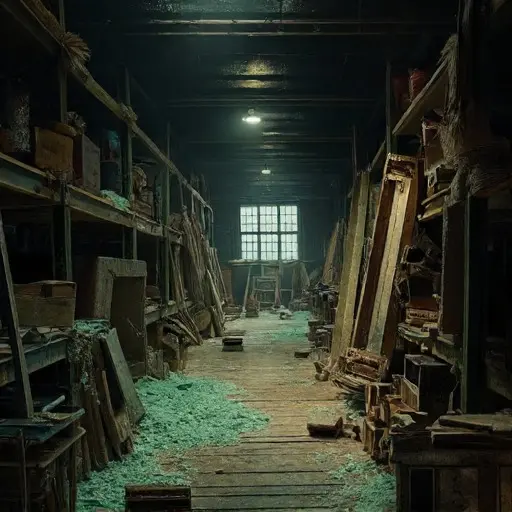
Inside a shallow drawer near the mounting frame, a small test piece lies untouched. It is a clear pane brushed with faint pigment, designed to judge transparency. The hue pools unevenly; surface tension has failed it. Miklós wrote beneath, in pencil: “Light shifts when doubt enters.”
The stained-glass loft sinks into its mineral quiet, colors stilled mid-glimmer.
And the house, holding its abandoned glazier’s room, remains abandoned.