The Silent O’Malley Shoemaker’s Bench Where the Soles Shifted Wrong
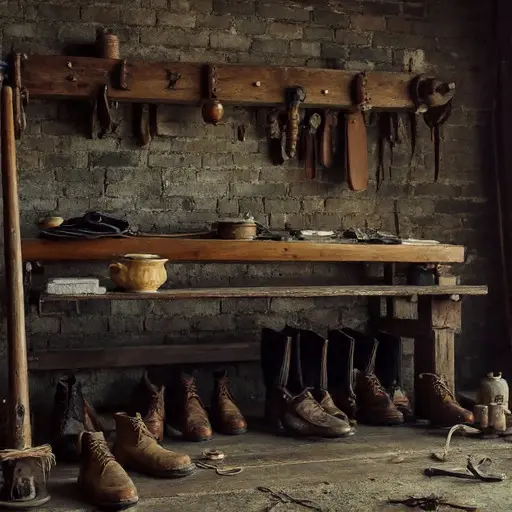
Everything here settles into a hush: the smell of oiled leather, the sweetness of beeswax, the muted creak of old floorboards. A single boot upper lies pinned to its last, welt stitching halted fewer than ten passes from completion. A rasp leans awkwardly against a stretcher, as if nudged aside by a distracted hand.
The room’s stillness hints less at catastrophe and more at a practiced rhythm suddenly lost.
A Cobbling Life Shaped by Steady Hands
This shoemaker’s bench shelters the world of Patrick Seamus O’Malley, cobbler and bootmaker, born 1872 near Galway. Raised in a modest family of fishermen, he learned to cut and stitch leather under a traveling tradesman who prized neat welts and patient shaping. His sister, Brigid O’Malley, lingers in a small silver brooch pinned to a leather apron hanging by the door.
Patrick lived by the steady cadence of handcraft—morning pattern-cutting, midday shaping, late-evening finishing under lamplight’s amber circle. His tools remain aligned with quiet devotion: awls sharpened to fine points, knives honed to a whisper, threads waxed until they clung just right. Merchants and travelers sought him for boots that molded gently to the foot.
Work Once Firm, Then Subtly Unmoored
In better years, the bench bustled with work: imported Spanish leathers folded neatly on racks; tin boxes containing brass eyelets stacked by size; spools of coarse linen thread coiled with tidy restraint. A pattern board holds sketches of brogues with Irish knotwork along the seams.
Yet signs of strain appear. A welt on one boot is sewn slightly off-center. Another upper is cut too generously along the throatline, suggesting an uncharacteristic mismeasurement. His ledger shows a customer’s name scratched out, replaced, then crossed again. A pair of lasts rests mismatched, the left one bearing fresh gouges as if pressed too forcefully. A scrap note, inked in wavering hand, reads: “They claim the boots warped—impossible.”
Rumors hinted that a patron accused him of shoddy construction or substituting inferior leather, threatening refusal of payment. Others whispered of tension over a custom pair that arrived too late for a planned voyage.
The TURNING POINT Pressed Into Leather
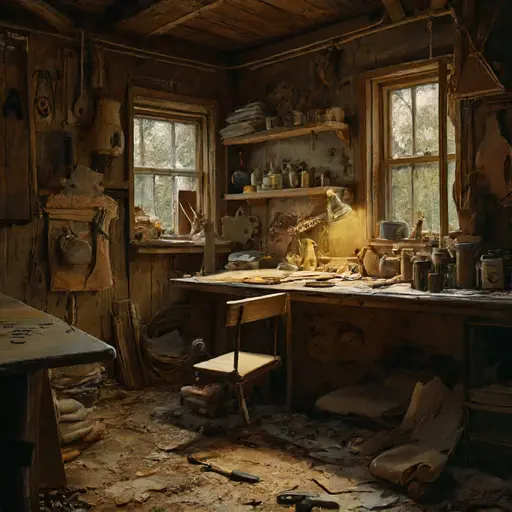
One evening, the shift became undeniable. A pair of boots—nearly complete—rests crookedly on the bench, their soles pulled partly away from the welt. A hammer lies on its back, handle stained by an unsteady grip. Stitching on one heel wavers, then stops entirely, needle still half-inserted.
Pinned beneath a shoelace is a terse note: “They say I ruined their commission. I did not.” Another torn scrap mentions a demand for reimbursement he could not meet, the ink heavier where the nib hesitated. The tallow tin shows fingerprints dragging across its surface, as though he tried to steady his hand.
Even the threads tell a story: a length of waxed linen knotted strangely, ends frayed into soft defeat.
A Narrow Hollow Behind the Last Shelf
Behind the lowest row of wooden lasts, a loose plank yields a hollow space. Inside lies a linen-wrapped pair of miniature boots—children’s size, beautifully formed but missing their final polish. Each heel bears a small clover motif Patrick used only for family pieces. A note folds between them, inked with quiet reserve: “For Brigid—when work steadies again.” The last word tapers, unfinished.
Beside the boots rests a strip of leather dyed richer than any on the rack; its edge has been carefully skived, ready for use but never sewn.
The Last Unfinished Step
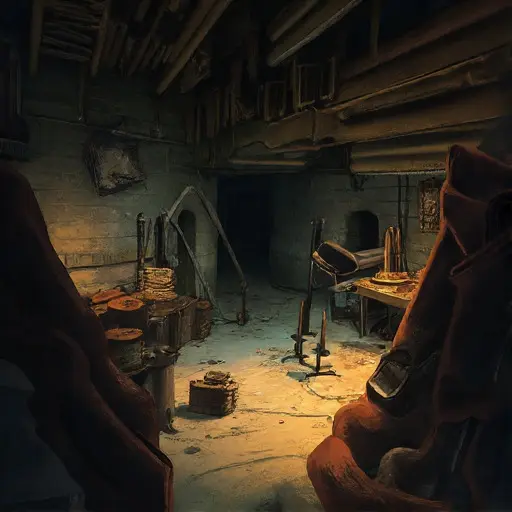
Inside a drawer beside the pressing stand lies one final remnant: a heel plate engraved faintly with guiding marks never followed. Beneath it, Patrick wrote: “Alignment slips when doubt enters.” No signature.
The shoemaker’s bench settles again in its quiet, stitched with the memory of halted craft.
And the house, guarding its abandoned cobbler’s room, remains abandoned.