The Strange Yamazaki Papermaking Studio Where the Fibers Drifted Aside
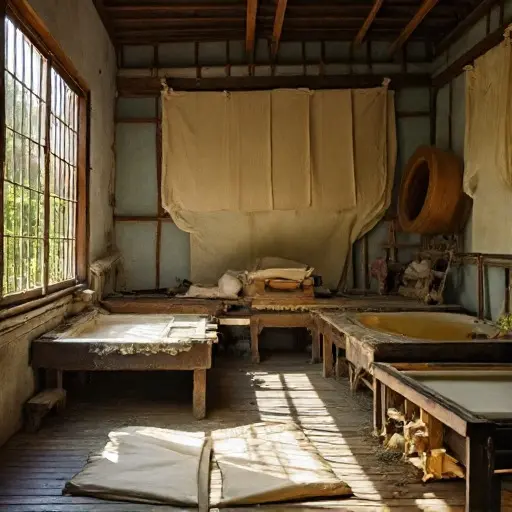
A hush clings to the studio—humid, quiet, almost trembling. A half-filled vat reflects the weak lamplight in broken ripples, as though someone stirred it hastily before stepping away. A bamboo screen rests crooked against the wall, its mesh darkened where the pulp clung too long.
Nothing shouts of rupture, yet nothing sits at peace. Each tool behaves as an interrupted gesture, halted mid-flow.
A Maker Devoted to Water, Fiber, and Habit
This papermaking studio holds the life-work of Haruji Kenji Yamazaki, artisan papermaker, born 1873 in a village near Nara. Coming from a family of modest scribes, he apprenticed with traveling washi-makers who taught him the patience of fiber and flow. His sister, Keiko Yamazaki, appears in a small cloth charm pinned near a drying rack—its silk thread faded from years of steam.
Haruji shaped his days by water: pre-dawn bark soaking, midday pulp beating, dusk sheet-pulling in a rhythmic dance of dip and lift. His tools rest precisely—bamboo screens tied with twine, ladles of smooth cypress, brushes for sizing arranged by softness. Patrons valued his paper for calligraphy and delicate printmaking; its even grain spoke of consistency bordering on devotion.
Flourishing Craft, Then Quiet Distortion
The studio once carried the warm harmony of repetition. Mulberry bark, imported from coastal traders, dried in neat stacks. Sizing pans smelled faintly of rice starch. Sheets rested in weighted piles to cure before trimming. A shelf of pigments—sumi black, persimmon, indigo—glimmered under a lacquered lamp.
But telltale flaws creep in. One sheet on the drying rod shows a thin patch where pulp thinned unexpectedly. Another curls too sharply, suggesting uneven pressing. A bamboo dip frame carries a streak where fibers clumped. His ledger of orders reveals a prestigious commission name erased twice. Beside it, a note in careful Japanese reads, “They say the grain fails their brush.”
Whispers later suggested a patron accused him of altering pulp ratios for profit, or failing to meet the exacting texture required for ceremonial calligraphy. Nothing proves such claims—only these small betrayals of fiber and form.
The TURNING POINT Imprinted in Water and Silence
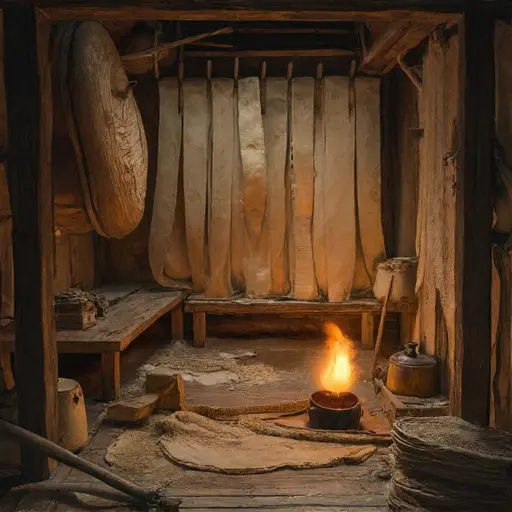
One evening altered the room’s rhythm irrevocably. A vat sits with pulp settled in a lopsided mound—sign of a hurried or distracted stir. A torn blotter with Haruji’s tight handwriting reads: “Client rejects—claims impurities.” The ink runs, touched by stray moisture.
Rumor held that a wealthy merchant accused him of using improperly bleached bark, implying dishonesty. Others said his sheets “shed fibers” under delicate brushes, though earlier batches never had. From the pulp trough to the drying racks, signs multiply: a mold warped by uneven soaking, a ladle cracked along the handle, sheets pressed out of alignment, their edges feathered.
Even his meticulous sizing tools lose order. A brush lies bristles-down in a pan of half-set starch. A drying board leans crookedly, as though he tried to right it and stopped mid-motion.
A Quiet Cache Behind the Cedar Rack
Behind the cedar drying rack, a loose panel breathes open. Inside lies a linen-wrapped bundle of sample papers—thin, luminous, nearly perfect. But each sheet ends in an unfinished corner, fibers gathered in a small knot where the pulp was never fully pulled.
A note, folded among the samples, bears his restrained script: “For Keiko—if my hand steadies again.” The closing line breaks, trailing into faint specks where moisture blurred the ink. One sheet carries a subtle watermark of a mountain ridge, incomplete yet strangely assured—a gesture he hesitated to finish.
Beside the bundle rests a cypress ladle, polished smooth, unused in days or weeks.
The Last Wet Edge of Evidence
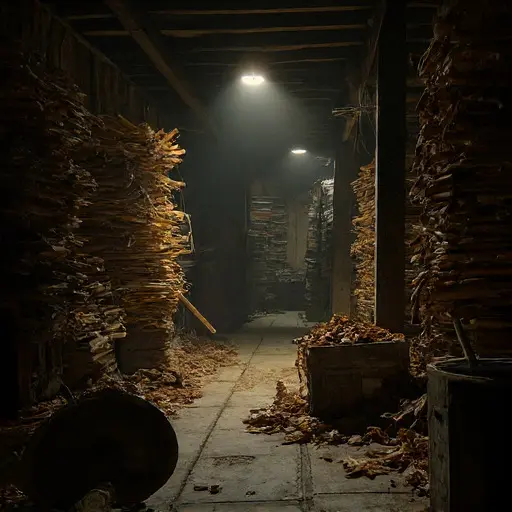
Inside a shallow drawer near the empty soaking tub lies his final fragment: a test sheet pulled only halfway, its grain clear on one side and wavering on the other. On the margin he wrote: “Flow breaks when trust does.” No date follows.
The papermaking studio settles into its thick, humid quiet, fibers unmoving in the air.
And the house, holding its abandoned washi chamber, remains abandoned.