The Hidden Singh Tailor’s Cutting Floor Where the Seams Drifted Off
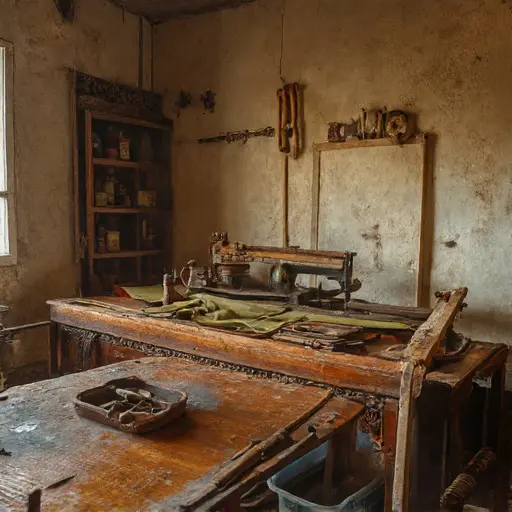
The room feels caught between breaths—fabric dust rising from each step, chalk lines ghosting across the tables, shears gleaming in unmoving vigilance. A single half-tailored waistcoat lies folded wrong-side-out, its lining bunched as though abandoned mid-adjustment. Nothing here shouts; everything mutters of a precision that thinned, a confidence that frayed, a quiet work abandoned for reasons never fully uncovered.
A Tailor’s Practice Quietly Threaded Through the Days
This cutting floor bears the touch of Arjun Dev Singh, bespoke tailor and garment cutter, born 1874 in Amritsar. Raised among modest craftsmen, he learned his trade from itinerant cloth merchants who taught him the mathematics of drape and grain. A small bundle embroidered by his sister, Simran Kaur, rests near the machine leg—once used to store spare buttons.
Arjun’s days were routine yet tender in detail: dawn pattern-drafting, midday cutting, dusk stitching under a steady lamp. His chalk marks ran clean; his thread tension seldom faltered. His garments, favored by traveling businessmen and minor officials, balanced British silhouettes with Punjabi embellishment. He measured twice, often thrice, his motions steady as his breath.
Skill in Bloom, Though Something Shifted Underneath
At his height, Arjun kept the cutting floor immaculate. Chalkboards recorded client measurings; spools of cotton thread stood sorted by gauge. Lengths of imported cloth from Calcutta merchants draped across the far rack. A tin of polished brass buttons gleamed under a hanging lantern.
But subtle deviations grew. A muslin pattern for a frock coat is slashed at an odd angle, as if revised hastily. A spool of thread lies tangled around a tailor’s square. A shoulder seam on a half-finished coat wanders slightly off its intended line. In his client notebook, a name is crossed out, rewritten, then struck again with firmer pressure. His consistent neatness begins to fray, though the room betrays no obvious cause.
Rumors later suggested a wealthy patron accused him of mis-sizing a commission or using inferior interlining. Some claimed he was pressured to imitate a patented pattern without credit. None of these stories sit fully inside the room—only the slanted seams do.
The TURNING POINT That Loosened Each Edge
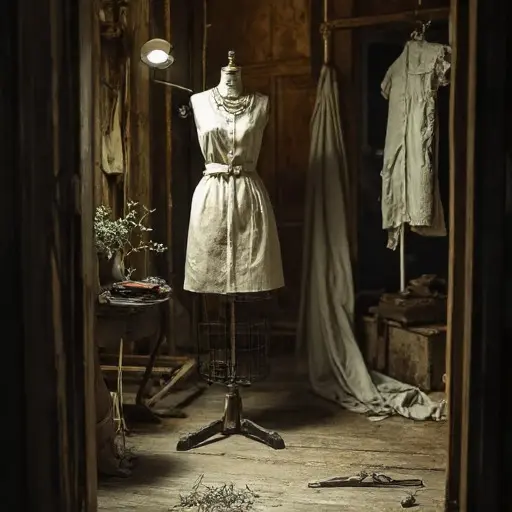
One dim evening left its signature. A coat-in-progress—nearly finished—rests on the table, its lapels uneven by several millimeters. A chalk line beneath it stutters, trailing off before reaching the hem. Scissors lie open, their blades stained faintly with oil from a toppled lamp.
A torn scrap pinned under the machine foot reads: “Client says I altered the silhouette—untrue.” Another page in his notebook mentions a dispute over delayed delivery after the patron changed requirements. A gossip whispered that he was threatened with repayment he couldn’t meet.
A tape measure hangs in a twisted loop from a peg. A length of interfacing buckled from damp lies discarded, though Arjun was meticulous about keeping materials dry. Even the sewing machine’s treadle bears a dent, as if struck by a frustrated heel.
A Hidden Fold Beneath the Cutting Table
A loose panel beneath the largest cutting table slides back with gentle pressure. Inside rests a rolled bundle of muslin. When unfurled, it reveals a perfectly drafted jacket pattern—precise, balanced—but the final seam line is missing entirely, left blank as though awaiting a decision he could not bring himself to draw.
A folded note lies with it, stitched at the corner with red thread: “For Simran—when I trust the measure again.” The last two words thin into wavering strokes. The muslin bears faint markers of a design he never dared cut, its edges still crisp.
Beside it sits a wooden spool of thread, nearly full—unused, reserved for something he never finished.
The Last Uncut Line
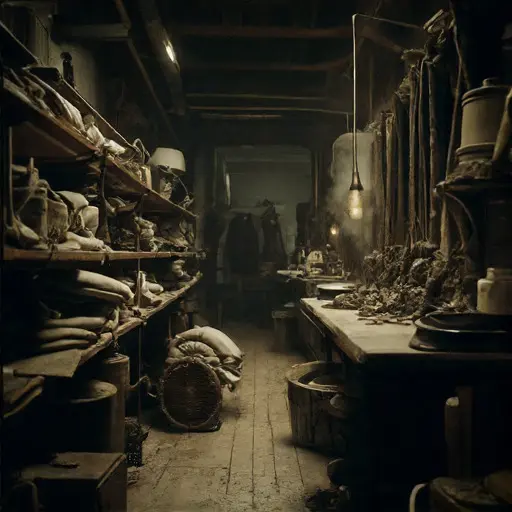
Inside a shallow drawer at the pressing station rests a final fragment: a chalk-drawn seam on a scrap of muslin, beginning confidently, drifting off, then stopping mid-curve. Beneath it Arjun wrote: “Alignment slips when doubt enters.”
The cutting floor exhales its hush, every garment piece still yearning for completion.
And the house, holding its abandoned tailor’s chamber, remains abandoned.