The Haunting Barakat Glass Furnace Where Shapes Dissolved
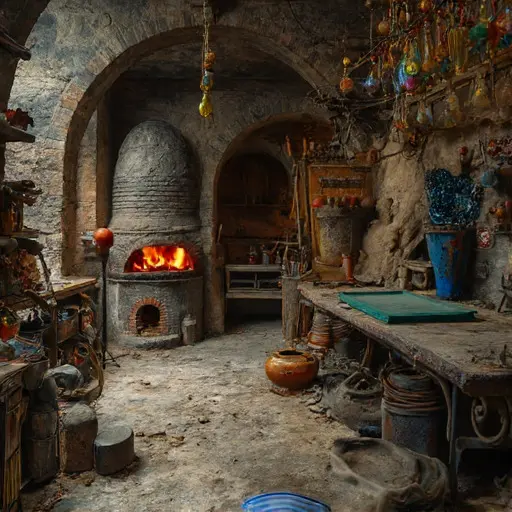
Heat no longer breathes here, yet the room carries the soft tremor of what once glowed. A faint mineral scent lingers on the air—silica, scorched lime, trailing embers of earlier nights. A half-shaped vessel sits clouded on the marver table, its lip collapsed inward as though caught between resolve and surrender.
No flame, no movement; only a silence steeped in cooling glass and halted intention.
A Master of Fire and Form
This glass-furnace room holds the work of Yusuf Khaled Barakat, glassblower and color-mixer, born 1875 in a coastal district near Aleppo. Raised among modest merchants, he apprenticed under an itinerant Syrian craftsman who taught him the pulse of molten glass. His sister, Amira Barakat, appears only in a palm-sized charm tucked beneath a bucket of colored frit.
Yusuf lived by heat’s rhythm—pre-dawn kiln tending, mid-morning gathers, and long evenings coaxing globes of amber, teal, and rose into slender vessels. His tools rest where he placed them: jacks neatly aligned, shears dulled by repetition, molds carved with Levantine patterns of pomegranates and palm leaves. Merchants prized his ability to trap light inside contour and color, “making brightness breathe,” as one patron once claimed.
Bright Craft, Then a Faltering Glow
In prosperous years, the furnace hummed with molten possibility. Murrine canes cooled in woven mats; cobalt ingots from Istanbul merchants gleamed atop ash-crusted shelves. A set of imported Victorian cutters lie in a velvet-lined box, their edges tempered for precision. Patterns for lantern glass lean in rolls along the wall, their arcs exact and balanced.
But disruptions linger. One cooling tray bears a vessel with a warped shoulder—heat imbalance Yusuf rarely permitted. A mold’s carved motif is scorched too deep on one side, evidence of uneven press. A jar of ochre pigment lies open, dust spilling in a careless ring. His ledger of commissions shows an entire page struck through, then rewritten in tight strokes. Perhaps a patron disputed the proportions of a lantern globe; perhaps someone accused him of failing to replicate a promised hue.
Another whisper persisted: a merchant claimed Yusuf substituted cheaper raw materials, alleging the glass “lost clarity.” Nothing definitive remains—only the faint infrastructural tremor of doubt.
The TURNING POINT Etched in Cooling Ash
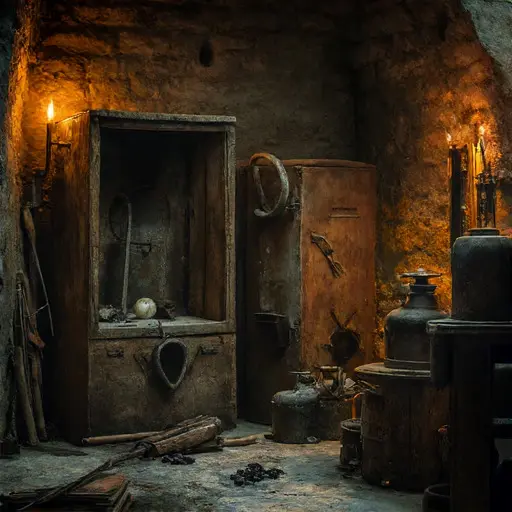
One evening left a disquieting trail. A lantern panel—once glowing with violet hue—lies fractured along a line too sharp to be cooling stress alone. A blowpipe on the furnace lip is bent slightly off-axis. A fragment of Yusuf’s handwriting on a scrap reads: “They claim I altered the color—impossible.” The ink blooms where the nib lingered too long.
Another scrap tucked under a mold states, “Refused their design change.” Rumors swirled: a wealthy buyer demanded a specific gradient impossible with the materials provided, threatening him with repayment or public accusation. Some believe he was blamed for a shipment of glass that arrived clouded, though the fault may have lain in transit.
A scorch mark trails from the furnace door to the water trough, as though he tried to quench a hot tool too quickly. The tongs, normally polished, remain blackened and cold. Even the kiln’s firebrick displays a new hairline fissure.
A Hidden Niche Behind the Cooling Table
Behind the broad cooling table, a panel of stone shifts inward. Within the niche lies a wrapped parcel of linen. Inside rests a delicate unannealed vessel—transparent, pale green, thin as eggshell. A single flaw mars it: a spiral twist Yusuf never allowed. Beneath it lies a folded note in curling Arabic: “For Amira—when the heat steadies again.” The final words diminish into faint strokes, the ink thinning like breath.
Beside the vessel sits a tiny jar of rare colorant—lapis dust—untouched though he had planned a commission requiring it. Whether he abandoned it out of frustration or refusal is unknown.
The Last Cooling Silence
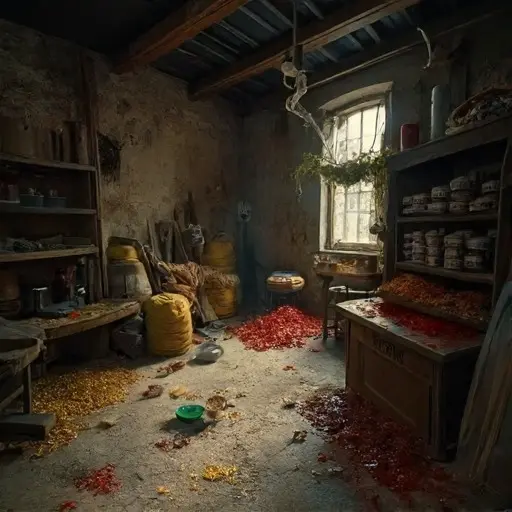
Inside a battered crate near the door lies one final trace: a circular glass test piece, clean at the edge yet clouded at the center. On its underside, Yusuf etched a faint line: “Clarity falters when forced.” No date follows.
The furnace room folds into hush, its tools suspended in unfinished motion.
And the house, holding its abandoned glassblower’s chamber, remains abandoned.