The Silent Quispe Loom Chamber Where the Motifs Unraveled
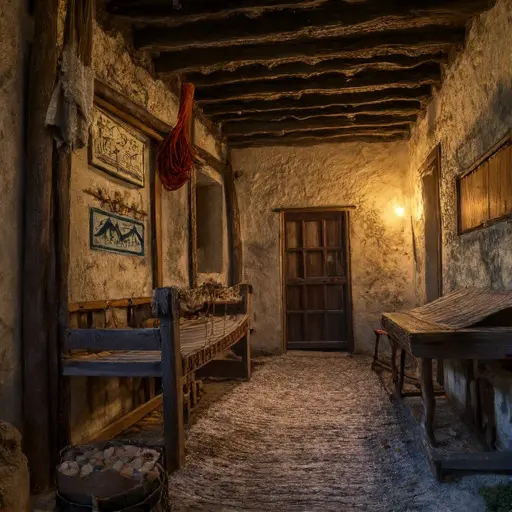
A hush fills the chamber, warm with the memory of wool, crushed dye, and kettle steam. The loom’s heddles are tilted as if touched once, then not again. A spindle rolls slightly with each draft, its whorl chipped on one side.
Whatever rhythm once ruled here has broken; the movements that built tapestries of order and story now linger only as tensionless strings. The air feels caught between patterns—half remembered, half refused.
A Weaver’s Life Bound to Threads and Quiet Resolve
This loom chamber keeps the legacy of Celia Maritza Quispe, tapestry weaver and textile artisan, born 1879 near Cuzco. Raised among modest herders, she learned fiber craft from traveling weavers who taught her both structure and spirit of pattern. A small woven charm from her brother, Diego Quispe, sits tucked inside a spindle bowl, its faded knots marking family bonds.
Celia’s routine was gentle but relentless: dawn carding, midday spinning, dusk weaving by steady lamp. Her tools remain arranged with austere care—beaters laid by size, combs wrapped in cloth, dyes sealed in pottery jars. Merchants prized her balanced geometric motifs; some claimed her mountain-line patterns captured real Andean highlands.
A Flourishing Practice Disturbed by Shifting Tension
In her fruitful years, the chamber brimmed with color. Cochineal reds dried on stretched cloth, indigo vats cooled by the wall, and pattern boards bearing stepped motifs leaned in orderly clusters. A crate stamped from Lima merchants holds imported mordants wrapped in parchment. Her finest textiles draped over a cedar rod, each marked by crisp symmetry.
Yet subtle asymmetries creep in. One tapestry-in-progress shows a weft line drifting a fraction too high. Another board displays revisions scratched atop the original design. A warp thread frays near the top beam, tied with an awkward knot Celia would never accept. A jar of dye lies overturned on a mat, the spill oddly shaped, as if she caught it mid-topple then froze. A folded order slip reads, “Client requests new border—untraditional,” with the last word underlined twice.
Traders murmured that a wealthy buyer demanded she alter ancestral motifs to match fashionable parlor styles, threatening to withdraw payment. Some whispered she was accused of passing off mill-dyed yarn as hand-dyed fiber. No certainty remains—only the marks of pressure.

The TURNING POINT That Warped the Pattern
One late evening, the chamber recorded its quiet rupture. The main tapestry on the loom—nearly finished—shows a sudden jagged shift in the mountain motif, as if her hand deflected sharply. The beater rests jammed between two warp threads. A spool of red yarn lies broken, snapped where tension became too much.
A note pinned to the loom reads: “They say it misrepresents—how can a mountain misrepresent?” The ink feathers at the edges, smudged by touch. Another scrap tucked beneath the loom mentions a dispute over “borrowed imagery” and a threat of legal complaint unless she changed her design. Celia, who wove motifs passed through generations, faced demands she could not reconcile.
A dye vat’s rim is dented where it struck something. A warp weight slipped free and chipped the floor tile. A cloth of reference patterns is torn along the border—as though she tried to remove a disputed symbol, found the tear spreading, then abandoned the attempt.
A Hidden Roll Behind the Cedar Chest
Behind the cedar chest near the hearth, a loose plank shifts outward. Within lies a slender textile roll bound in soft yarn. Unwrapped, it reveals a small tapestry panel—immaculate, centered, serene. The stepped mountains align perfectly until the final row, where the motif stops short, leaving a narrow, untouched band.
A note is stitched into the fabric’s edge in tiny thread: “For Diego—hold our line.” The final stitch strays from tension, curling slightly before it ends. No accusation here, no denial—only the hint of something she meant to finish but could not carry past that vacant band.
Beside the panel lies a comb, polished smooth from years of use, its teeth unbroken—saved, perhaps, for a return that never came.
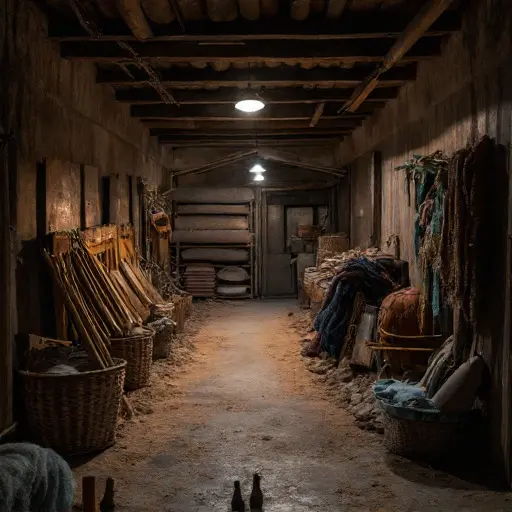
The Last Soft Trace of Craft
Inside a folded pattern board near the stretching frame lies a single penciled sketch: a mountain motif drawn in sure lines until the lower edge, where the pattern dissolves into hesitant strokes. At the corner, Celia wrote: “Tension slips when I bend to their design.” Nothing else.
The loom chamber folds itself into silence, threads motionless on the beam.
And the house, holding its abandoned weaving room, remains abandoned.