The Haunting Lindström Engraving Studio Where the Lines Bent Wrong
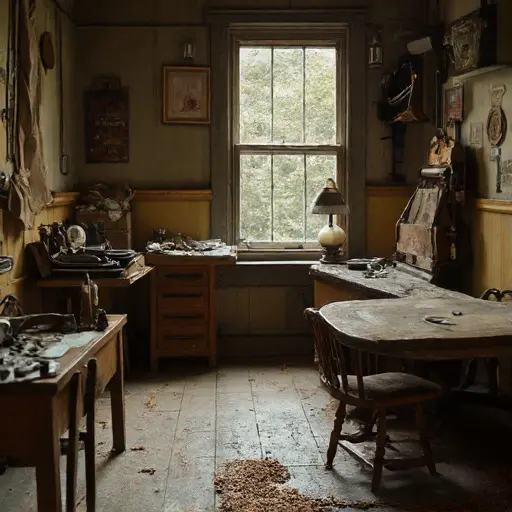
A settled stillness fills the studio, layered with oil, metal dust, and the faint sap-sweet scent of birch. A single graver rests askew beside an unfinished copperplate, its surface mottled where the etching bath dried prematurely. A lamp’s wick curls inward, unlit, leaving the room to its own murmuring shadows.
Something was being shaped here—patiently, expertly—until suddenly it wasn’t. The space retains the breath of halted craft, the echo of a line that meant to continue.
A Craftsman’s Life Marked by Steel and Restraint
This engraving studio preserves the meticulous habits of Erik Johan Lindström, plate engraver and metal ornament etcher, born 1879 near Uppsala. Raised among modest joiners, he refined his discipline in a printmaker’s shop before taking commissions for decorative metalwork, monograms, and precision plates. His sister, Ingrid Lindström, appears only in a pressed sprig of lingonberry he kept atop a case of gravers.
Erik’s days unfolded in careful repetition—sharpening burins each morning, cutting test strokes on pewter scraps, then tackling commissioned plates by late afternoon. His tools are arranged by bevel angle; his inkstones wiped smooth between sessions. In better years, he produced fine detail for clocks, silverware, and ceremonial plaques sought by merchants across the north.
Work in Its Prime, Quiet Slippage Beneath
At his pinnacle, Erik’s studio glowed with confident order. Brass plates from Copenhagen lean in polished stacks. A sheaf of pattern sheets—Nordic scrolls, knotwork, delicate florals—sits pinned against a frosted window shutter. His copperplate press, still gleaming beneath the dust, carries faint traces of blue-black ink along its rollers.
Yet hairline signs of trouble spread. A pattern sheet bears an erased border, redrawn shakily. One pewter plate shows an errant incision slicing across a flourish. A tray of burins sits mismatched—wrong sizes mingled, tips dulled. A ledger of commissions reveals a critical entry scraped out entirely, leaving only a smear of graphite. Something interfered with his measured rhythm: perhaps a dispute over an insignia, or accusations of misrepresenting a patron’s crest.
The TURNING POINT That Unsettled His Hand
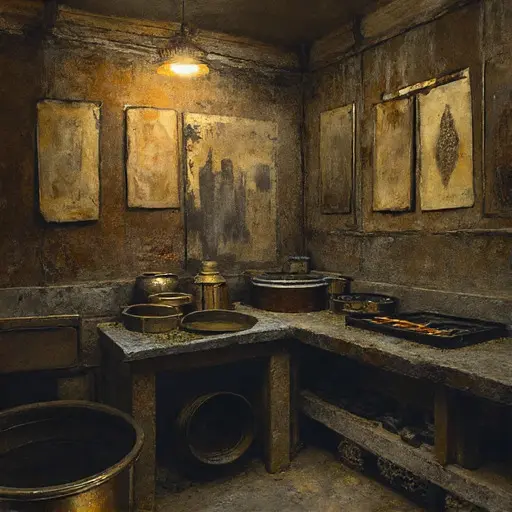
One late night left unmistakable disruptions. A silver plaque—commissioned for a prominent family—lies half-engraved, its monogram twisted off-axis. A slip of pattern paper beneath it bears furious scoring marks, as though he tried to carve clarity into the page itself. The press handle sits jammed, tensioned too tight, perhaps forced in frustration.
Rumor said a patron accused Erik of deliberately altering a family crest, claiming the curve of a line implied insult. Others whispered he was blamed for damaging a ceremonial piece by over-etching it. Near the drafting table, a folded note in Swedish reads: “Misread? Or mistrusted?” The ink trembles as if written during a sharp breath.
A burin with a snapped tip rests near the hearth, beside shavings scattered wider than his normal sweep. Even his engraving block—once impeccably leveled—tilts on a loose wedge, as though he abandoned it mid-adjustment.
A Narrow Cavity Behind the Birch Cabinet
Behind the tall birch cabinet, a panel shifts with surprising ease. Within the recess lies a linen-wrapped bundle. Inside rests a small brass plate bearing the beginning of an intricate knotwork border—precise, balanced—until the final section, where the motif suddenly buckles and stops. A slip of paper is tucked beneath: “For Ingrid—when certainty returns.” The last word fades into a broken tail of graphite.
Beside the plate lies a graver sharpened perfectly, untouched since. Its point gleams with resolve he did not wield again.
The Last Faint Mark
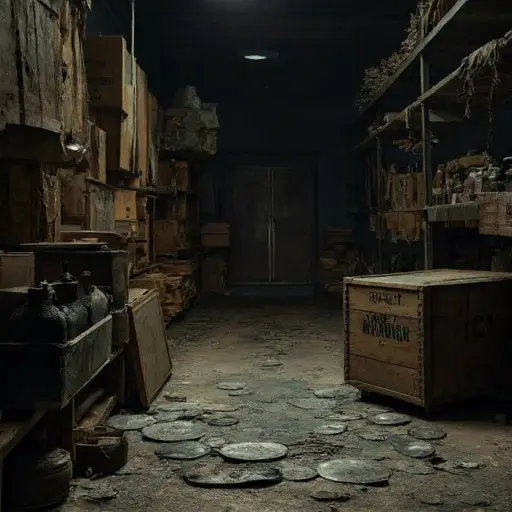
Inside a folio slipped between two crates lies a single test sheet: one long engraved line beginning with flawless precision, then wavering near the midpoint before stopping altogether. Beneath it, Erik wrote: “Grip failed—or faith did.” No clarification.
The studio sinks back into its cold, metallic quiet.
And the house, holding its abandoned engraving room, remains abandoned.