The Shrouded Caldeira Luthier’s Parlor Where the Strings Fell Quiet
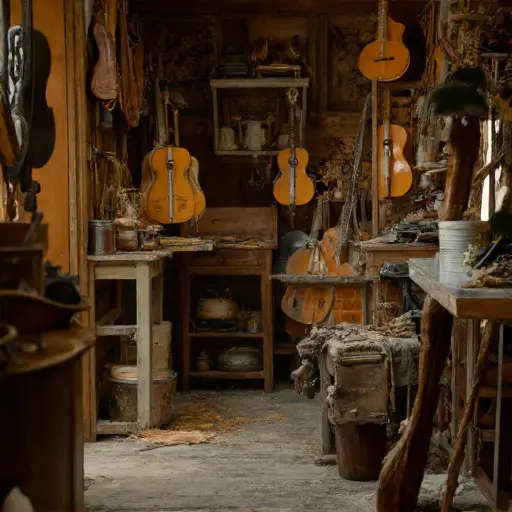
The parlor breathes faint wood resin and varnish, steeped into every board. A dropped peg reposes near the threshold; a fret file rests crookedly, its handle stained with old oil. From a ceiling hook hangs a curved Portuguese guitarra body, its ribs uneven, as if bent during haste or hesitation.
Nothing is broken—yet every object trembles at the edge of change, recording the moment a craftsman’s sure touch faltered.
A Maker’s Years Tuned to Wood and Stillness
This luthier’s parlor contains the quiet labor of João Manuel Caldeira, maker of Portuguese guitars and stringed folk instruments, born 1875 in Setúbal. Known for his patience, he arranged tools by task: rasps wrapped in linen, fretwire sorted in cork-lined trays, tiny chisels stored in a citrus-wood box. A small embroidered handkerchief belonging to his younger sister, Isabela Caldeira, lies tucked beside a pouch of ebony shims.
João’s routine moved with the light: thicknessing plates at dawn, fitting braces by afternoon, adjusting bridge angles late into lamplit nights. His instruments—warm, bright, favored by local singers—were prized for their subtle balance. Even now, a stack of templates on the side table displays the elegant curves he once shaped with confident breaths.
Craft in Bloom, Interrupted by Uneven Notes
During his best years, João’s parlor filled with instruments for touring musicians. A crate stamped from Porto merchants contains imported spruce, its grain tight and even. Sheets of Portuguese lyrical verses lie tucked under the bench, commissioned for engraved soundhole cartouches. A varnish pot of amber resin sits near a folded cloth scented faintly of citrus oil.
But clues of tension gather. One guitar top shows a brace glued off-center, raw hide glue dried in uneven beads. A rosette design lies half inlaid, its mother-of-pearl chips misaligned. A fretwire coil unspools across the bench, loops tangled. A ledger of commissions reveals a prestigious order scratched out, rewritten, then abandoned entirely. Something disrupted his careful progress—perhaps a dispute over an overdue instrument, or an accusation of miscopied ornamentation.
The TURNING POINT That Warped the Tune
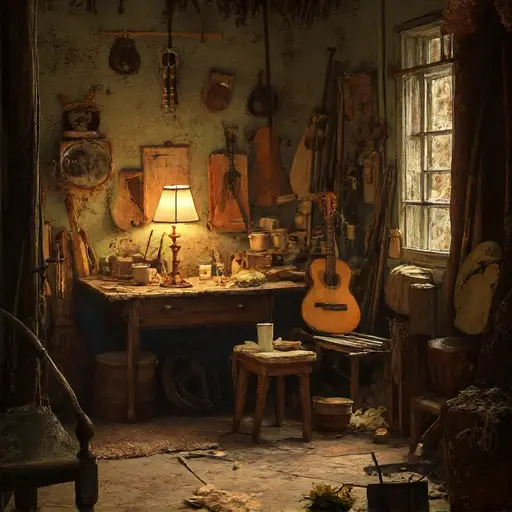
One evening’s work left its marks sharper than any blade. A nearly completed guitarra rests on the main bench, its fretboard skewed by a millimeter—until then, an unthinkable misalignment. The bridge is only half seated, glue dried into an amber ridge. A pearl rosette ring nearby bears a fresh fracture. João’s normally steady script falters in a note pinned to the bench: “The patron insists it is flawed—yet I measured thrice.”
Rumors fluttered through the district: a noble client accused him of delivering an instrument with unstable intonation; another claimed the tone was “muddy,” blaming João’s bracing rather than humidity or handling. Some whispered of a financial threat—compensation he could not afford. A folded receipt shows his attempt to return payment, crossed out twice.
Near the hearth, a fret slotting saw lies overturned beside a splinter of rosewood, snapped sharply as if bent in frustration. Even the varnish jar’s lid remains off, its contents thickened to ruin. On the floor, an imprint of a heel marks the spot where he may have stood long, undecided.
A Secret Resting Behind the Peg Rack
Behind a row of tuning-pegs strung on twine, a loose panel shifts with a muted creak. Within the cavity lies a linen-wrapped parcel. It contains a single unfinished guitar top—its braces perfectly curved, its surface sanded to a luminous, feather-thin lightness. Yet the soundhole rosette is missing entirely, replaced only by a penciled circle.
Beneath the top rests a folded scrap: “For Isabela—when I find the right voice.” The handwriting slopes downward near the end. No mention of the patron dispute. No clarification of the hesitation that froze his hands. Alongside the note lies a set of pearl inlays, one chipped at the edge, as if dropped in tremor.
The Last Quiet Vibration
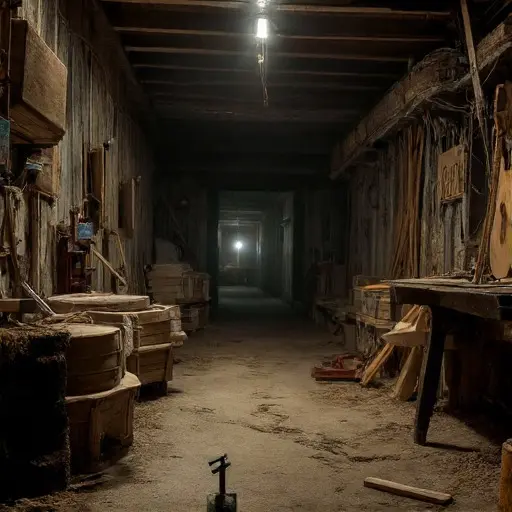
Inside a narrow drawer near the tilted chest, one final clue lies: a small practice strip carved with experimental bracing patterns. The lines begin precise, then drift, the last scallop carved too deep. Under the strip, João wrote in faint Portuguese: “The instrument resists me now.” The pencil breaks where the words end.
The parlor holds its silence, each curve and chip suspended in unfinished song.
And the house, wrapped around its abandoned luthier’s room, remains abandoned.