The Silent Petrov Foundry Corner Where the Casts Lost Shape
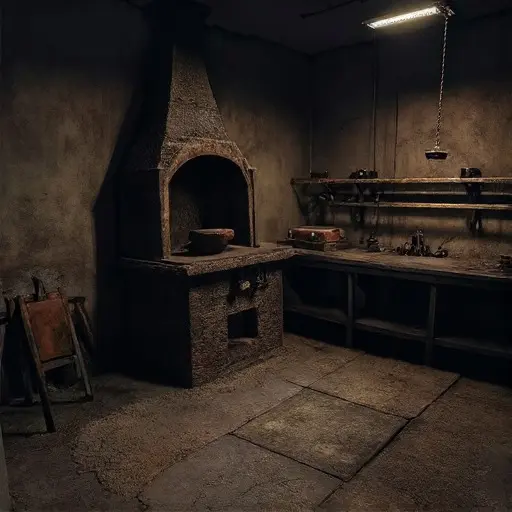
The corner holds a weighty hush, thick with old smoke that seems settled into the bricks. Drafts from the furnace flue sigh through the iron hood. A fractured ladle rests on the floor as if dropped mid-pour.
The low table bears uneven scorch marks in a pattern of halted routines. Whatever happened here, it came with heat, pressure, and sudden hesitation—an interruption that left the metal unmolded.
A Craftsman Whose Work Burned in Patience
This foundry corner preserves the labor of Sergei Aleksandrovich Petrov, metal caster and artisan molder, born 1873 near Novgorod. His training under blacksmiths shaped a temperament of steadfast precision. Tools remain laid out by size: chisels for trimming seams, iron tongs wrapped with worn cloth, and a small jar of graphite dust meant to ease release from molds.
A tarnished locket belonging to his sister, Tatyana Petrov, lies tucked behind a casting frame. Sergei began each morning by heating the crucible, testing the charcoal’s dryness, then sketching mold patterns on slate tablets. His metalwork—door handles, small statues, components for machinery—was sought by merchants who prized functional art. At his strongest, he cast with a calm that belied the violence of molten iron.
Strong Years Fractured by Subtle Pressure
In prosperous times, the corner bustled. Boxes of iron filings stood sorted by fineness. Brass ingots arrived wrapped in rough linen stamped with Cyrillic shipping marks. Clay molds, carved with elaborate motifs, lined the shelves. Sergei’s ledger shows commissions from distant workshops, including intricate gear housings requiring exact geometry.
But fine cracks spread. A mold half-carved for a merchant’s order shows a jagged line as if his hand slipped. One casting frame is warped, its pins bent. A slag skimmer lies in the wrong drawer. His slate pattern board bears smudged arcs, the geometry uncertain. Word drifted that a client accused him of flawed castings—parts not fitting their machines, blamed on Sergei rather than their own mismeasurements.
The TURNING POINT That Shifted the Metal’s Will
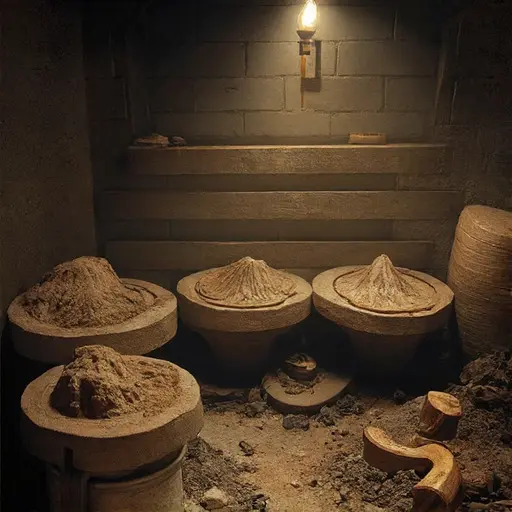
One night left a deeper cleft in Sergei’s practiced control. A brass figure—once halfway cast—remains fused to the mold as if cooled too soon; beside it, the sprue channel is chipped. The furnace grate is jammed by a single wedge of iron, suggesting he forced it shut in panic. A casting spoon sits bent at the neck, its bowl warped as though overheated beyond tolerance.
Rumors circulated: a threatened lawsuit over machinery parts said to have failed in service, or an accusation he reused contaminated sand to cut costs. Sergei’s neat Cyrillic annotations suddenly turn frantic in the ledger: “Not my misalignment—did as asked.” The phrase repeats, trailing into illegible scratches.
Charcoal lies in a scattered crescent on the floor, kicked back from the furnace. A weight scale stands tipped, its pan dented. Even his protective gloves lie discarded, stiff with soot and something else—perhaps indecision, perhaps haste.
A Hollow Behind the Furnace Shield
A loose panel in the furnace’s shielding reveals a cavity blackened by heat. Inside rests a single mold core: a small, delicate piece meant for a mechanical assembly. Its channels are carved with expert precision—until the final curve, where the passage abruptly narrows into an impossible angle. Wrapped around the core is a scrap of paper reading: “Tatyana—this fault is not mine.” The words are faint, broken by soot.
Beside it sits a brass nugget partly melted, then quenched too quickly, edges fractured. Whether as evidence, mistake, or plea, the fragment offers no clarity.
The Last Quiet Residue
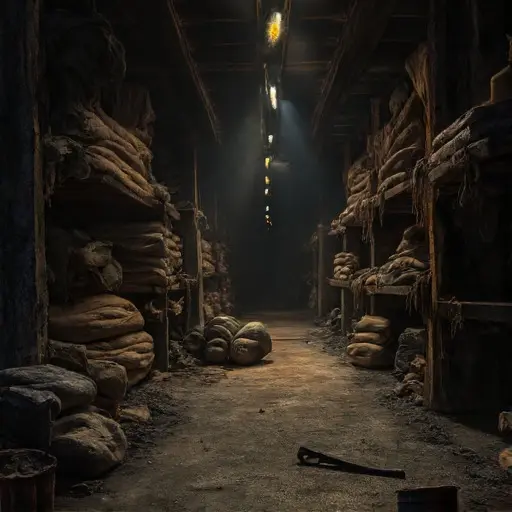
Within a sand-filled crate near the corridor’s end lies one final clue: a slate tablet etched with a design for a simple household handle. But the lines fail to intersect correctly—an error Sergei had not made since childhood. Beneath it, in faint Cyrillic, he wrote: “Could not correct once accused.” Nothing further.
The foundry corner exhales its cold, metallic hush.
And the house, guarding its abandoned casting space, remains abandoned.