The Haunting Volkov Lens-Grinding Room Where the Stars Went Dim
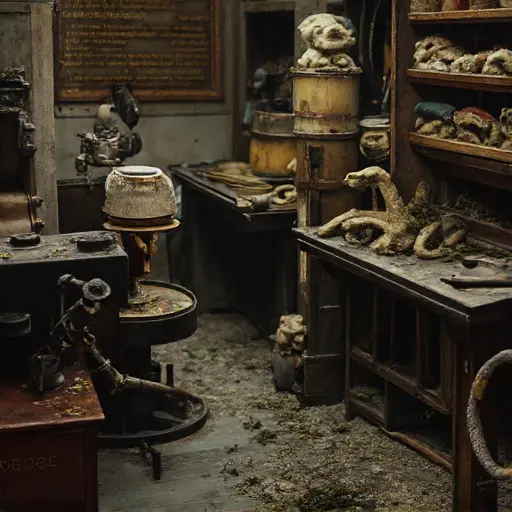
The air carries a mineral chill, a faint bite of ground crystal, and the distant odor of lamp oil. The treadle wheel shows a shallow rut where feet once pressed steadily; now its belt droops, tired and unstirred. On a low bench, a polishing tool rests in a smear of rouge, its felt head hardened, stiff as regret.
Nothing here is broken, yet nothing continues: the faintest sense of a routine severed hangs over the trays of blanks—each one a possibility abandoned.
A Craftsman’s World of Edges and Light
This lens-grinding room preserves the careful life of Arkady Mikhailovich Volkov, optical finisher and maker of telescope elements, born in 1871 on the outskirts of Moscow. Though raised in modest means, he apprenticed under a traveling optician and mastered the slow, disciplined shaping of glass. His temperament is recorded in the precise order of his trays, in Cyrillic notes inked onto strips of scrap paper, and in cloths folded to protect delicate curves.
A postcard from his younger sister, Yelena Volkov, is tucked beneath a crate of tin oxide, the faint watercolor of birch trees on its front now blurred. Arkady once began each day by heating water in the samovar, reviewing celestial charts imported from St. Petersburg, then setting the wheel into rhythmic hum. His lenses were sought by amateur astronomers across the district—small refractors, opera glasses, and delicate ocular elements that carried promise of distant clarity.
Years of Skill, Then Hairline Disturbances
At the room’s peak, shelves filled with glass blanks graded by thickness, each shielded in paper stamped with Russian suppliers’ marks. A tin of ultrafine rouge—once bright scarlet—now lies dulled in its tin, its lid dented by haste. A wooden gauge for measuring curvature angles sits atop charts annotated with orbital sketches in Arkady’s tidy hand.
But quiet disruptions accumulate. One curvature gauge is misaligned; another bears a hairline crack. A strip of Cyrillic notations has been torn where a formula once appeared. A thick lens blank shows deep scoring marks that suggest uneven pressure—unthinkable for Arkady in his steady years. A polishing block, usually cleaned methodically, holds clotted residue where strokes were once even and sure. Something had begun to erode his calm: perhaps too many commissions, or too little pay, or the scrutiny of a patron demanding precision beyond feasibility.
The TURNING POINT That Distorted the View
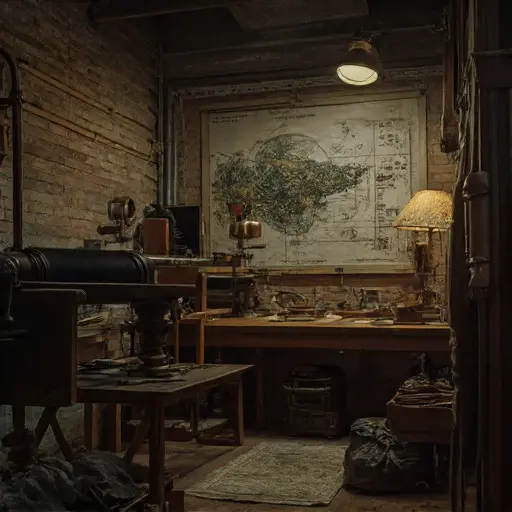
One winter night left a mark more telling than breakage. The treadle wheel’s shaft is bent a fraction off true, just enough to warp rotations. A convex lens, nearly finished, lies chipped at its edge—too clean a chip to be accidental, too sharp to ignore. A test logbook is open to a page where Arkady wrote a single line before the pencil dragged off the margin: “Pattern accused—unfair.”
Rumor suggests a patron claimed he falsified a curvature report for a custom telescope mirror, alleging he concealed an aberration. Others whispered of an unpaid shipment of blanks that left him financially cornered. A more troubling hint lies in a half-filled envelope addressed to Yelena: “They doubt my hand… perhaps I should leave it unfinished.” The remaining words have smeared into ghostly arcs of graphite.
A tray of small ocular lenses lies overturned, scattering pieces across the floor in a trembling semicircle. One of the felt-lined forms used to nest delicate elements shows a torn corner, as if yanked open in sudden agitation. Even the samovar’s lid sits askew, cooling tea ringed with dust.
The Hidden Hollow Behind the Crates
Behind a stack of pumice sacks, a narrow plank shifts under fingertips. Within the cramped recess sits a bundle wrapped in coarse linen. Inside rests a single plano-convex lens, its surface half-polished, the remaining portion clouded in a swirl of halted strokes. Beneath it lies a folded slip containing only a few cramped Cyrillic words: “Not fit—nor false.” No date. No recipient.
Beside the lens sits a small brass ring meant for a telescope’s focusing assembly. Its threads have been filed unevenly, not by accident but by intention—rendering the piece unusable. Perhaps a symbolic refusal, perhaps a private admission of doubt, perhaps neither.
The Last Faint Impression
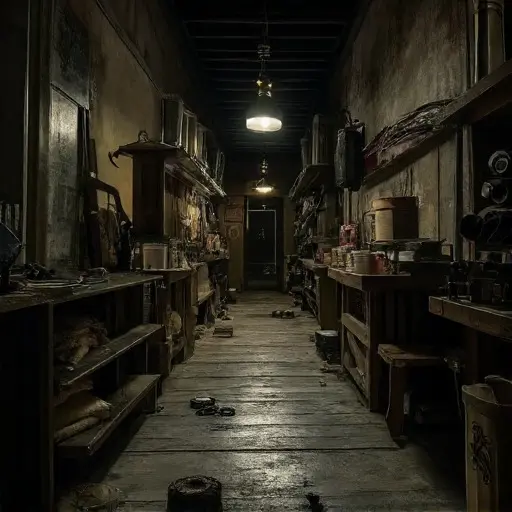
Inside an old star chart tucked beneath the stool lies Arkady’s final trace: a graphite sketch of Saturn’s rings, the edges wavering where his once-steadiest hand faltered. Under the sketch he wrote: “Clarity postponed.” The pencil breaks at the last letter.
The room absorbs the quiet, the mineral dust settling without protest.
And the house, guarding its abandoned lens-grinding room, remains abandoned.