The Eerie Van der Meer Loom Loft Where the Threads Fell Silent
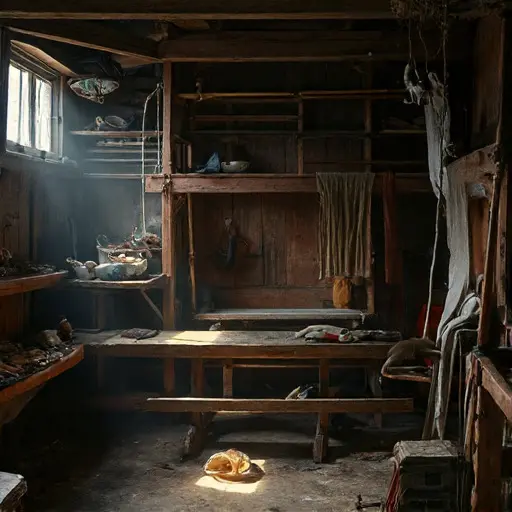
The loft feels close and breath-held, its beams absorbing the hush that settles when a rhythm long practiced abruptly stops. Dust glints in narrow strips across the heddles. A shuttle, fallen near the treadles, lies angled as if dropped mid-motion.
Indigo pigment powders the corner of a Delft-tiled box, its pattern chipped by hurried handling. The whole room seems caught between motion and retreat, awaiting the next pull that never came.
A Maker’s Life Etched in Fiber and Patience
This loom loft carries the careful habits of Catharina Hendrika van der Meer, textile weaver and pattern designer, born 1877 near Leiden. Raised in a cloth-merchant’s household, she learned early the cadence of thread and shuttle. Her gentleness and precision show in the arrangement of tools: beechwood heddles sorted by gauge, bobbins wound to exact tension, and a tin of Dutch beeswax for smoothing fibers.
Her younger brother, Pieter van der Meer, appears in a single spool wrapped with red thread he once gave her before leaving for a merchant’s post abroad. Catharina wove through each dawn and dusk—treadles tapping against floorboards polished by habit, warp threads humming with subtle vibrations. She recorded motifs in a linen-bound folio now resting on a small stool, its corners softened by years of handling.
Prosperity Twined with Subtle Disquiet
At her height, Catharina produced cloth prized in the district: patterned damasks, dyed tapestries, and precise household linens. A Dutch indigo vat—its rim stained sapphire—sits beneath the side window’s shutter. Racks of flax fiber from Zeeland stand sorted by fineness. A bolt of cloth embroidered with windmill motifs lies folded across a chest, half-finished edging pinned in place.
But trouble whispered through small disruptions. A bobbin snapped from over-tensioning, left discarded on the bench. A set of heddle bars sits misaligned, their combs uneven. A sample textile pinned to the wall is punctured where a single pin tore through the motif. Her folio pages bear drafts crossed out in blunt strokes, markedly unlike her usual deliberate edits. These fissures hint at strain—contracts unmet, or perhaps a dispute with a merchant over pattern rights.

The TURNING POINT That Unraveled Control
One autumn evening shifted something irrevocable. The loom’s main beam is dented where a shuttle must have struck it hard. A batch of dyed wool lies clumped on the floor, tangled as though yanked free in frustration. The treadle cords have been retied—but poorly, their knots rushed. A ledger of orders, usually neat, is cramped with contested revisions and abrupt cancellations.
Those who whispered about Catharina’s troubles said a traveling merchant claimed she copied a proprietary pattern, threatening legal complaint. Others insisted she was owed payment withheld unfairly, leaving her unable to buy new flax. A folded slip tucked under the loom reads, in cramped script: “Warp miscount? Not my fault.” The edges of the slip are stained where indigo splashed across it.
A wooden shuttle, normally polished smooth, shows a sharp gouge across its face—too deep for routine wear. A dye vat has tipped slightly, its edge damp with overflow. Her meticulously stored flax fibers slip from their pegs, drifting in flattened tangles across the loft floor.
A Quiet Hollow Behind the Yarn Racks
Behind the highest bundle of skeins, a loose floorboard lifts under gentle pressure. Beneath lies a narrow recess, barely wider than a scarf. Inside rests a single woven strip—an intricate trial pattern of Delft-blue diamonds and cream weft. The strip ends abruptly, threads snarled. Wrapped around it is a letter she never sent, addressed to Pieter. Only one line is visible: “I cannot defend what I did not do.”
Beside the strip is a broken heddle with its eye bent inward, as if crushed between anxious fingers. A few grains of mordant salt have spilled across the wood, glittering faintly in the dim.
The Final Quiet Thread
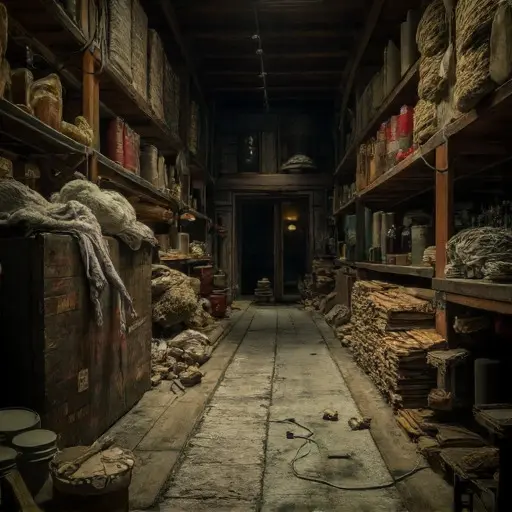
Inside a torn pattern book slipped under the trunk lid lies Catharina’s last trace: a tiny weft sample stitched in place, threads knotted suddenly mid-row. Under it, written in an uneven hand: “Could not finish—not with judgment waiting.” No dates, no explanation, only the sense of work stopped by fear.
The loom loft settles, its threads drooping into stillness.
And the house, wrapped around its abandoned weaving room, remains abandoned.