Forgotten Havelock Herb Cellar and the Vials Left Unlabeled
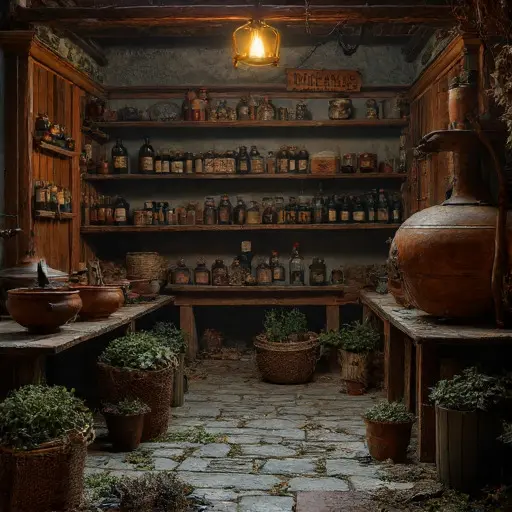
The air in the cellar feels thick and herbal, as if every scent ever mixed here has sunk into the stones. A faint medicinal sweetness drifts from the trestle table, settling into corners where dust clings to bundles hung long ago. Beneath a shelf of tinctures rests a folded cloth stained by something amber and brittle.
The cellar seems paused mid-thought, waiting for a hand to finish what it had begun, a formula half-shaped, a hesitation never explained.
A Life Distilled Through Botanicals
In this herb cellar, the routines of Edmund Charles Havelock, apothecary and botanical preparer born 1872 in Sussex, linger through carefully placed instruments. Raised among modest merchants, he trained in a provincial chemist’s shop before traveling to study plant compounds from India and Ceylon. His temperament—devoutly orderly—appears in the chalk labels aligned by height, the folded drying cloths, and the exacting layout of sieves and funnels.
A small carved elephant from his sister, Beatrice Havelock, perches atop a crate of cassia bark, its tusk chipped from an old accident. Edmund’s handwriting, elegant yet firm, graces recipe slips tucked into jars. At his professional peak, he prepared restorative syrups and herbal balms for households across the district, working by lamplight late into winter evenings.
Refinement, Then Quiet Fractures
The cellar thrived during Edmund’s busiest years. Shelves filled with tincture bottles sealed in beeswax, some shipped from Bombay, others crafted on-site. A chest of dried petals from English meadows sits beside imported quinine bark. A rare brass scale—calibrated to delicate increments—rests on a marble slab, proof of his growing reputation.
But subtle fractures grew. One corked vial lists sideways, its residue pooled and crusting along the rim. Bundles of drying mint are unevenly trimmed, bruised where he once cut with calm precision. A blending bowl bears scrape marks inconsistent with his steady hand, as if stirred too roughly. A slip of parchment pinned to the shelf reads “Adjust proportion?” but the ratio beneath has been rubbed blank. These quiet departures hint at mounting strain: too many commissions, too few hours, and whispers of a failed preparation that caused a household dispute.
The TURNING POINT That Altered His Craft
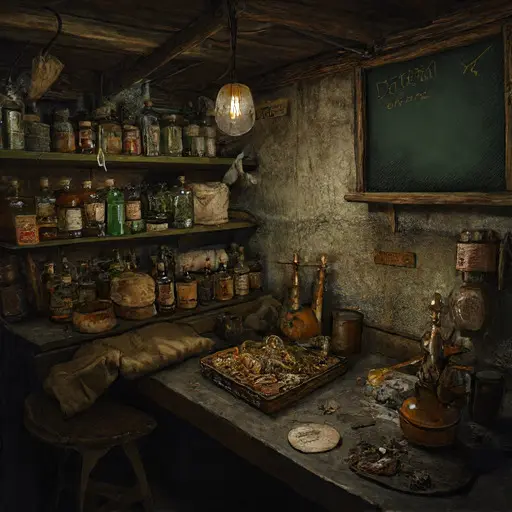
One evening’s work changed his composure irrevocably. A heavy stone mortar lies overturned, its rim chipped. The copper still’s catch basin is warped, as though overheated. Vials on the lowest shelf shiver out of alignment, one shattered entirely, leaving a dark stain feathered by soot. Edmund, normally cautious, seems to have rushed through a preparation—a tonic requested by a prominent household, rumors say—leading to accusations of improper dosage or faulty extraction.
His ledger reflects the shock: entire pages ripped out, replaced by hurried arithmetic. A letter addressed to Beatrice remains unsealed, its first line trembling: “It was never my intent—” before the ink trails off. A second slip rests inside a drawer, reading only: “Rebalance or abandon,” the edges scorched as if held too close to the lamp.
A bundle of lemon balm lies scattered on the floor, stems snapped rather than cut. Tongs sit in the wrong drawer. And the scale, prized above all, is tipped askew, as if someone pressed down on it too hard—testing weight, or perhaps trying to erase a memory of improper proportion.
A Small Pocket of Secrecy
Behind a stack of crates filled with dried gentian, a narrow panel in the stone juts outward. Pressed lightly, it reveals a hidden recess no wider than a jar. Inside rests a single vial wrapped in muslin. Its contents have long dried into a brittle amber crust. The label has been scratched away entirely. Beneath the vial sits a folded note: “Not for use. Not for them.”
The words are sparse, edged by hesitation. Nothing here clarifies which “them” he meant—patients, patrons, or those who doubted his craft. Deeper inside the recess, a small sprig of lavender tied with Beatrice’s thread lies neatly placed, a gesture both gentle and inconclusive.
The Last Faint Evidence
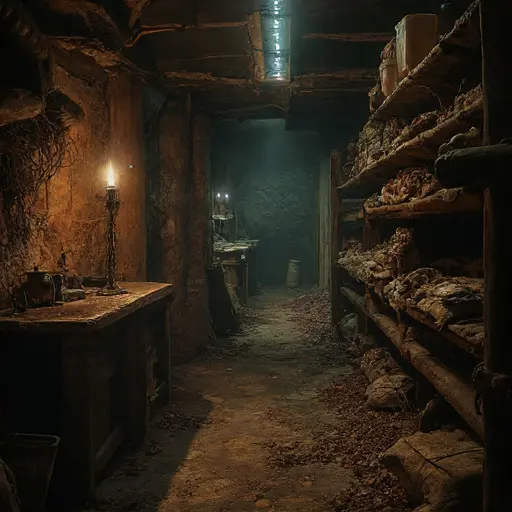
Inside the warped ledger, tucked between curled pages, lies one final remnant: a drafted formula written in Edmund’s steady hand, then crossed out by a single diagonal line. Only the words “Beatrice’s request” remain unobscured. No ingredients, no measures, only the hint of something he intended to prepare for her but never dared finish.
The cellar settles into its deepening hush, holding close its unsolved proportions and altered routines.
And the house, wrapped around its abandoned herb cellar, remains abandoned.