The Lost Bauer Shoemaker’s Room Where the Soles Went Quiet
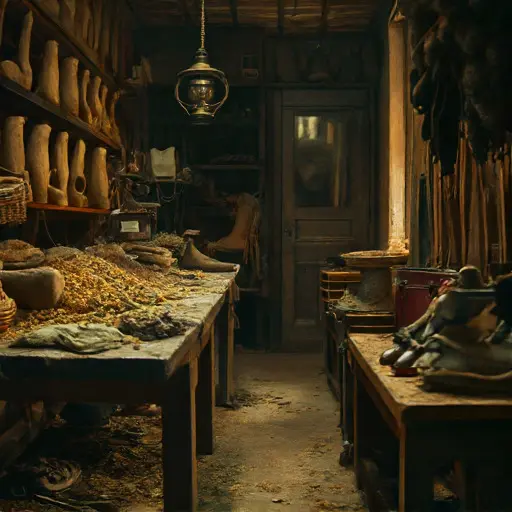
The room holds a dense hush, thick with the smells of tallow, oak bark, and resin. A fallen scrap of welt stitching lies coiled like a small question at the edge of the bench. The floorboards bear shallow gouges from years of heeled boots dragged across them for fitting.
A single unfinished boot stands upright, its leather stiffening in the cold air. Something here slowed abruptly, as if the craft itself hesitated.
A Life Worn Into Leather and Silence
Everything in this shoemaker’s room speaks to Heinrich Otto Bauer, cobbler and bespoke bootmaker, born 1873 near Stuttgart. Raised among modest tradespeople, he trained early in a guild where precision meant reputation. On the worktable lie German-patterned measuring tapes and a tin of beeswax stamped with a Black Forest emblem. His sister, Liese Bauer, appears only in a frayed ribbon knotted around a child-sized last she once used as a toy.
Heinrich’s temperament was quiet and exacting. He traced foot patterns at dawn, shaped soles by midday, and stitched welts late into the evening. Every shelf carries the imprint of his routines: wooden pegs sorted by size, tacks stored in a porcelain saucer, heel blocks labeled in clean Gothic script. In his strongest years, the room echoed with the gentle tap of his hammer, a steady rhythm that shaped boots for travelers, merchants, and soldiers alike.
Craft in Its Prime, Shadows Creeping In
As orders multiplied, Heinrich expanded his workspace. A tall rack holds boots lined with felt from the Rhineland. Imported Italian polish tins—rare luxuries—sit beside German-made lasts engraved with clients’ initials. He had begun experimenting with decorative stitching, evident in delicate motifs etched into a half-completed ladies’ shoe resting beneath the window’s shuttered frame.
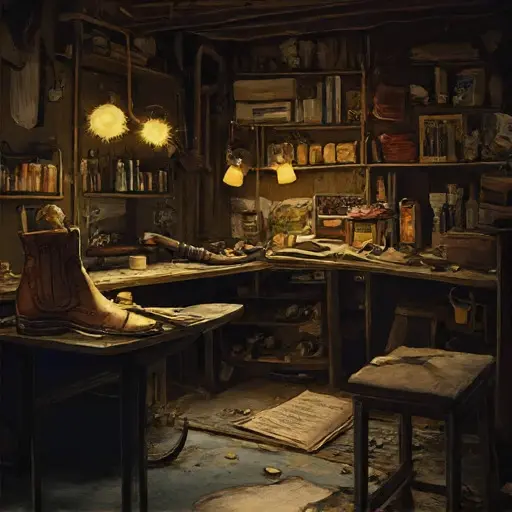
Yet disturbance lingers in small discrepancies. A sewing awl rests at an odd angle, its haft stained with something darker than polish. A stack of soles is misaligned, thick edges cut at a haste-driven slant. Leather offcuts lie unsorted, curling at their ends. His ledger has smudged columns, numbers crossed out, then restored, then abandoned. A heavy boot clamp on the bench stands open, but the boot it once held is missing.
The TURNING POINT That Frayed the Edges
One winter evening left its mark in ruptures rather than breaks. A nail-studded boot, meant for a military client, lies overturned near the threshold, its heel block splintered. The bench vise is twisted slightly out of true, as though struck or forced. A pattern sheet for a client’s commission bears a smear across the tracing, obscuring the measurements—an error Heinrich would never have tolerated.
Rumors later murmured through the district: a dispute over defective material, a client accusing him of substituting cheaper leather, or perhaps debts arising from a delayed shipment of hides. Some hinted at a confrontation that turned sharp but left no visible violence. In a drawer under the bench, a letter addressed to Liese trembles in uneven script: “Not my fault—miscount, not deceit.” The ink runs where a drop of something—water, polish, or sweat—spilled unsteadily.
A crate of heel pegs lies toppled, scattering across the floor in a chaotic constellation. One boot form has been sanded too thin, almost translucent at its arch, as if he lost control of pressure mid-stroke. A small bottle of liniment sits uncapped, suggesting either injury or frantic distraction.
A Hidden Niche in the Grain of the Room
Behind a row of stacked lasts, a slat in the oak wall shifts loose with minimal coaxing. The cavity beyond contains a single unfinished boot upper, carefully wrapped in coarse cloth. Its stitching is nearly flawless, but the throat of the boot is torn, not cut—strained by force. Tucked inside is a slip of paper: “Returned. No settlement.” The signature is absent, the handwriting tight and slanted downward.
Beside it lies a child-sized heel plate—the one from Liese’s keepsake last—polished until its metal gleams like a small accusation or apology. Why he paired these items remains unspoken.
Final Quiet Imprint Left Behind
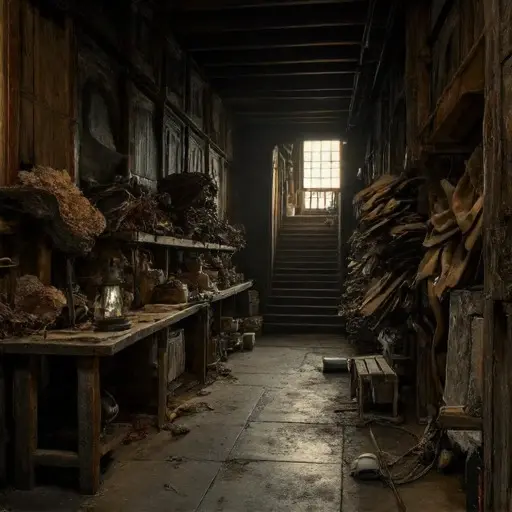
Inside a worn leather pouch beneath the storage crates lies the last remnant: a tracing of a client’s foot pattern, redrawn several times, each attempt more shaky. The final version ends abruptly at the instep—unfinished. Beside it, Heinrich wrote in faint pencil: “Cannot remake—apology withheld.”
No dates. No explanation. Just a quiet collapse of confidence pressed into thin paper.
The room, heavy with tools that once obeyed him, returns to stillness.
And the house, wrapped around its abandoned shoemaker’s room, remains abandoned.